Impact in Hungary
Peter Magyar’s centre-right opposition Tisza party, currently leading the ruling Fidesz party in the polls, has sought to capitalise on the issue. Solidarity with ethnic-Hungarians abroad has traditionally mattered to Fidesz voters and Magyar clearly senses an opportunity to make gains ahead of the general election expected in April.
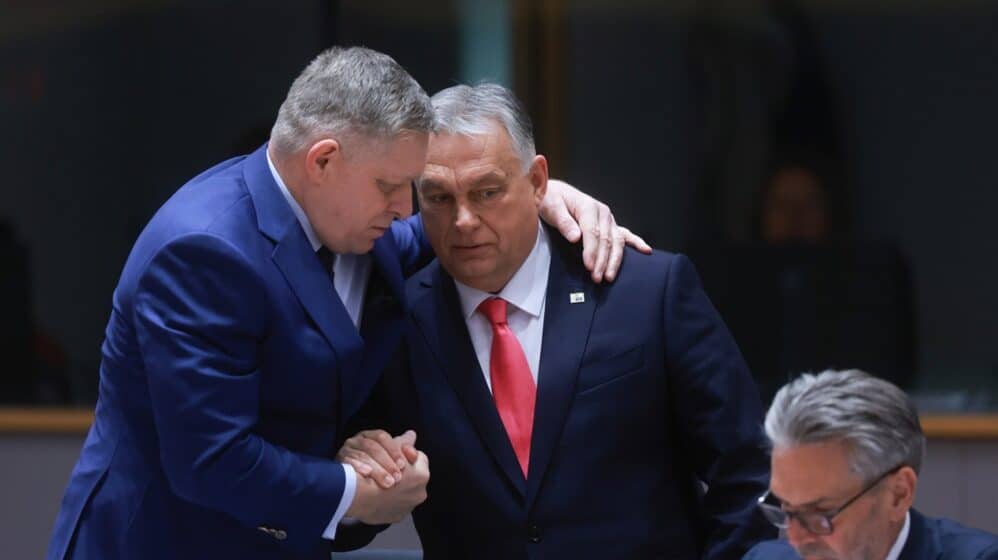
The fact that Orban waited six days before making any response to the Slovak law created significant vulnerabilities for the Hungarian government. Orban has “betrayed the Upland Hungarians: he doesn’t say a word when his buddy Fico threatens them with prison,” Magyar wrote in a Facebook post on December 19 – one of a plethora of social media comments from him on the subject over the last month.
Tisza’s rally in Szeged on December 20 prominently featured Viktoria Strompova, one of his party’s MP candidates and herself an ethnic-Hungarian born in Slovakia, together with other candidates hailing originally from cross-border Hungarian communities.
Some experts, however, question how much benefit Magyar can derive from the topic. Philosopher and theologian Dr Istvan Zalatnay served as vice president of the Government Office for Hungarian Minorities Abroad (1992-94); he remains a keen observer of how minority issues intersect with domestic politics. In his view, while the present situation is “clearly embarrassing for Fidesz”, he also doubts that Magyar can benefit from it substantially.
“Staunch Fidesz supporters are pretty unmovable,” he says. The question is rather the potential “impact on those with a weaker level of attachment.”
So far as Magyar is concerned, “the benefit is likely to be in terms of causing a limited number of wavering Fidesz voters to stay at home”, rather than prompting them to defect.
The extreme-right party Mi Hazank could, however, actually gain from the issue. Hungary has a large pool of voters with explicitly far-right sympathies, well beyond the approximately 5 per cent who currently back the party. Figures vary, but researchers typically estimate this wider group at between a further 10-15 per cent of the population – noting that at its peak in the 2010s, the (then) extreme-right party Jobbik achieved 20 per cent of the vote.
Subsequently, most far-right voters have lent support to Fidesz as the party with the greatest practical chance of delivering their policy preferences. In their hearts, though, according to Zalatnay, “really they would prefer Mi Hazank”, and are prone to complain that “almost none of what Fidesz says is true”.
In a notable contrast to Fidesz, Mi Hazank put out a statement strongly condemning the new Slovak law within 24 hours of its parliamentary passage. More widely, the party has been able not only to make use of Orban’s proximity to Fico, but also a lack of comment from the European Commission, thereby bolstering its own anti-EU agenda.
Mi Hazank’s potential to exploit the Benes Decrees issue at Fidesz’s expense raises a worrying possibility. Most analysts expect April’s election to deliver a close call between Fidesz and Tisza. With Mi Hazank the only other party polling above the 5-per-cent threshold to enter parliament, the possibility arises that, strengthened by defections, the extremist party could act as ‘king maker’ in the event of a hung parliament.