Nawrocki vetoes again and again
At home, he has repeatedly used his veto to frustrate the government. In his first year, Nawrocki vetoed 41 bills, more than any other Polish president since the fall of Communism. Among the most consequential were legislation linked to Poland’s access to nearly 44 billion euros under the EU’s SAFE defence program, bills concerning the justice system and public finances, two laws expanding rights for unmarried couples and, three times, legislation regulating the crypto-assets market.
The conflict, however, extends beyond legislation. Forty four ambassadorial nominations remain unsigned amid a long-running dispute between the palace and Foreign Minister Radoslaw Sikorski. Poland still has no fully accredited ambassador in Washington, one of its most important diplomatic postings; Bogdan Klich continues to run the embassy as chargé d’affaires.
But Nawrocki has also been unusually active in proposing legislation of his own. In a year, he submitted 22 bills; if he continues at this pace, he is on course to breaking another record by the end of his term. His predecessor Andrzej Duda by comparison submitted 32 during the entire first five years of his presidency.
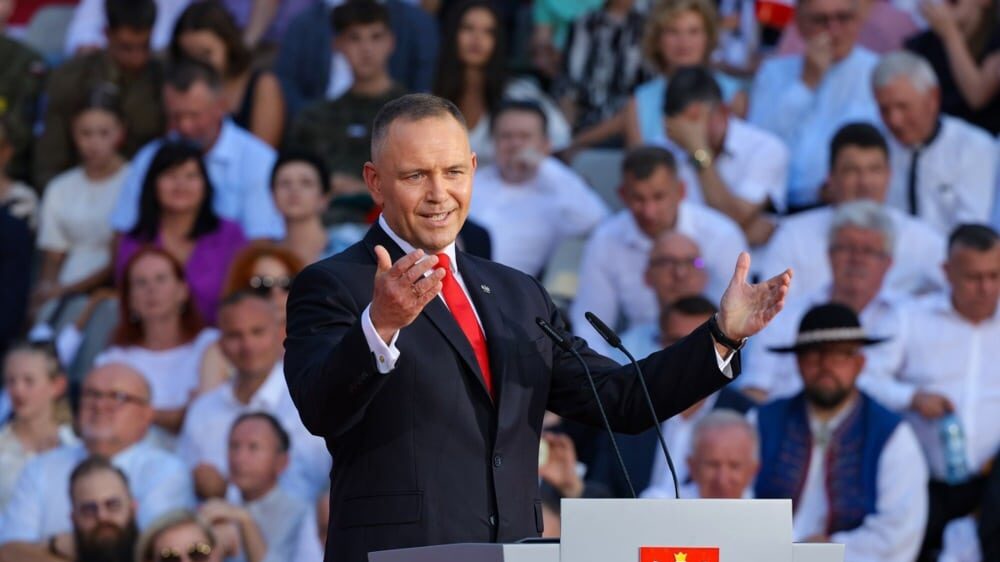
“I want, in fact, to change the model of the presidency,” Nawrocki told the crowd on Thursday. “The president is not only there to review the law and deal with bills that come from parliament. The president is also there to come forward with legislative initiatives and carry your voice and your demands.”
That ambition goes beyond the number of bills. Poland is a parliamentary democracy in which the government runs most day-to-day policy, while the president has important but more limited powers, including the veto and a role in foreign and defence affairs. Nawrocki has repeatedly floated constitutional change and has been pushing the Presidential Palace towards something closer to a parallel centre of power. His ministers regularly speak on the same issues as their government counterparts, while the 17 presidential councils that aid him, involving around 700 people, are working on a broader development strategy that Nawrocki says he will unveil within months.
“I deeply believe that the presidential development strategy… will become, in the next parliamentary elections, a point of reference for all those who aspire to govern Poland,” he said.
Tusk has accused Nawrocki of trying to change Poland’s political system in practice without changing the constitution. Government spokesman Adam Szlapka described the first year of the presidency as a “bad time”, accusing Nawrocki of thinking primarily in political terms and obstructing government policy.
So far, however, the confrontation has not hurt the president much. Nawrocki remains Poland’s most trusted politician: an IBRiS poll published in late July found that 51.3 per cent of respondents trusted him.
Foreign policy has been another central part of his presidency. Nawrocki has worked hard to cultivate ties with Donald Trump and the US, while taking an increasingly confrontational line towards Ukraine over the historical legacy of the Ukrainian Insurgent Army (UPA), which was responsible for massacres of Polish citizens during World War II.
On Thursday, he again tried to hold both positions at once. It was in Poland’s strategic interest, he said, for Ukrainian soldiers to keep Russia as far from Poland as possible. But it was also in Poland’s interest that “Banderite flags” should not fly in Warsaw, referring to the common term used for fighters of the UPA. “You can help and you can demand.”