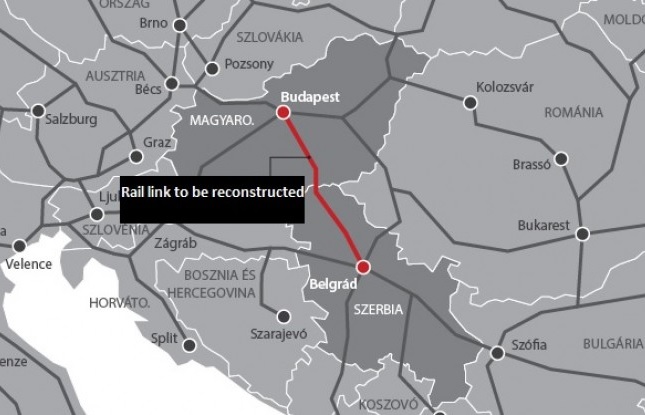
A specific date for the commencement of passenger services on the Budapest–Belgrade railway line has not yet been set. Final testing of the European Train Control System is currently under way, with Chinese experts working to fix software issues as the deadline for these rectifications approaches, according to responses provided to Forbes Serbia by the Hungarian Ministry of Transport and Investment.
Forbes Serbia submitted questions to the Hungarian Ministry regarding the commissioning of the Budapest–Belgrade railway, specifically concerning works on the Hungarian side. The responses arrived a few days ago.
As implied by the response, the launch of passenger services will depend on how quickly the identified issues on the Hungarian side are resolved. As a reminder, passenger traffic on the Serbian section of the line – from Belgrade to Subotica – has been operational since October last year.
Recently, the Hungarian Minister of Transport and Investment, Dávid Vitézy, reaffirmed to the media that safety remains the top priority, and that passenger services can only begin once all preconditions are met.
Traffic can only start once the Chinese contractor completes all necessary software upgrades and safety tests pass with top marks, Vitézy added. He noted at the time that the train control system – crucial for launching passenger transport – is used in China but not in Europe, leading to software bugs that required fixing.
What Budapest has to say
A short while ago, the Hungarian Government announced its decision to initiate proceedings to declassify the investment contract for the Budapest–Belgrade railway modernisation.
Forbes Serbia asked the ministry whether this declassification process would affect the project’s completion and the start of passenger services. In its response, the Ministry of Transport confirmed that the Government has initiated the process to lift confidentiality provisions for the Budapest–Belgrade rail project as part of the bilateral agreement between Hungary and China.
They added that at the end of June, Transport Minister Dávid Vitézy informed Gong Tao, the Chinese Ambassador to Hungary, of this initiative. “Since the project is being executed under a bilateral agreement, publishing the relevant contracts also requires the consent of the Chinese side. This process is not expected to affect the launch of passenger transport,” the ministry stated.
Resolving software issues
Regarding the current status of works on the Hungarian stretch, the ministry stated that final testing of the European Train Control System (ETCS) is under way. This system is a mandatory prerequisite for passenger services. The Hungarian ministry added that “a specific date for the start of passenger transport has not yet been determined.”
Technical experts from MÁV (Hungarian State Railways) had previously identified a number of software issues. A detailed list of these bugs was handed over to Chinese experts, who are currently working on rectifications. “The deadline for completing these fixes is drawing near,” the response noted. If the identified issues are successfully resolved, test runs without passengers could begin as early as August to verify that the system is fully operational for passenger service.
“If all tests are completed successfully, passenger transport could begin as early as this autumn.”
On the other hand, if the identified issues are not fully resolved, or if further problems arise during testing, the current schedule cannot be maintained, and the launch of passenger services will have to be postponed. “For both the Hungarian Government and MÁV, passenger safety is the absolute priority.”
Passenger transport will therefore only begin after all tests are successfully passed, the ministry concluded. “Until the Chinese contractor fully meets all applicable European railway safety requirements, the Hungarian Government will not accept the system, and passenger services cannot begin.”
European Train Control System (ETCS)
According to data on the official European Union website, ETCS is a standard for monitoring train movement based on equipment installed inside the train driver’s cab. This equipment enables continuous oversight of train movement, including automatic stopping, according to the maximum permitted speed on each section of track.
Track parameter information is transmitted from trackside ETCS equipment – eurobalises – or via radio link. This data is used to calculate and continuously monitor the maximum safe speed during transit.
Driver reactions are constantly monitored, and if necessary, ETCS can automatically trigger emergency braking.
China–Hungary–Serbia connection
For the Serbian Government, the Serbian–Hungarian railway project is, as stated in official documents, of “exceptional strategic importance”. The line constitutes a core transport corridor in Serbia, directly linking three of the country’s five largest cities. The railway forms part of the trans-European transport network (TEN-T) within Serbian territory.
It is also a key segment of the southern route of the 21st Century Maritime Silk Road, connecting China’s container shipping hub in Piraeus and Far Eastern ports with South-Eastern, Central, and Eastern European nations via rail.
The total length of the Belgrade–Budapest line is 350.7 kilometres – comprising 183 kilometres through Serbia and 167.7 kilometres through Hungary, according to reports from Serbia’s Ministry of Construction, Transport, and Infrastructure.
In Serbia, the project involved the reconstruction and modernisation of the existing line as well as the construction of a second track for mixed traffic capable of speeds up to 200 km/h on the Belgrade–Novi Sad–Subotica–state border (Kelebija) route.
Three sections
The Serbian section of the project was divided into three stages: Belgrade Centre–Stara Pazova, Stara Pazova–Novi Sad, and Novi Sad–Subotica–state border.
Two of the sections (Belgrade–Stara Pazova and Novi Sad–Subotica–state border) were executed by Chinese firms and financed predominantly (85%) through a loan from the Export-Import Bank of China. The main contractor was a consortium of Chinese companies, CRIC-CCCC (China Railway International Co. and China Communications Construction Company).
Conversely, works on the Stara Pazova–Novi Sad section were financed by a Russian loan, with RZD International acting as the main contractor.
The railway from Belgrade to Novi Sad was opened to traffic in March 2022, while the section from Novi Sad to Subotica was commissioned on 3 October 2025. Regular passenger services on the Belgrade–Subotica high-speed line began on 8 October. Based on figures from the Ministry of Construction, Transport, and Infrastructure reports, the total value for the Serbian sections of the railway stands at approximately $2.37 billion.
(Forbes Serbia, 30.07.2026)
https://forbes.n1info.rs/novac/ministarstvo-saobracaja-madjarske-za-forbes-srbija-nema-konkretnog-datuma-za-otvaranje-pruge-kinezima-istice-rok/