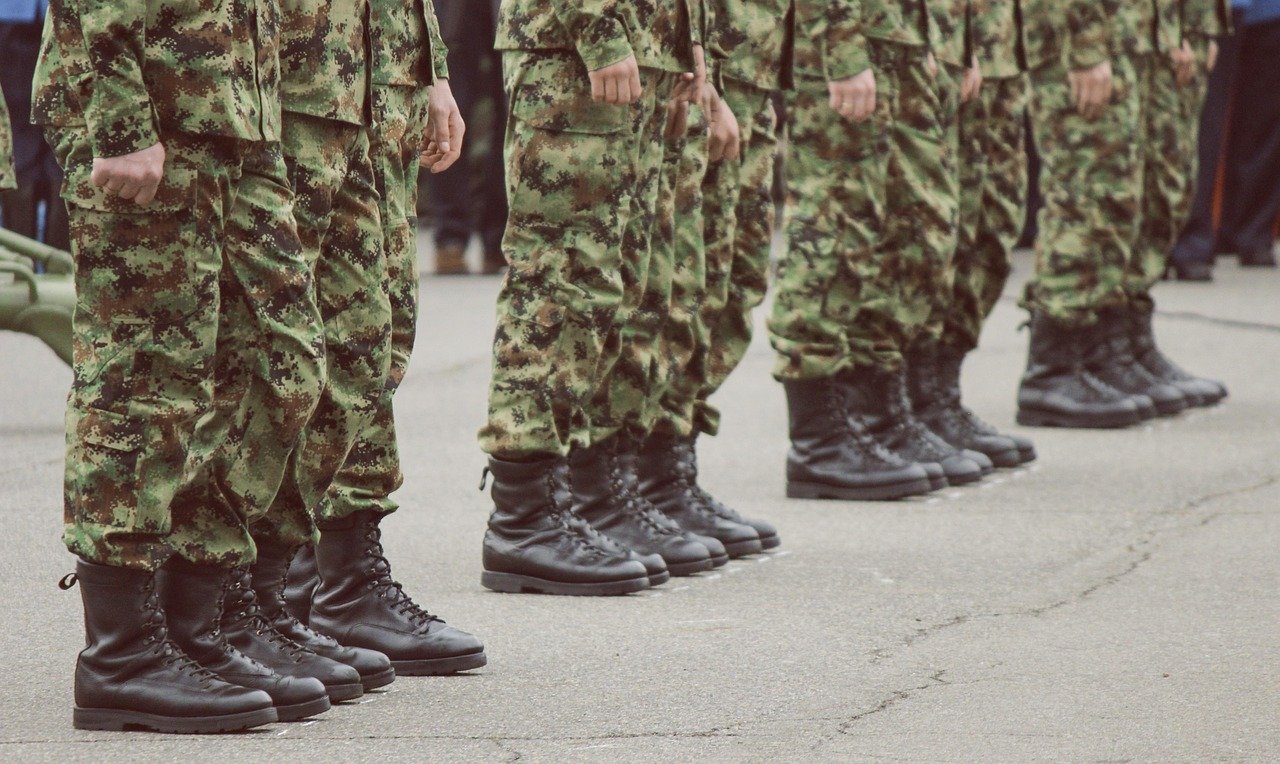
The Military Security Agency (VBA) has become the main pillar of the authoritarian rule of Aleksandar Vučić’s regime, serving both as a tool for spying on its own associates and for eliminating those perceived as potential opponents of the ruling party. This role became crystal clear in the case of the unlawful persecution of military analyst Aleksandar Radić, yet the public remains unaware of the VBA’s role in planning the government’s response to the largest protest in Serbia’s history on 15 March last year.
The judiciary played a significant role in Radić’s persecution through the actions of the Higher Public Prosecutor’s Office (VJT) in Belgrade, led by Nenad Stefanović – known for executing government orders – and the court itself, specifically the duty preliminary proceedings judge of the Higher Court in Belgrade, Sonja Kusturić. Her warrant of 22 June, which Radar has reviewed, even authorised a “forcible search” of Radić’s flat and premises without his presence.
The judicial terror and the raid
The judicial terror against Radić was initiated by the Special Prosecutor’s Office for High-Tech Crime (now also under Stefanović’s control), continued by the Counter-Terrorism Department, and ultimately taken over by the General Crime Department of the Belgrade Higher Public Prosecutor’s Office.
On 22 June, Radić was questioned in his capacity as a citizen upon the order of the Belgrade VJT at the premises of the Criminal Police Directorate (UKP), which is headed by another loyalist, Marko Kričak. He was interrogated after his premises had been searched and his mobile phones, computers, and USB drives seized – which were then handed over to the VBA, clearly the main objective of the operation.
To search the premises and seize the property, the highly controversial role of the court was necessary. This is where preliminary proceedings judge Sonja Kusturić stepped in, issuing a search warrant on 22 June for “the flat and other premises in Belgrade”, listing the exact addresses of Aleksandar Radić.
The Legal Abuse: This legal violence is evident in the fact that the judge issued this controversial warrant even though Radić was not a suspect; the Belgrade Higher Public Prosecutor’s Office had only requested to question him in his capacity as a citizen.
Despite this, she ordered: “the forcible opening of locked premises, furniture, and other items if their holder is not present, or refuses to open them voluntarily, or if the present person refuses to do so. The search is conducted to find the suspect, traces of a criminal offence, and items important to the criminal proceedings, arising from the criminal offence of preparing acts against the constitutional order and security of Serbia under Article 320 of the Criminal Code, etc.”
Such warrants are typically issued when the prosecution suspects an imminent threat of criminal activity, which was not the case here.
The search and its execution
Judge Kusturić authorised the Ministry of Internal Affairs (MUP) – specifically the Police Directorate, the Criminal Police Directorate (UKP), and the Counter-Terrorism Service – to conduct the search, in the presence of the competent prosecutor from the Special Prosecutor’s Office for High-Tech Crime. She set an eight-day deadline for the execution of the warrant, but it was carried out on the very same day.
She also instructed that the “holder of the flat and other premises” be allowed to secure a solicitor to attend the search, and that the start of the search could be delayed for up to three hours for this reason. However, Judge Kusturić also ordered:
- “The search may be initiated without the prior delivery of the warrant, without a prior call to surrender the person or items, and without instruction on the right to defence counsel or a solicitor, if armed resistance or other violence is expected, or if the destruction of traces of a criminal offence or items important to the proceedings is clearly being prepared or has begun, or if the holder of the flat and other premises is unavailable.”
- Additionally, she specified that the search could be carried out during the day, as well as during the night between 10:00 pm and 6:00 am.
“An exercise in intimidation”
“In terms of how the search was conducted, they actually repeated the exact same method applied at the Faculty of Philosophy,” solicitor Božo Prelević told Radar, pointing out that everything was done contrary to the spirit of the law.
“They conduct a search, seize electronic devices, and then have the ability to insert whatever they want, especially because they have equipped themselves with sophisticated technology from Israel and China. This opens up massive opportunities for fabrication.”
Prelević agreed that this is essentially a psychological-propaganda war waged against society, where Radić’s case serves as an example of what can happen to those who speak out on sensitive topics:
“Exactly! It was an exercise in intimidation,” Prelević concluded.
Numerous sources told Radar that the events of 15 March last year were executed like a military operation. Due to developments on the ground, it was not fully completed, and its symbolic closure was attempted through recent crackdowns and harassment campaigns against selected media and individuals.
Faced with a combined assault through weaponised institutions and government-aligned tabloids – which did not spare even his underage daughter – military analyst Aleksandar Radić was forced to temporarily leave Serbia. The brutality and intensity of the attacks on him strongly resemble the persecution of Novica Antić, the president of the Military Union who spent months in detention, also orchestrated by the Military Security Agency.
The hostile takeover of the VOA
In a telephone conversation with Radar, Aleksandar Radić pointed out that the campaign against him was launched back in February 2025, following an interview with our weekly magazine. In that interview, he shared information with the public regarding the VBA’s de facto takeover of the Military Intelligence Agency (VOA):
“I think they viewed my public appearances as a compromise of their position, hence what I would call a personal animosity. That interview of ours from February 2025 is very important. It was prompted by Radar’s information about a secret meeting between former Prime Minister Vučević and the heads of all security services. At the time, I pointed out that the Military Intelligence Agency wanted to continue its work in accordance with the regulations governing it, rather than party assignments. Its director was dismissed, and a man from the VBA was put in his place. That was the turning point, because they realised this threatened their main goal: to remain in their positions forever, and to prevent us from exposing their ambition to expand into other structures.”
- The VOA: An agency vital to Serbia as it deals with foreign intelligence operations directed at the country.
- The VBA: Spends most of its working hours hunting “internal enemies” at home for the benefit of the ruling party.
“They have swallowed the VOA, and I believe there are trends and ambitions to do the same with the Security Intelligence Agency (BIA). Their intention is to create a single military-civilian service, and we can assume that the director of the VBA, Đuro Jovanić, aspires to lead it. Of course, the list of us who publicly expose them is very small. I am exposed; these people know me, and everything I did in the military is known to them. Naturally, such a system crashed down on me because I am alone. I am not a member of any party, and I have no effective protection. I predict they will come up with a scenario claiming I am an agent of a foreign intelligence service, and that I attempted a coup alongside other agents leading the opposition.”
The culture of “might is right”
Radić points out that the reason for fabricating such a scenario is very simple and pragmatic: to protect the interests of the ruling party and prepare for elections. Commenting on the extreme legal violence that characterises the VBA’s actions, Radić notes that the police and BIA try to stick to certain legal limits, except when operating on the streets:
“The VBA and the military police have created a very strange value system in which they are above the law. If they say you are guilty, that is that. The day after the search of the flats, I communicated with a military police major via my daughter’s phone; several people heard that conversation. That man took the stance that he was ordered to do something, and that was the end of it. The call ended mid-sentence, as if someone else cut it off, and they never called back. That is the VBA’s style: we were told you are guilty, and that is that. This is a system where those of us who speak out are treated as enemies, and when dealing with enemies, you do not worry about things like facts and legal frameworks.”
The interviewee pointed out once again that the nature of the conflict the government is waging against society bears the hallmarks of hybrid warfare – a remark for which he was heavily criticised. Radić highlights that the VBA has penetrated all systems, but there is a structure it competes with: the structure of the ruling party itself:
“Yes, this is hybrid warfare, and that is how they behave. Independent media are enemies to them. On the other hand, we tend to view Informer as a media outlet, but it is actually a unit in this hybrid war wearing the mask of a media outlet. Many things indicate they work directly with state structures, as evidenced by the high quality of their recordings, which are extremely sharp despite being taken from a great distance. Those are not their own technical capabilities.”
“Balkan fascism” and the shadow of paramilitaries
Although Radić was highly active during the nineties, an obscure website published an entirely fabricated biography of him. This biography was used to construct a narrative depicting him as someone who aided the process of Montenegrin independence:
“It is suggested that I work for Croatian intelligence, while the same text claims that the Croats had major issues because of my activities on behalf of what is essentially a third structure. These are unbelievable fabrications, but this is typical of the VBA. If needed, they will charge you with doing something on 31 February and see no issue with it. You are the enemy, and they are the instrument of hybrid war. I expect increasingly radical actions. We are entering a phase where they won’t just detain people and search their flats, but will resort to direct violence. Things will escalate because there is no difference between our regime and any other totalitarian, fascist regime. This process is unstoppable, and it is fascism – Balkan, dirty, and dusty, but fascism nonetheless. What they did to me today, effectively expelling me from the country, they will do to groups of people tomorrow. The day after, armed groups will attack protesters. It is well known that under the auspices of the VBA, parts of the military have been flirting with paramilitary organisations for a long time.”
Radić notes that what actually happened in Banjska remains unclear and highly controversial to the Serbian public, particularly the role of the VBA in that event. He recalls that Veljko Belivuk used military training grounds, and that the campaign against Novica Antić began because, as a military policeman, he made that information public.
The arrest of Veljko Belivuk
“We spoke about the fact that the 72nd Special Operations Brigade was stationed in Batajnica on 15 March. Could there be an active effort to train various paramilitary formations in cooperation with state structures? Was 15 March supposed to be the day of a coup in favour of the regime, which we disrupted because we refused to play the victim?” Aleksandar Radić concludes.
Persecution by the same actors
There is now clear information that on 15 March we witnessed a military operation, says Novica Antić, a long-time military security officer and president of the Military Union, in an interview with Radar. According to him, the persecution of Aleksandar Radić today is being carried out by the exact same people:
“I know these people. I know how ignorant of the law they are and how arrogant they are because they are used to doing everything by force. Information was gathered from Radić in his capacity as a citizen regarding the preparation of a criminal offence against the constitutional order. This does not fall under offences against the Armed Forces of Serbia, which automatically excludes the jurisdiction of the military police. Therefore, it was absolutely unlawful for the prosecution to hand this over to the jurisdiction of the military police. They did so precisely because they knew they had nothing against Aleksandar Radić. Given his profession, they believed they would surely find at least some document on him that could be categorised as a military secret, or an offence to the detriment of or against the army. They are obsessed with this and operate on the principle of ‘whatever we find’. That is why it is so important for them to seize someone’s phone or computer, where they can find something that can be interpreted as compromising material to publish in their media. This is a severe abuse.”
Antić fully supports Radić’s decision to leave, as he would certainly have spent months in detention had he stayed in Serbia, whilst his family would have been targeted as well:
“I went through all of that myself. Besides harassing my family members, they also arrested my solicitor, claiming they found he had forged a power of attorney. We are witnessing the militarisation of society and the military security service acting as a party police – a role that has not changed since the nineties. They do not know any other methodology, which Vulin re-established during his mandate. The director of the VBA is a man who does not meet the basic criteria, who was unlawfully promoted extraordinarily five times through corrupt practices. It is obvious that such a man must carry out the government’s orders. On the other hand, there is no effective oversight of their work. The last person who tried and was met with fierce hostility was Saša Janković as the Ombudsman. Now, you have a situation where VBA members boast about having Zoran Pašalić under their control, along with everyone else who is supposed to oversee the work of these security services under the law and the Constitution.”
Antić stresses that the VBA, as part of the Ministry of Defence, should be subject to civil and democratic oversight:
“We have not seen a single official report from that service. We do not know what they do, who finances them, or what procurement is carried out for their needs. I have reliable information that in recent years they have acquired modern equipment and tools for covert surveillance, which they are now widely abusing.”
When asked to comment on the brutality and legal violence in the VBA’s actions, Antić notes that this agency, like the military, operates on the principle of hierarchy and single command, and that discipline is far stricter than in the police force.
“That is why we had the death of Sergeant Dejan Stojković on Pešter, and pilot Major Omer Mehić – they were both carrying out orders and lost their lives. Single command is being abused because, following changes to the law, the President of the Republic has now formally become the Supreme Commander of the Armed Forces.”
The rise of Đuro Jovanić
Until he became the aide-de-camp to the then Minister of Defence and First Deputy Prime Minister Aleksandar Vučić, the director of the VBA, Đuro Jovanić, had a conventional military career. Prior to Vučić’s return to power, Jovanić was a quartermaster officer and managed the military canteen at the barracks in Sombor.
Đuro Jovanović, Head of the VBA
However, once he became Vučić’s aide-de-camp, his rise began at a speed unprecedented in the military during peacetime. He advanced from captain to colonel in just four years, even though by law, in the case of extraordinary promotion, at least seven and a half years should have passed. During this period, Jovanić was promoted extraordinarily three times.
On Military Day, 23 April 2019, Vučić promoted him to brigadier general, making him the youngest general in the Serbian Armed Forces at the time. Jovanić has been the director of the VBA since September 2018, and until May 2019, he was also the president of the Board of Directors of Srpska Banka, which was tasked specifically with supporting businesses involved in the arms and military equipment trade.
Thus, Jovanić was responsible in two different capacities for the highly controversial arms trade. The first to expose these highly lucrative, corrupt deals involving the top echelon of government was Krušik whistleblower Aleksandar Obradović. The VBA was also in charge of the still-unfinished investigation into the corrupt deals exposed by whistleblower Obradović more than seven years ago.
Interestingly, Srpska Banka granted a loan to Krušik. Consequently, the person who chaired the Board of Directors of Srpska Banka – the bank that granted the loan – was, as head of the VBA, supposed to investigate its business dealings. Specifically, on 27 November 2018, Srpska Banka lent Krušik two million euros, and the Valjevo-based factory had to mortgage numerous properties to secure the loan, as shown in the minutes of Krušik’s Supervisory Board meeting.
Jovanić has rarely made public appearances, though they have become more frequent recently. He addressed the public after the riots in Novi Sad, when the Cobras (military police unit) guarded the premises of the SNS (Serbian Progressive Party), and after the incident involving the discovery of explosives in Kanjiža, which the defeated Viktor Orbán used during the elections in Hungary.
The Cobras
Stefan Ćorda: Every illegality in the proceedings
Solicitor Stefan Ćorda, who was with Aleksandar Radić during the search of his flat, told Radar that the most significant illegality in the treatment of his client was the involvement of the Military Police:
“Even if we disregard the reasons why Radić was summoned for a so-called citizen’s interview and had his premises searched, it was unlawful that they did not seal the evidence they seized – computers, USB drives, CDs… They even confiscated his underage daughter’s computer. The police and three different prosecutors were present. We had a prosecutor for High-Tech Crime attending the search of Radić’s wife’s flat, a prosecutor from the Counter-Terrorism Department present at his offices, and a third prosecutor of general jurisdiction at the flat where Radić was with his daughter.
The prosecutors stated that the evidence would be opened in our presence. However, the next day at 10:15 am, a military police major called his underage daughter’s phone to say that the opening of the evidence would take place at 11:00 am. I only found out about this at 11:15 am, even though I had left my phone number and power of attorney. I was called by a man who told me they were waiting for me at the opening of the evidence. I said I hadn’t been notified in time. I then spoke with Radić, who informed me they had called his daughter. I then called the number they had used to contact me and asked who it was; he introduced himself as a military police major. I asked how they could be acting in this matter, and he said I should take it up with the court. When I warned him that they could not legally have jurisdiction, someone else cut off the call, and he no longer answered my calls. That was when I publicly declared the search unlawful.
To make the absurdity even greater, the Higher Public Prosecutor’s Office (VJT) in Belgrade publicly announced that I was not telling the truth about the search being unlawful. They cited Article 152, Paragraph 2, claiming they had the right to do this in the presence of the Military Police as an expert authority. However, if you look at Article 152, Paragraph 2, it does not refer to this at all, and Article 153 states that an expert may be engaged by court order. If needed, an IT expert is engaged as an expert authority with court approval, and that is not the military police. All of this is therefore unlawful. By doing this, they contaminated all the evidence, and I believe the Belgrade VJT scored an own goal,” says solicitor Ćorda.
(Radar, 16.07.2026)
https://radar.nova.rs/drustvo/vba-nova-udba-radic/