Your support helps us to tell the story
From reproductive rights to climate change to Big Tech, The Independent is on the ground when the story is developing. Whether it’s investigating the financials of Elon Musk’s pro-Trump PAC or producing our latest documentary, ‘The A Word’, which shines a light on the American women fighting for reproductive rights, we know how important it is to parse out the facts from the messaging.
At such a critical moment in US history, we need reporters on the ground. Your donation allows us to keep sending journalists to speak to both sides of the story.
The Independent is trusted by Americans across the entire political spectrum. And unlike many other quality news outlets, we choose not to lock Americans out of our reporting and analysis with paywalls. We believe quality journalism should be available to everyone, paid for by those who can afford it.
Your support makes all the difference.Read more
In the heart of Serbia lies Arilje, a town proudly known as the nation’s “raspberry capital,” its reputation for producing high-quality berries extending across continents.
From this hilly region, raspberries are exported as far afield as the United States and Japan, cementing Serbia’s position as one of the top three global exporters of the fruit.
“We are born, we live and we die with raspberries,” stated Mileta Pilcevic, who leads a local association of raspberry producers.
He emphasized Arilje’s unique standing, noting, “You can’t find a smaller place with such big concentration of raspberry production.”
The area’s ideal climate fosters cultivation, with berries grown without chemicals and meticulously hand-picked to ensure their superior quality.
However, the demanding work is increasingly overshadowed by uncertainty. Unpredictable weather patterns and volatile purchase prices have cast a shadow over the business in recent years.
This year’s yield is expected to be 20-30% lower than normal, a consequence of last year’s drought (AP Photo/Darko Vojinovic)
These raspberry fields, often run as family enterprises for generations, contribute significantly; the municipality, home to roughly 17,000 residents and located about 100 miles from Belgrade, accounts for approximately a fifth of Serbia’s total raspberry exports. Annually, these fields typically yield between 15,000 and 20,000 tons.
Pilcevic explained that a raspberry field requires at least two years to mature, and the delicate fruit demands constant care to develop its globally recognized smell, taste, and aroma.
“Nothing must be done with machines or chemicals,” he said.
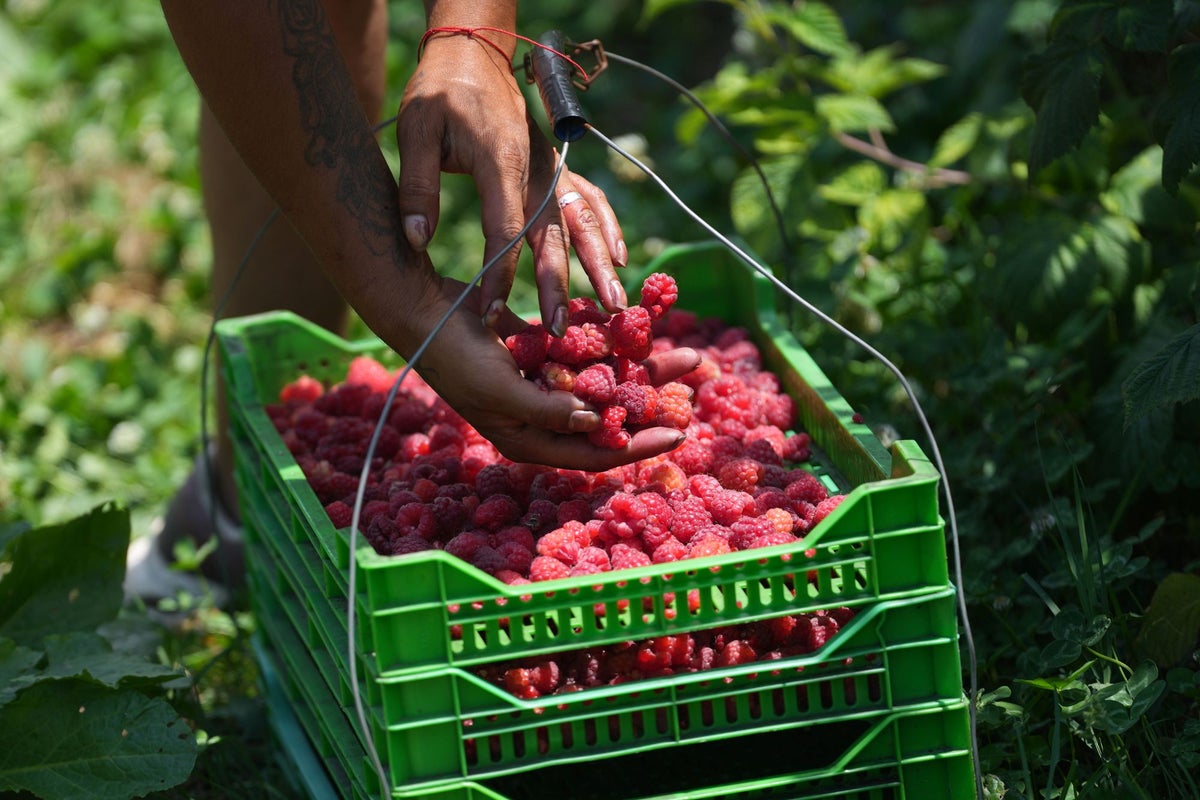
Early summer marks the picking season, drawing seasonal workers, including some from India and other parts of South Asia. Local resident Nada Marinkovic highlighted the manual labor involved, stating that everything must be cleared by hand, with the actual picking only difficult “because of the sun.”
Around 90 percent of Serbian raspberries are exported frozen, primarily to Europe, where they are used in food processing, retail, jams, yogurt, and bakery products. The remaining portion is sold in domestic markets, with some producers offering direct online sales of fresh fruit and natural juices.
Extreme weather that experts say may be fueled by climate change has become a concern for producers (AP Photo/Darko Vojinovic)
This year, however, a 20-30 percent reduction in yield is anticipated, a direct consequence of last year’s severe drought.
Extreme weather, which experts increasingly link to climate change, is a growing concern for producers. They argue that these environmental shifts necessitate more predictable purchase prices.
Pilcevic lamented that the prices offered for raspberries too often leave producers with minimal or no profit, hindering their ability to cover unexpected costs. This ongoing struggle has previously led to protests on roads near Arilje.
“It is not our job to be on the road but in the orchard,” Pilcevic asserted, “But, believe me when I say that we will be on the road if we have to.”