Mon 13 July 2026, Apia Samoa. The Supreme Court has heard allegations that the appointment of District Development Committee (DDC) chairpersons and co-chairpersons was driven by political considerations rather than merit, while the Government maintains the appointments were lawful and necessary to implement its development agenda.
The constitutional challenge, brought by the Human Rights Protection Party (HRPP), is being heard before Chief Justice Satiu Simativa Perese and Justice Leiataualesa Daryl Clarke.
The applicants argue the appointment process breached Article 15 of the Constitution by unlawfully discriminating against applicants associated with the HRPP.
Appearing for the HRPP, King’s Counsel Rodney Harrison told the Court it was unnecessary to prove the Government’s political motives if the outcome of the process clearly demonstrated discrimination. “You don’t have to prove that the decision-makers were politically motivated if the outcome speaks for itself.”
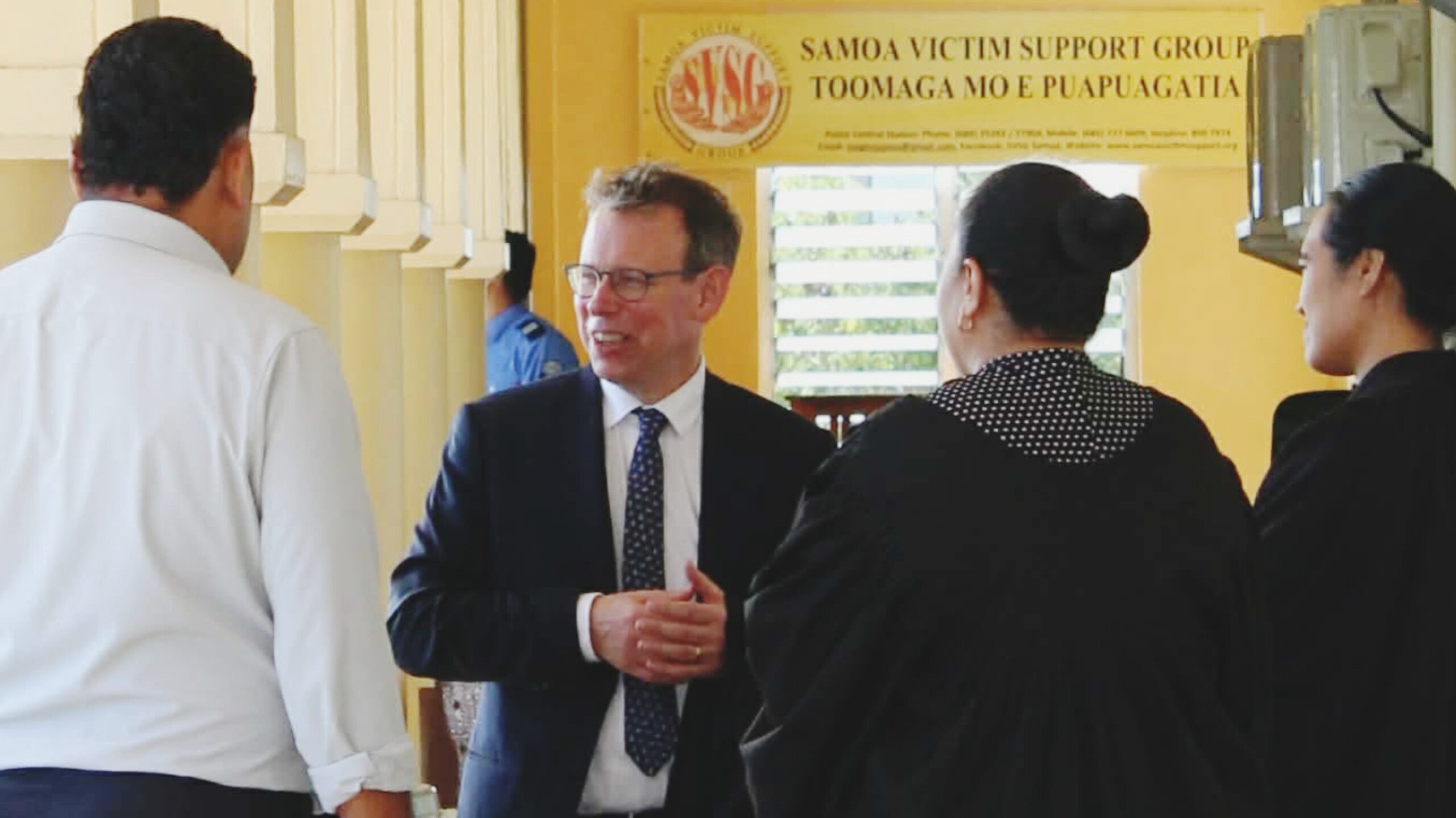
HRPP Party Secretary Lealailepule Rimoni Aiafi with King’s Counsel Mr Rodney Harrison.
Harrison argued that every constituency ultimately ended up with either a FAST Party chairperson or a FAST Party co-chairperson, regardless of which political party held the parliamentary seat. “That result, I submit, speaks for itself.”
Harrison submitted that applicants who submitted protest letters challenging the appointment process were disadvantaged throughout the selection process. They were told the letter was an ‘objection’ to the process and as a result, the applicants were held as being ‘not supportive’ of the government initiative.
He told the Court those who submitted only protest letters were excluded, while those who submitted both the protest letter and a formal application were interviewed, but all of them were ultimately unsuccessful.
Harrison argued that the process followed a pattern.
“The panel committee thought: protest letter plus no application – you’re out..
“Protest letter plus application – you’re considered but rejected..
“No protest letter – you’re a co-chairperson.”
“They weren’t decided on merit. They were decided on the view taken of the paperwork submitted..”
He also argued there were no approved application guidelines in force when applications closed, making it unlawful to reject applications for failing to meet the formal requirements.
He further claimed Cabinet altered the rules after applications had already closed.
“The rules were changed on the spur of the moment without any reasons..”
Describing the process, Harrison argued the sequence of decisions lacked proper administrative order.
“It’s done completely in the wrong order. And it’s not how good governance works.” Counsel Harrison said.
He also criticised the policy process.
“A very confusing attempt at policy-making… very difficult to know what Cabinet really thought it was doing at any given time.”
The applicants argue both the process and the final appointments amounted to political discrimination prohibited by Article 15 of the Constitution.
“The result speaks for itself in terms of a breach of 15(2).”
The hearing also examined the timeline surrounding Cabinet’s decisions on 16 December 2025.
Chief Justice Satiu questioned how the interview reports, the steering committee’s review, Cabinet papers and the ultimate Cabinet decisions could have all been completed on the same day.
“It’s a very compressed timeframe from the signature of those interview reports, to the steering committee on the same day… and the Cabinet decisions, again, on the 16th of December.”
The Court raised the question, if Cabinet had the completed interview reports before them, or summary documents.
For the Government, New Zealand based Counsel Keith rejected claims that the appointments were based on party allegiance.
Keith argued applicants were distinguished according to whether they supported or opposed the Government’s policy objectives.
“It was not from party allegiance, but from opposition expressed by those members to policy changes..”
Keith submitted that it was proper for the Government to appoint people committed to implementing its programme.
“It was legitimate, objective and proper… to differentiate between those who support that policy and those who strongly opposed it.”
During exchanges with the bench, Keith accepted that political considerations formed part of the appointments but argued that the real legal question was whether those considerations were constitutionally permissible.
“Yes… the question is whether it is legitimate or not.” Said Keith.
Justice Leiataualesa asked why co-chairpersons were appointed only in constituencies represented by opposition MPs.
“Why is it only in these seats, and not across the board?”
Leiataualesa asked if public resources should be administered according to political lines.
“The government may say, ‘This is our policy.’ The public might say, ‘This is our money’”.
Keith maintained the Government was entitled to make political appointments to implement its mandate.
The Chief Justice summarised the Government’s argument. “Your position is that there is no discrimination because the Government is entitled to make a political appointment to further its own chosen policy.”
At the start of proceedings, the Chief Justice disclosed that two individuals referred to during the hearing are related to him. He invited Counsel to raise any objection to his continued involvement in the case, with the issue deferred until after the Court adjourned.
The hearing continues in the Supreme Court today..
Job Opportunities
Alofa Grace Masina is an Intern Reporter and Photographer with Samoa Global News. Alofa Grace is passionate about sharing stories and capturing real moments. She is a graduate of Maluafou College and hopes to continue a career as a Journalist.
Latest posts by Alofa Grace Masina (see all)
Post Views: 1,082