1
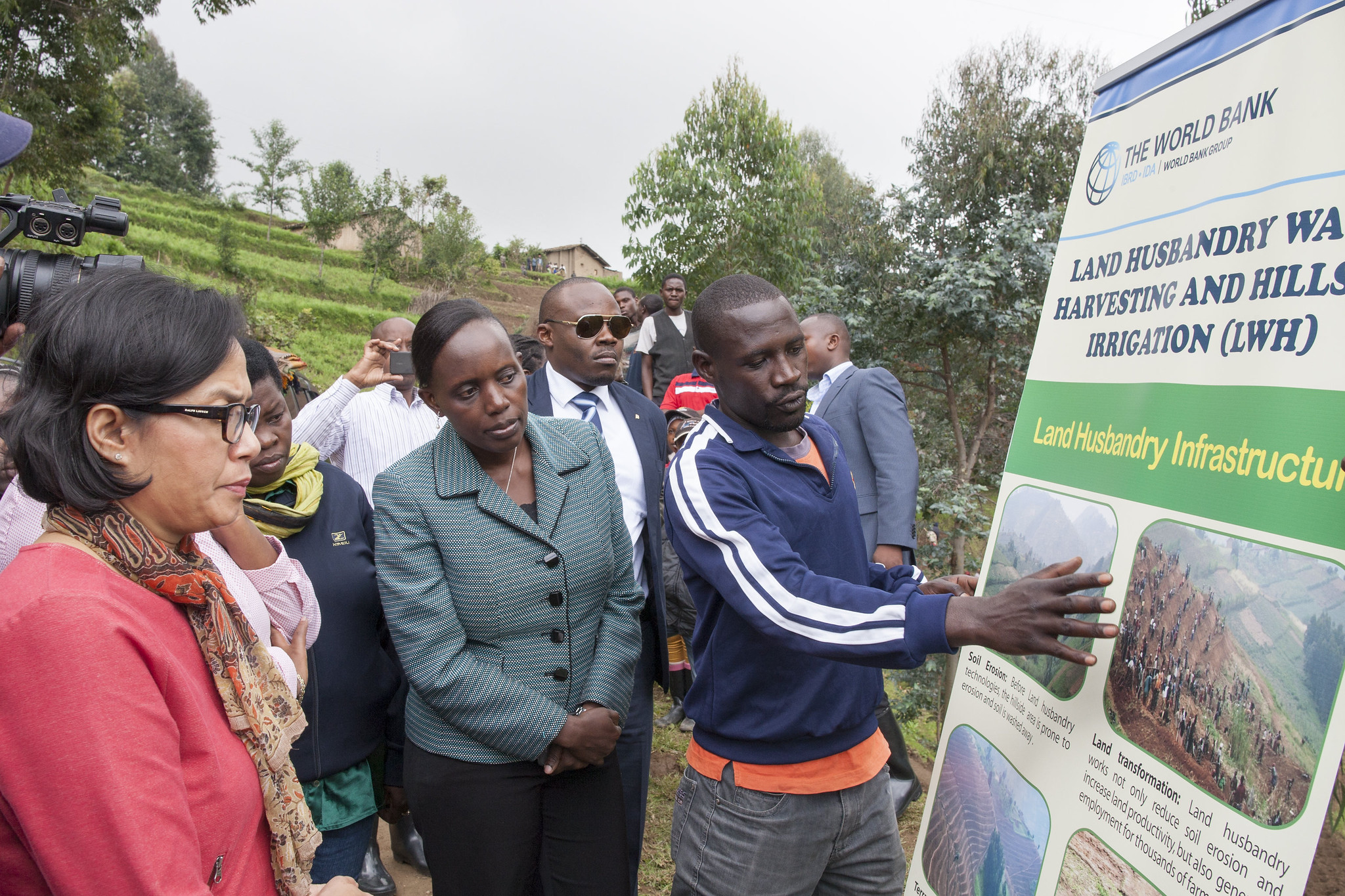
May 2015 – NYABIHU DISTRICT. World Bank Managing Director and COO Sri Mulyani Indrawati visits impressive land husbandry activity on a steep hills.
KIGALI — The World Bank is preparing to launch a new nine-year financing and development partnership for Rwanda, signaling continued confidence in the country’s long-term economic ambitions while placing greater emphasis on job creation, private sector growth and improving livelihoods.
The new Country Partnership Framework (CPF) 2026–2035, which will run from July 2026 to June 2035, will serve as the World Bank Group’s principal strategy for supporting Rwanda’s development agenda over the next decade.
It will be aligned with Rwanda’s Vision 2050, the National Strategy for Transformation (NST2) and the country’s intermediate development targets for 2035.
The framework follows the conclusion of the previous FY2021–FY2026 partnership, under which Rwanda received an indicative allocation of US$912 million during the first financing cycle while remaining eligible for additional World Bank financing through special funding windows.
Unlike a traditional aid package, the Country Partnership Framework determines where and how the World Bank Group—including the International Development Association (IDA), the International Finance Corporation (IFC) and the Multilateral Investment Guarantee Agency (MIGA)—will focus its financing, technical support and private sector investments.
Between January and March this year, the World Bank consulted government institutions, Parliament, private sector representatives, civil society organizations, development partners and senior public officials to identify Rwanda’s most pressing development priorities.
According to the consultation summary, participants consistently identified job creation as the central objective of the new partnership.
Stakeholders called for stronger investment in market-relevant skills, easier access to finance for businesses, expanded private sector growth and measures that can generate more employment opportunities, particularly for young people.
Agriculture also featured prominently in the discussions, with participants urging greater emphasis on increasing productivity, strengthening agricultural value chains, promoting value addition and improving climate resilience to raise rural incomes.
The consultations further highlighted infrastructure, digital connectivity and urban development as essential foundations for sustaining competitiveness, while emphasizing that future development programmes should remain inclusive so women, youth, persons with disabilities and vulnerable communities share in the country’s economic progress.
The priorities outlined during the consultations closely mirror many of the challenges identified by the World Bank in the previous partnership framework.
While describing Rwanda as having experienced a “remarkable social, political, and economic renaissance” since 1994, the World Bank also concluded that the country’s next stage of development would require stronger private sector-led growth, higher-quality jobs, improvements in education and skills, more productive agriculture and greater integration into regional and international markets.
The earlier framework also praised Rwanda’s governance record, stating that strong public institutions, a results-oriented approach to service delivery and a zero-tolerance stance on corruption helped the country become “a highly favored recipient of development assistance,” making external financing one of the principal sources of Rwanda’s development funding.
At the same time, the World Bank argued that sustaining Rwanda’s rapid growth would increasingly depend on expanding the role of the private sector rather than relying primarily on public investment, while ensuring economic growth translates into faster poverty reduction and broader employment opportunities.
The new CPF is expected to define the World Bank Group’s engagement with Rwanda through 2035 and provide the strategic framework that guides future lending, grants, technical assistance and private investment support over the next nine years.
Visited 1 times, 1 visit(s) today