1
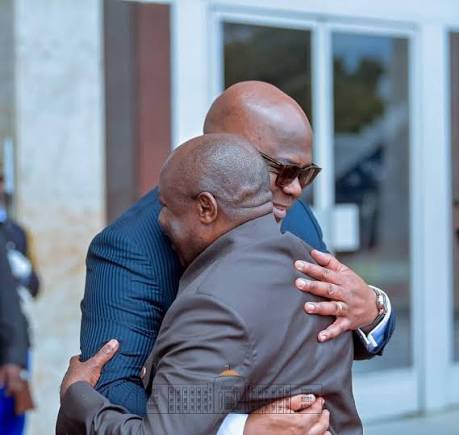
DR Congo President Félix Tshisekedi and Burundi counterpart Evariste Ndayishimiye hug at a previous meeting. They may have very likely had a phone conversation to celebrate current state of affairs, rather join the mourning of over a million in Rwanda
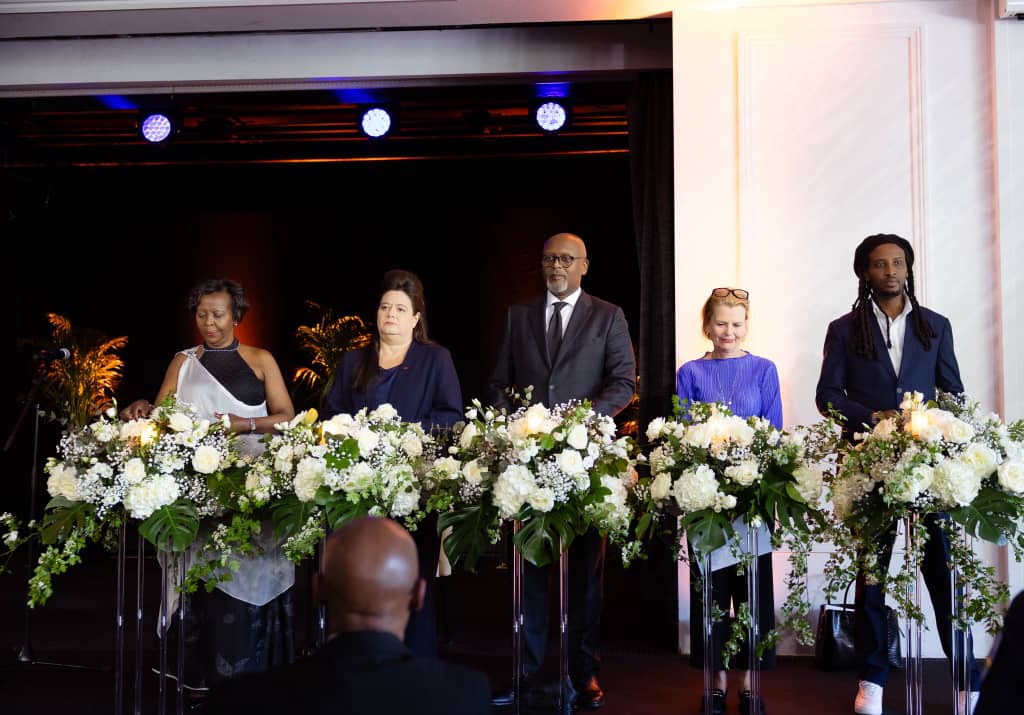
As Rwanda concludes the opening days of Kwibuka 32 — the annual commemoration of the 1994 Genocide against the Tutsi — from April 7, 2026, the contrast with its two immediate neighbors could hardly have been starker.
While the United States, the United Nations, the African Union and the East African Community held solemn events, issued statements of solidarity and flew flags at half-staff, the governments of Burundi and the Democratic Republic of the Congo remained conspicuously silent on the genocide itself.
Instead, Burundi staged a high-level national ceremony on April 6 to remember the assassination of its president, Cyprien Ntaryamira, in the same plane crash that killed Rwandan President Juvénal Habyarimana — the event that immediately preceded the mass killings.
The distinction is not merely ceremonial. It is political.
For several years, both Burundi and Congo have insisted, in near-identical language, that they harbor “no problem with the people of Rwanda” — only with the government in Kigali.
Yet when the moment arrived to express solidarity with Rwandan survivors on the precise anniversary of the genocide’s outbreak, neither country did so publicly.
Their absence, set against a backdrop of regional accusations of proxy warfare, rebel harboring and closed borders, raises a pointed question: If the quarrel is truly only with Government of Rwanda, why the reluctance to honor the dead and comfort the living?
Burundi’s April 6 Ritual
On Monday, April 6, 2026, President Évariste Ndayishimiye led a wreath-laying ceremony at the tomb of President Ntaryamira in Bujumbura, attended by top officials and former heads of state.
State media described the event as a “solemn moment of remembrance” focused on Ntaryamira’s brief tenure and the “tragic disappearance” of the two presidents whose plane was shot down over Kigali.
This was no one-off.
Since relations between Bujumbura and Kigali deteriorated sharply around 2016— Burundi has annually elevated April 6 as a national commemoration of its slain leader.
The framing is deliberate: it centers the plane crash itself, an event that Hutu extremist radio in 1994 used as the immediate pretext to unleash the genocide.
Rwanda, by contrast, begins Kwibuka on April 7, the day the systematic slaughter of Tutsi civilians began.
Ndayishimiye, who also serves as the African Union’s rotating chair for 2026, has in recent years echoed the “people versus government” distinction.
Yet his government offered no parallel message of solidarity with Rwanda’s genocide survivors on April 7.
The contrast with the broader African Union, which organized an official Kwibuka 32 event at its Addis Ababa headquarters complete with a Walk to Remember and Flame of Remembrance, was unmistakable.
Active Reframing
Kinshasa’s position is, if anything, more telling.
President Félix Tshisekedi has repeatedly told diplomats and audiences over the past three years that Congo’s grievances lie solely with “the government in Kigali,” not the Rwandan people.
Yet no statement, wreath-laying or official participation from the Congolese government appeared in connection with Kwibuka 32.
The East African Community — of which both Congo and Burundi are members — did hold a commemoration in Arusha, Tanzania, including a solidarity walk and wreath-laying at the EAC Genocide Memorial.
But that was an institutional, not a national, initiative.
The omission matters because the 1994 genocide’s perpetrators, the Democratic Forces for the Liberation of Rwanda, still operate from Congolese soil – openly funded and armed by Kinshasa.
Rwanda has long cited their presence as justification for its military posture in eastern Congo and alleged support for the M23 rebel movement — accusations Kinshasa denies.
President Kagame himself, in his Kwibuka 32 address and related interviews, referred pointedly to “noise in the region” and gatherings in Kinshasa involving relatives of Habyarimana.
Instead of joining the commemoration, the Congolese government actively defended and reframed one such figure.
In response to President Kagame’s public rebuke that Jean-Luc Habyarimana — son of the late president — was being used by Kinshasa to “mobilize support” for the FDLR, Information Minister Patrick Muyaya issued a robust rebuttal.
“Jean-Luc Habyarimana is not a war leader,” Muyaya stated.
“He has never called for violence or the overthrow of any regime. He is a political figure who advocates for peace and reconciliation.”
Muyaya dismissed what Rwanda says as “lies used to justify Rwanda’s illegal actions in eastern Congo” and emphasized that “those who lived through tragedy cannot become the ones who reproduce it.”
This defense forms part of a broader Kinshasa-led campaign to present members of the Habyarimana family as victims themselves and promoters of dialogue, rather than figures linked to networks associated with the FDLR.
By portraying Jean-Luc Habyarimana as a reconciliation advocate while rejecting any connection to armed groups, the statement effectively sanitizes associations that Rwanda views as direct continuations of the genocidal ideology.
The timing — coinciding with Kwibuka 32 — amplified the message that Congo’s narrative prioritizes countering Kigali’s security concerns over collective remembrance of the genocide.
By not marking the genocide’s anniversary, Congo avoided any gesture that might be read as implicit criticism of the FDLR or validation of Rwanda’s security narrative.
The silence, paired with this public reframing, also contrasted sharply with the actions of countries that, like the United States, maintain sanctions or policy disagreements with Rwanda yet still sent high-level representatives to Kwibuka events or issued formal remarks honoring the commemoration.
A Pattern, Not an Oversight
The pattern is not new.
For several years, neither Bujumbura nor Kinshasa has sent official condolences or participated visibly in Rwanda’s national mourning period.
This stands in contrast to virtually every other African state, Western capitals and global institutions.
The United Nations held its annual International Day of Reflection on April 7 at headquarters in New York.
The African Union, despite containing both Burundi and Congo as members, proceeded with its own ceremony.
Even the East African Community, whose membership includes the two holdouts, gathered publicly in Arusha.
Diplomats and analysts in the region note the irony.
Both presidents have used the “people, not government” formulation to keep channels open for potential economic or humanitarian cooperation.
Yet the annual genocide commemoration — a moment when Rwanda invites the world to stand with survivors rather than litigate current disputes — has become the one occasion on which that distinction collapses.
Refusing to participate, or redirecting attention to the April 6 plane crash while defending figures tied to the old regime’s legacy, effectively treats the genocide’s trigger as the story worth remembering, not the genocide itself.
What the Absence Reveals
In international protocol, attendance at national days of mourning is rarely about perfect bilateral harmony.
The United States and its allies routinely mark Russia’s Victory Day or Israel’s Holocaust Remembrance Day despite deep strategic disagreements.
The same logic applies here: solidarity with victims of genocide is not an endorsement of any government’s current policies.
That Burundi and Congo chose a different path — one that elevates the assassination of two presidents or the rehabilitation of the Habyarimana family name over the systematic extermination of Tutsi civilians — sends a signal louder than any joint communiqué could.
Whether this reflects genuine ideological alignment with narratives that downplay or reframe the 1994 events, fear of domestic political backlash, or simple diplomatic retaliation amid the M23 conflict and border closures, the effect is the same.
Two of Rwanda’s closest neighbors, countries whose leaders profess to distinguish between a people and its government, have become the only ones in the Great Lakes region to treat Kwibuka 32 as an occasion for pointed non-participation — and, in Congo’s case, active narrative counter-offensive.
As the 100-day Kwibuka period continues in Rwanda, the empty chairs from Bujumbura and Kinshasa, alongside Muyaya’s defense of Jean-Luc Habyarimana, will remain a quiet but unmistakable feature of the commemoration.
In the end, the test of the claim “no problem with the people of Rwanda” was never going to be economic summits or back-channel talks.
It was always going to be April 7.
Visited 1 times, 1 visit(s) today