2
When Rwanda participated in the Programme for International Student Assessment (PISA) in 2025 for the first time, the results are unlikely to be flattering. However, they may prove to be far more valuable than a strong global ranking.
Unlike national examinations, PISA does not test how well students remember what they were taught. Instead, it measures whether 15-year-olds can apply reading, mathematics, and science skills to real-life problems—often in unfamiliar contexts. The shift from syllabus mastery to functional competence presents a revealing test for Rwanda’s education system.
“Beyond assessment data, PISA also collects information on students’ backgrounds, aspirations, and attitudes, which can be used to improve performance and strengthen the education system,” said Dr. Bernard Bahati, Director-General of the National Examination and School Inspection Authority (NESA).
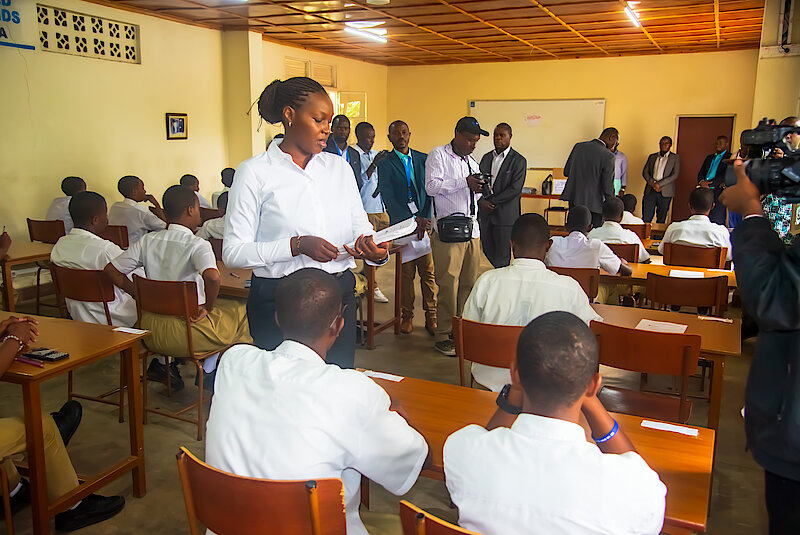
Rwanda conducted a pilot PISA test in 2024 to prepare for the main assessment. According to Dr. Bahati, the trial phase was essential. “The purpose of the PISA pilot is to refine the assessment process before the main study. It ensures that the tools and methodologies are valid and reliable, and helps identify any issues so the main assessment produces accurate data,” he said.
At Lycée de Kigali (LDK), one of the pilot schools, the experience challenged some common assumptions. Brother Jean Mfurayase, the school’s head teacher, said students found the test manageable. “They told me the questions were easy and connected to everyday life,” he said. “The main challenge was time because the questions required careful reading and thinking.”
For students, the difference lay not in difficulty but in approach. “It is easier than class exams because it is not about memorizing formulas,” said Aime Safari, one of the students who sat the test. “You are asked to think—how science or mathematics applies to real life.”
Experience from other African countries offers useful perspective. Morocco, Tunisia, Senegal, and Zambia—all recent PISA participants—scored well below the OECD average in their first attempts. Senegal ranked near the bottom globally in reading and mathematics, despite years of curriculum reform. Zambia’s 2022 results similarly exposed gaps between national exam performance and real-world problem-solving skills.
These outcomes did not reflect a lack of student ability. Rather, they revealed education systems still oriented toward rote learning, exam drilling, and content-heavy teaching, with limited emphasis on reasoning, interpretation, and critical thinking—the very skills PISA prioritizes.
Rwanda faces similar constraints. Although the Competency-Based Curriculum aligns in principle with PISA’s philosophy, classroom practice remains uneven. Many teachers were trained under older, exam-focused models and continue to prioritize recall, partly due to pressure from national assessments. Students, meanwhile, are more accustomed to short, direct questions than long texts, open-ended reasoning, or multi-step problems.
In the short term, Rwanda should, therefore, expect below-average results, particularly in reading literacy and applied mathematics. This should not be read as failure but as a baseline diagnosis.
Handled wisely, PISA can help Rwanda answer a deeper question: are schools preparing students for life—or only for exams? The true value of participation will not be found in league tables but in whether the data leads to better teaching, smarter policy, and classrooms that reward thinking over memorization.
Visited 1 times, 1 visit(s) today