1
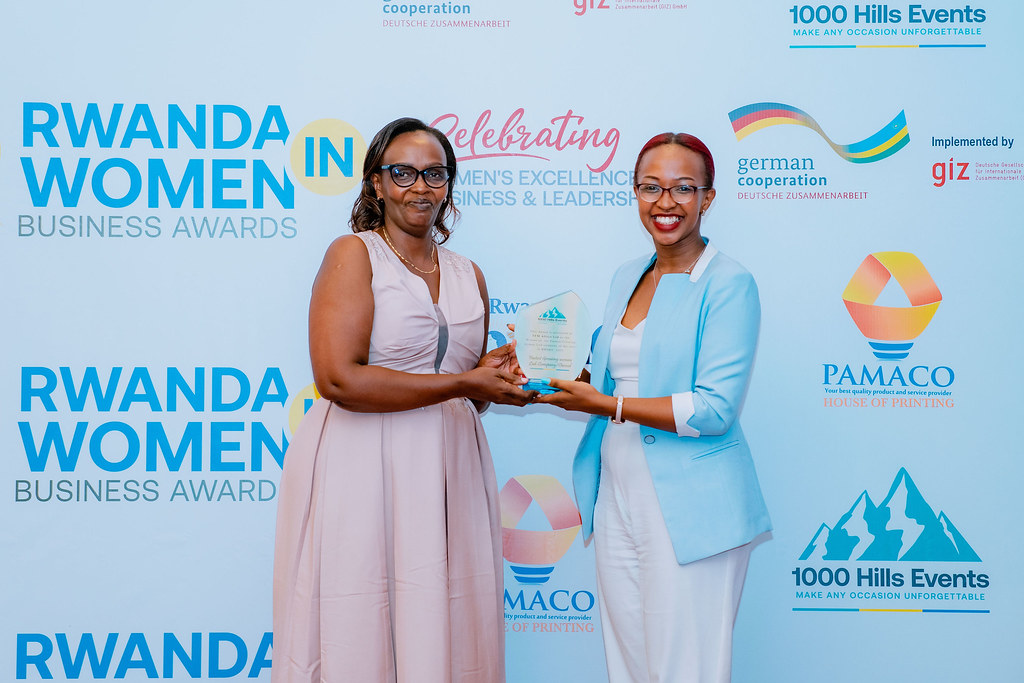
This was the Rwanda Women In Business Awards for the year 2023. Such initiative are aimed at spotlighting women’s role in the country’s economy
KIGALI — Women have crossed an important threshold in Rwanda’s cities and towns.
A new national census shows they now manage more urban business enterprises than men, a quiet but remarkable shift in a country where business leadership has long mirrored the wider gender inequalities found across much of the world.
Yet beyond the milestone lies a more complicated story: as businesses become larger, women almost disappear from the top ranks.
The findings come from the National Institute of Statistics of Rwanda’s (NISR) 2023 Establishment Census Gender Thematic Report, which counted 261,398 enterprises across Rwanda.
Of the total, 130,996 were located in urban areas, where women managed 66,341 enterprises (50.6 percent), narrowly surpassing the 64,655 (49.4 percent) managed by men.
It is the first time women have overtaken men in managing businesses in Rwanda’s urban economy.
The milestone reflects a broader transformation taking place across the country’s private sector.
Nationally, women now manage 104,316 enterprises, representing 39.9 percent of all businesses, up from 32.6 percent in 2017 and 37.1 percent in 2020.
Between 2020 and 2023, the number of female-managed enterprises grew by 24.7 percent, more than double the 10.9 percent growth recorded among male-managed businesses.
But the report makes clear that starting a business is only part of the journey.
Women account for 40.8 percent of managers among micro-enterprises employing one to three people. Their representation falls to 30.3 percent in small enterprises, 22.7 percent in medium-sized firms and just 10.8 percent among large businesses employing more than 100 people.
The picture also changes dramatically outside Rwanda’s cities.
While women have edged ahead in urban enterprise management, rural Rwanda remains overwhelmingly male-led.
The census recorded 92,427 male-managed enterprises in rural areas, compared with 37,975 managed by women, highlighting the gap in economic opportunities between urban and rural communities.
The report also shows where women are making the greatest gains.
Women manage nearly 45 percent of businesses in wholesale and retail trade, one of Rwanda’s largest sectors. They also have a strong presence in accommodation and food services, while Administrative and Support Service Activities is the only sector where women outnumber men in business management, accounting for 52.8 percent of enterprises.
In contrast, men continue to dominate capital-intensive industries. They manage 94.7 percent of enterprises in electricity supply, 88 percent in construction, 83.7 percent in mining and quarrying, 79 percent in transport and storage, and 77.9 percent in information and communication.
Beyond gender, the census paints a picture of Rwanda’s business landscape. More than 92 percent of all enterprises employ between one and three workers, while only 0.2 percent qualify as large enterprises.
More than 90 percent operate as sole proprietorships, highlighting the dominance of small family-run businesses across the country.
The report also suggests that many businesses remain at an early stage of development. Fewer than 10 percent of sole proprietorships keep regular accounting records, while only 0.1 percent of female-owned and 0.2 percent of male-owned sole proprietor businesses export goods.
Perhaps the clearest indication of the challenge ahead is the concentration of capital.
Among enterprises with more than Rwf1 billion in capital, 79.1 percent are managed by men, compared with 15.8 percent managed by women, showing that the country’s largest businesses remain overwhelmingly male-led.
The census therefore tells two stories at once.
One is of remarkable progress. Women are starting businesses at a faster pace than men and have, for the first time, overtaken them in managing enterprises across Rwanda’s urban areas.
The other is that Rwanda’s biggest companies, largest investments and most capital-intensive industries remain largely in male hands.
The next measure of success, the report suggests, will not simply be how many women become entrepreneurs, but how many are able to build businesses that grow into the country’s next generation of major employers.
Visited 1 times, 1 visit(s) today