0
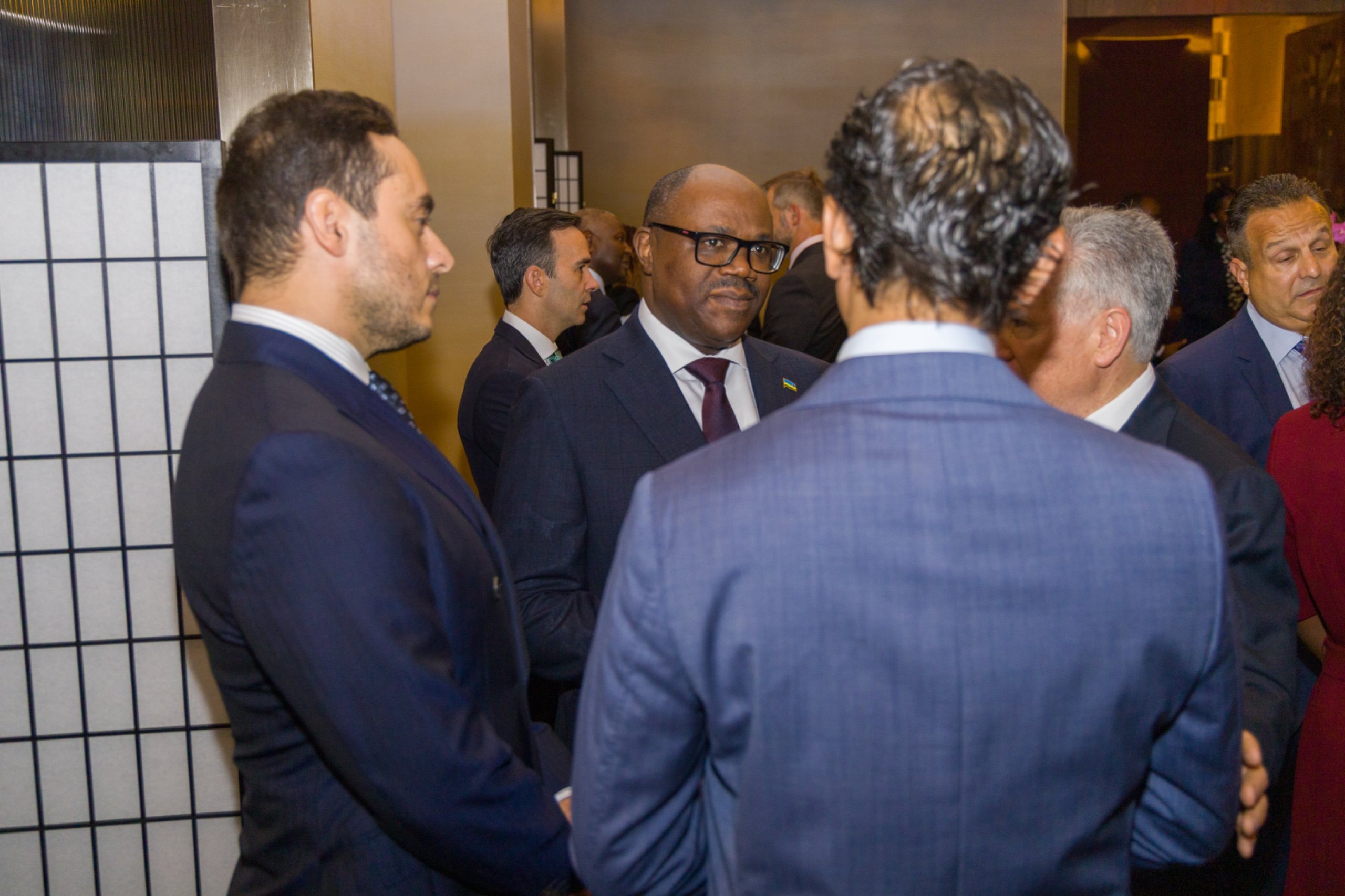
Delegates at the Global Africa Business Initiative’s Unstoppable Africa 2026 in New York.
NEW YORK – The most consequential question at this year’s Unstoppable Africa gathering in New York was whether Africans will have enough control over the technologies, industries, businesses and human capital driving that growth.
At the Global Africa Business Initiative’s Unstoppable Africa 2026, held on the margins of the 81st United Nations General Assembly, that distinction became harder to ignore as global demand rises for Africa’s minerals, markets, energy and talent.
The continent has long supplied what the world needs, but too much of the value has historically been created elsewhere.
Rwanda’s Prime Minister Dr. Justin Nsengiyumva, industrialist Alhaji Aliko Dangote and Kenyan entrepreneur Wawira Njiru offered three different dimensions to the same challenge.
Africa Must Build Its Own Digital Economy
Rwanda’s Prime Minister Dr. Justin Nsengiyumva speaking at the Global Africa Business Initiative’s Unstoppable Africa 2026.
Representing President Paul Kagame in New York, Nsengiyumva placed the ownership debate squarely on artificial intelligence, the world’s fastest-moving economic frontier.
Africa, he said, cannot afford to become a continent comfortable with technologies developed elsewhere, trained on African data and then simply sold back to African consumers.
“Africa is no longer satisfied to be a passive consumer of technology. We want to build, adapt, and deploy it at scale, in our own context and in response to the needs and opportunities of our people,” Nsengiyumva told the gathering.
He pointed to Rwanda’s fibre-optic backbone, near-universal 4G coverage, 5G pilots, more than 250 digitized government services and national digital payment infrastructure as foundations for that ambition.
“However, AI cannot thrive on algorithms alone. It needs connectivity to carry it, digital services to put it to work, and rules that people can trust,” he pointed out.
Rwanda’s position, he added, is to ensure that partnerships do not leave African countries with little control over the systems on which their economies increasingly depend.
His most pointed test was whether African states can govern the data their citizens generate, secure access to essential infrastructure and allow African companies to earn margins rather than merely distribute foreign products.
“If the answer to all three is no, that country is a market, not a participant,” Nsengiyumva said.
Stop Exporting What You Can Process
Dangote brought the argument of ownership of the digital economy through factories, refineries and raw materials.
The Nigerian industrialist described the extraordinary risk involved in building his 700,000-barrel-per-day refinery, saying international contractors initially refused to take on the project and engineers questioned whether it could be built at that scale.
The refinery is now operating at full capacity. For Dangote, the experience reinforced a conviction that Africa cannot industrialize by continuing to export resources in raw form.
“We want to lead and champion the industrialization of Africa but this will only happen if we exploit our precious mineral, add value and then send finished products rather than sending raw materials,” Dangote said.
His ambition now extends beyond Nigeria, including a planned refinery project in Kenya, while his wider expansion plans involve substantially increasing refining and petrochemical capacity.
Turning Africa’s Demographic Dividend into Productive Power
Wawira Njiru, who started Food for Education by feeding 25 children, told the New York gathering that the organization now feeds 700,000 children every day while creating markets for farmers, jobs for parents and a large procurement network.
Her central challenge to conventional thinking was that school feeding should not be treated simply as welfare spending.
“We think about school feeding as an expense. We don’t see that if you link it with agriculture, for example and create structured markets for farmers, it can be worth a journey to take” Njiru said.
For her, the idea to turn feeding programs into economic infrastructure by creating dependable demand for local farmers while investing in the children who will eventually become Africa’s workforce, is the real deal.
That matters because Africa’s celebrated demographic advantage is not automatic.
“An asset is not necessarily an advantage. Because we have a lot of young people, it does not mean we will convert that to an advantage for us in Africa and across the world,” she said.
In her view, the continent must deliberately convert its population into productive human capital through nutrition, education, skills and opportunity.
The language surrounding Unstoppable Africa 2026 is in constant motion that’s why the continent should no longer being presented simply as a place where opportunities exist.
The harder conversation is about who builds the factories, owns the platforms, controls the data, develops the talent, processes the minerals and captures the returns.
As Rwanda’s Prime Minister put it, “We are not asking to be included in someone else’s AI economy. We are building our own, safely, equitably, and responsive to our own needs and opportunities.”
Visited 1 times, 1 visit(s) today