1
REIMS, France – Family members, friends and mourners from France and Rwanda gathered in Reims on Monday to lay to rest Dafroza Gauthier, a Franco-Rwandan campaigner who spent nearly three decades helping bring suspected perpetrators of the 1994 Genocide against the Tutsi to justice in France.
Gauthier, a chemical engineer by training, died of cancer on 3 October at the age of 72.
In a notice announcing her death, the family asked mourners not to bring flowers or wreaths. Instead, they encouraged donations in her memory to the Collectif des parties civiles pour le Rwanda (CPCR), the organisation Gauthier co-founded with her husband, Alain Gauthier, in 2001 to pursue justice for victims of the genocide.
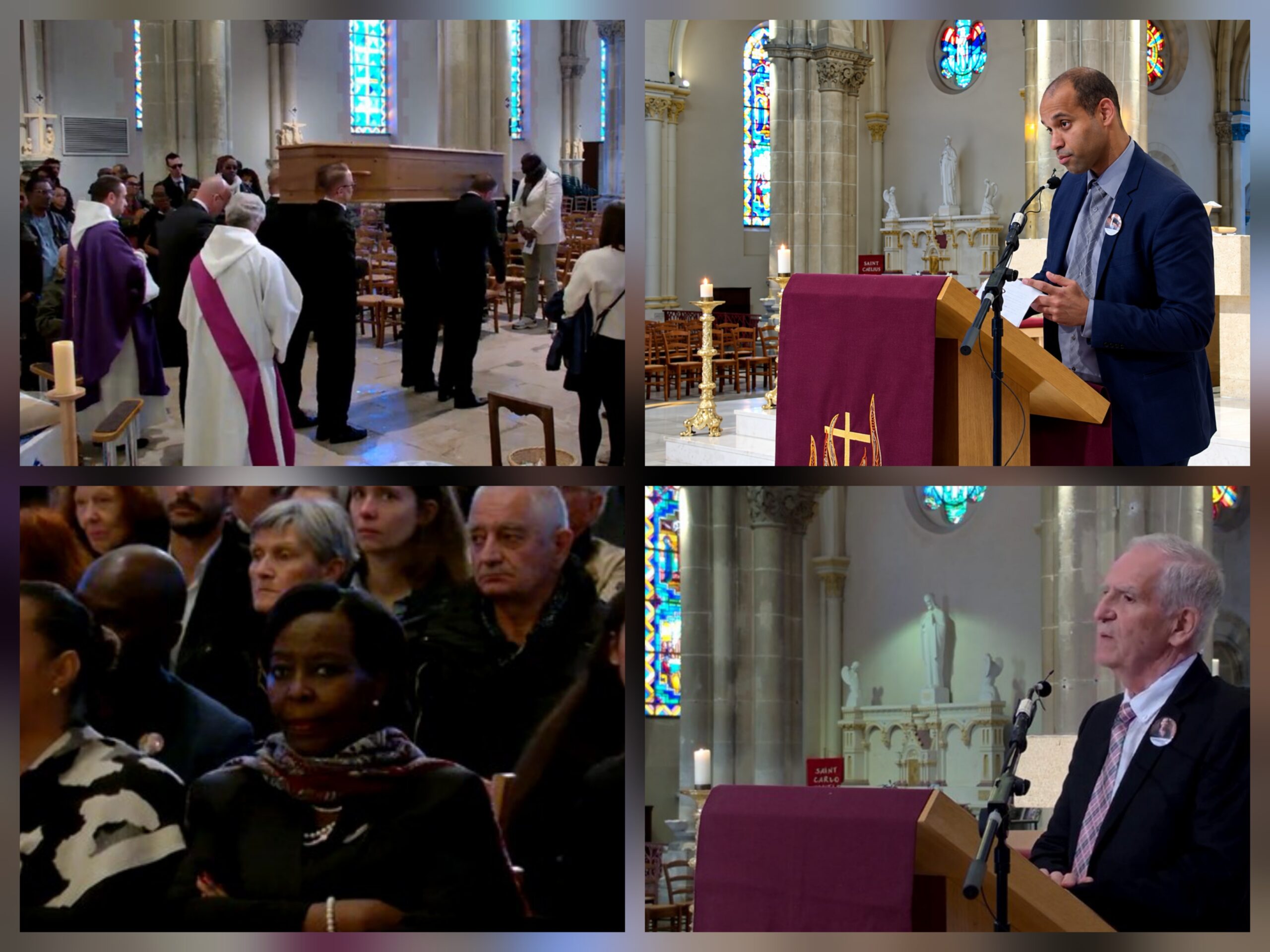
During a solemn funeral Mass, family members and friends shared personal memories of a woman whose public life was defined by her pursuit of justice, but whose family remembered her warmth, generosity and love of celebrations.
One of the most moving tributes came from her son, Emmanuel, who addressed his mother directly, speaking of the pain of losing her and the pride he felt in her life’s work.
“Dear Mother, your departure has left us with great pain, because to us you were an extraordinary parent,” he said.
“Mama, you carried us in your womb, in your arms, but today we know you will be somewhere, perhaps in Rwanda, but you will not return.”
He thanked her for everything she had done for her family and for Rwanda, the country of her birth, adding that people around the world were now expressing their gratitude for her work.
Emmanuel also recalled the family gatherings that offered a glimpse into her life away from the public spotlight.
“Sometimes I think of you in your kitchen, in the living room where we used to have meals every week, and where we celebrated Epiphany, Easter and Christmas,” he said.
He remembered her as a welcoming host who organised celebrations with champagne, beer, and red and white wine.
“In short, you were a person of festivities,” he said.
But his tribute also carried a sense of unfinished connection to his mother’s Rwandan roots.
“Mama, I am saddened that you have gone without me having learned Kinyarwanda—yet it is not too late because our aunts and uncles are still here,” he said.
He ended with words of gratitude for a mother who, he said, had turned bitterness into sweetness for her children and given them everything she could.
“You taught us many things in our lives; I cannot thank you enough,” he said. “But in everything, Mama, you did so much.”
A warrior who fought without hatred
Gauthier’s husband, Alain, who worked alongside her for decades, described her as “a warrior who fought without hatred”.
Following her death, he said his thoughts were with their children and grandchildren, as well as the victims and survivors of the genocide to whom his wife had devoted her life.
“I would like to thank all those who say that Dafroza is a great lady who changed something in their lives,” he said.
Rwanda’s ambassador to France, François Nkulikiyimfura, delivered a message from President Paul Kagame expressing condolences to Alain, their three children and all those who had worked with Gauthier.
“Dafroza will always remain in our hearts because of her unwavering commitment to fighting impunity for those responsible for the 1994 Genocide against the Tutsi,” Kagame said.
The president praised her decades of work to restore dignity to victims and support survivors by pursuing accountability for those responsible for the killings.
IBUKA, the umbrella organisation representing genocide survivors, also paid tribute to her contribution.
Its president, Dr Philbert Gakwenzire, described her as “an extraordinary heroine, Mama Dafroza Gauthier” and a voice for victims who could no longer speak for themselves.
He called her “a light of justice”, recalling that about 80 members of her extended family, including her mother, were killed during the 1994 genocide. No one on her maternal side survived, according to the tribute.
“Rest in peace. The justice you fought for will forever stand as a tribute to you,” IBUKA said.
From personal loss to a lifelong mission
Born Dafroza Mukarumongi in Butare, then known as Astrida, on 4 August 1954, Gauthier experienced anti-Tutsi violence long before the 1994 genocide. She studied in Belgium, married Alain Gauthier in 1977 and settled in Reims, where she worked as a chemical engineer.
The 1994 genocide claimed nearly her entire maternal family. In its aftermath, she and her husband began gathering testimonies from survivors in Rwanda and filing legal complaints in France against people suspected of participating in the killings who were living there.
Their work helped bring several suspects before French courts under the principle of universal jurisdiction, which allows national courts, under applicable legal conditions, to prosecute certain grave international crimes committed outside their territory.
The couple co-founded the CPCR in 2001 to help victims and survivors participate in legal proceedings and support efforts to hold suspected perpetrators accountable.
They travelled repeatedly to Rwanda to collect testimonies, identify witnesses and compile evidence for cases submitted to French authorities. Their work helped bring the stories of survivors into courtrooms and challenged the ability of suspected perpetrators to live abroad without facing prosecution.
The couple became prominent figures in the effort to ensure that people suspected of taking part in the genocide could not escape justice by settling in France.
Their work drew comparisons with Beate and Serge Klarsfeld, the campaigners known for pursuing Nazi war criminals. Gauthier also regularly spoke to students at schools and universities, warning against forgetting the genocide and the dangers of denial.
Rwanda honours the couple
Rwanda formally recognised the couple’s contribution in November 2017, when President Paul Kagame awarded Dafroza and Alain Gauthier the Igihango National Order of Outstanding Friendship, one of the country’s highest honours.
The medals were conferred in Kigali on 18 November 2017, during the inaugural ceremony for the award. The Gauthiers were among nine recipients recognised for their contributions to Rwanda and its people. Other recipients included investigative journalist Linda Melvern, philanthropist Howard G. Buffett and physician and humanitarian Paul Farmer.
The honour recognised the couple’s joint commitment to bringing those responsible for the 1994 Genocide against the Tutsi to justice and their contribution to preserving the dignity of victims.
Speaking at the ceremony, Kagame described the recipients as people whose actions had helped Rwanda through difficult periods and strengthened their bond with the country.
He explained that Igihango represents a profound bond of friendship, rooted in truth, mutual sacrifice and a lasting commitment between people.
The award reflected a commitment the Gauthiers had demonstrated over many years: working to ensure that the genocide’s victims were not forgotten and that suspected perpetrators faced justice, even decades after the killings.
KT Press previously profiled Dafroza in a feature titled “Dafroza Mukarumongi-Gauthier, The Woman Terrorizing Genocide Fugitives”, published on 31 August 2025. The profile traced her personal losses, her work with Alain and the painstaking investigations that helped advance cases against genocide suspects in France.
KT Press also published a profile of Alain Gauthier in October 2024, detailing his early connection to Rwanda and the couple’s shared commitment to justice.
Read it here: Alain Gauthier, From Yearning for Sainthood As A Child to Battling Against Evil As An Adult.
A legacy that continues
The family’s decision to request donations instead of flowers reflected the priorities that shaped Gauthier’s life.
Rather than directing resources towards funeral tributes, they asked mourners to support survivors through the organisation she helped establish.
Through the CPCR, the couple spent years gathering evidence, supporting legal proceedings and helping bring suspected perpetrators of the genocide before French courts.
Her death marks the end of a personal journey shaped by profound loss, but her husband and the organisation have pledged to continue the work.
As mourners left the funeral in Reims, the tributes brought together two sides of Gauthier’s legacy: a mother remembered for her warmth and generosity, and a campaigner whose determination helped give victims a voice and kept the pursuit of justice alive.
Visited 1 times, 1 visit(s) today