1
KIGALI – When the first floor of a commercial building in Nyabugogo was completed, cracks were already visible, according to local residents.
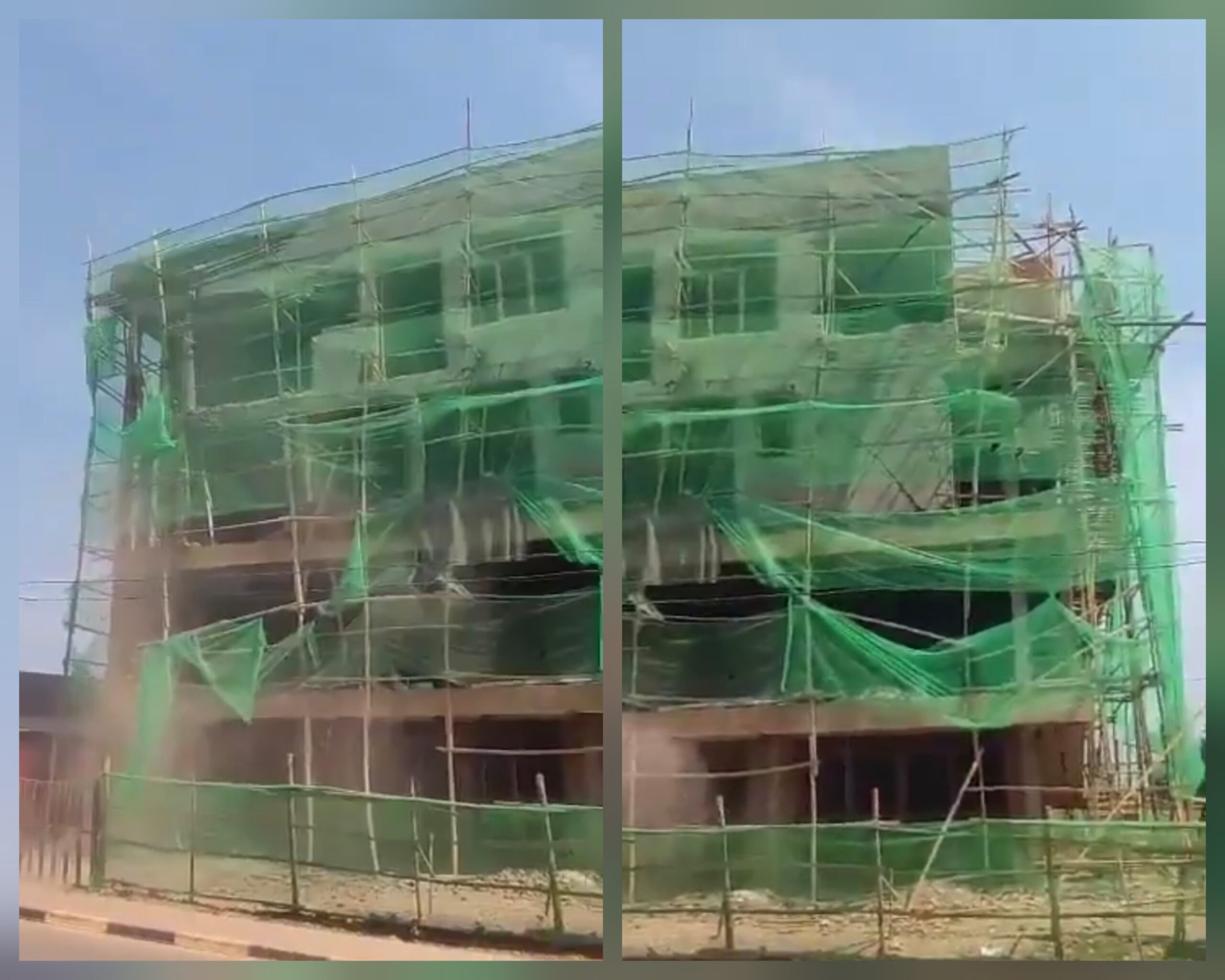
By August 2026, videos circulating on social media showed portions of the structure breaking off as workers continued construction.
Inside, support columns were reportedly crumbling under the weight of the floors above. The building, which was supposed to become a commercial investment worth more than Rwf800 million (over US$600,000), had instead become a dangerous structure before it was even completed.
Now, the City of Kigali has ordered its complete demolition, leaving the owner facing a substantial financial loss after entrusting the project to the professionals responsible for designing and constructing it.
The three-storey building, located in the Norvege area of Nyabugogo, Nyarugenge District, attracted widespread attention after images and videos showed its upper section leaning and parts of the structure deteriorating.
The case has raised questions about construction standards, professional accountability and the risks faced by property owners who rely on architects and construction engineers to deliver safe buildings.
A costly failure
Twahirwa Theoneste, the owner, said he had not yet calculated the exact financial loss but estimated that the completed building would have been worth at least Rwf800 million.
“We have suffered a major loss. I cannot immediately give an exact figure, such as saying it is this many millions. When we calculated the value of the building upon completion, it was estimated at Rwf800 million or more,” he said.
Twahirwa said the problem was not a shortage of construction materials but mistakes made during the construction process.
His investment depended on the people he had entrusted to turn his plans and materials into a sound commercial building. Instead, the structure developed serious defects that ultimately made demolition the only viable option, according to the city.
He urged construction professionals to respect the money clients invest in their projects and deliver buildings that meet the required standards.
“What we ask of people doing this work is that they should respect people’s money. If someone pays you and provides the materials, you should give them a strong, high-quality structure,” he said.
He added that contractors and other professionals should apply the knowledge they acquired through training rather than carry out work that violates professional standards.
Warning signs appeared early
The building began attracting attention online in August, when videos showed parts of the structure falling away while workers were still on site. The damage appeared particularly alarming because the building had not yet been completed.
Residents said cracks had been visible from the time the first floor was finished, raising concerns about the quality of the work as construction progressed.
The defects identified in the building included improperly mixed cement and steel reinforcement that did not meet the standards required for a large structure. Some steel components bent under the weight of the upper section, contributing to the building’s instability.
What began as a construction project had become a potential safety hazard, with the possibility of a collapse posing a risk to workers and anyone who might eventually have occupied the building.
For some residents, the decision to demolish the structure was therefore necessary, even if it meant losing an investment worth hundreds of millions of francs.
Habimana Assouman, a resident of Nyarugenge District, said allowing construction to continue could have resulted in a much greater tragedy if the building had collapsed after people moved in.
“But looking at it another way, what if it had been completed and this happened while people were inside? Wouldn’t that have been a much bigger problem?” he said.
No safe way to save the building
Emma Claudine Ntirenganya, spokesperson for the City of Kigali, said the decision to demolish the entire structure followed a technical assessment that found no safe way to retain parts of it.
She explained that laboratory tests initially indicated that some sections could potentially be removed while others were preserved. However, a further technical study was needed to establish whether the remaining structure could safely support reconstruction.
The findings ruled out that option.
“Once both assessments were completed, they showed that it simply would not work and was not feasible. The only option is to remove the entire building, after which the owner can apply for a new construction permit,” Ntirenganya said.
Demolition has since begun. Any new construction will require a fresh application for a building permit.
The decision means that the owner will lose the structure already built and would need to start again if he chooses to pursue the project.
Who is accountable?
The failure has highlighted the risks property owners face when the professionals they hire do not deliver work that meets construction requirements.
An architect is responsible for the building’s design, while construction engineers and other qualified professionals have roles in ensuring that the structure is built safely and in accordance with approved plans and technical standards.
In this case, the defects identified in the structure raise serious questions about whether those involved met their professional obligations. However, the specific responsibility of each professional, and whether any individual deliberately deceived the owner, has not been established in the information available.
Ntirenganya urged investors to engage qualified professionals with the necessary expertise and to ensure that they belong to the relevant professional bodies.
She said doing so helps promote compliance with professional standards and makes it easier to hold practitioners accountable for their work.
The building’s collapse in quality before completion illustrates the financial consequences of poor construction, beyond the immediate danger to human life. A project that should have produced a valuable commercial asset has instead left its owner facing demolition costs and the prospect of rebuilding from scratch.
For the residents who watched the structure deteriorate, the lesson was visible long before the demolition began: cracks appeared, parts fell away, and the building continued to lean.
The City of Kigali says compliance with construction standards and the use of qualified professionals are essential to preventing such failures, protecting lives and avoiding losses that could have been prevented.
Visited 1 times, 1 visit(s) today