
Your support helps us to tell the story
From reproductive rights to climate change to Big Tech, The Independent is on the ground when the story is developing. Whether it’s investigating the financials of Elon Musk’s pro-Trump PAC or producing our latest documentary, ‘The A Word’, which shines a light on the American women fighting for reproductive rights, we know how important it is to parse out the facts from the messaging.
At such a critical moment in US history, we need reporters on the ground. Your donation allows us to keep sending journalists to speak to both sides of the story.
The Independent is trusted by Americans across the entire political spectrum. And unlike many other quality news outlets, we choose not to lock Americans out of our reporting and analysis with paywalls. We believe quality journalism should be available to everyone, paid for by those who can afford it.
Your support makes all the difference.Read more
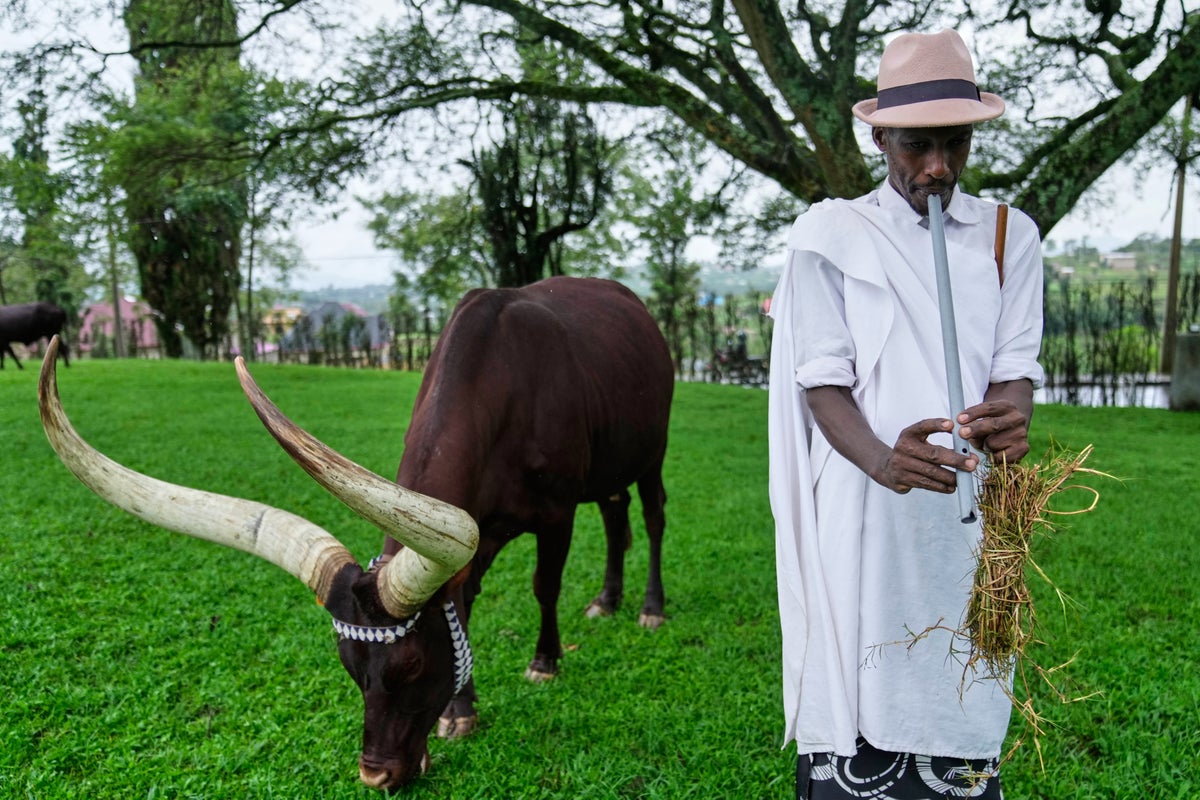
A flute here, a line of poetry there. Such is the daily treatment of Rwanda ’s royal cows that have become living symbols of the nation’s cultural heritage.
With their long and crescent-shaped horns, the Inyambo cows graze at the King’s Palace Museum in Nyanza and at the homes of some of Rwanda’s richest people, including President Paul Kagame.
The breed is descended from the distinctive Ankole cattle of East Africa and is also found in neighboring Uganda and Burundi. The Inyambo have long been associated with nobility, raised in royal courts where they symbolized wealth, prestige and power.
“They’re not for milk, they’re not for meat. They were just used as decorations around the palaces,” said museum curator Bigira Junior.
Even though the monarchy no longer exists in Rwanda, so revered are the cows that the traditional gifting and exchanging them among kingdoms has been embraced by Kagame. A local newspaper, The New Times, once called the president’s practice of giving cattle to heads of state “Inyambo diplomacy.”
As Rwanda seeks more tourists, it is investing heavily in places like the King’s Palace Museum, where the Inyambo cows are the main attraction.
The cows are pampered with melodious poetry describing their beauty and calling them by their names. This is believed to calm the cows ahead of major events where they are presented to visitors or during traditional ceremonies.
“You have beautiful horns. Move your head so that we can see your beautiful neck and body. You are the most beautiful cow among others,” the caretaker sings.
The cows are also brushed by caretakers, another way of calming them.
“Remember, they are to be loved and cherished, and you can’t love something from afar. You have to get close to it,” Junior said.
Cattle in Rwanda and a number of other African countries signify social and economic importance. The larger the herd and the more unique a breed, the more respected a farmer is. In 2004, South African President Cyril Ramaphosa bought a special breed of Ankole cows from Uganda’s Yoweri Museveni.
The Inyambo breed stands apart as cultural ambassadors and heritage symbols in Rwanda and Uganda.
Their beauty also shapes traditional dance in Rwanda, with graceful movements performed by women who extend their arms to mimic the cows’ horns.
“The dance is more or less a way to portray the beauty of the royal cows,” Junior said.
The cows were reintroduced around the King’s Palace Museum in the early 2010s as part of a conservation initiative. It is not known how many of them remain.
Caretakers manage breeding programs to preserve their distinctive traits, including their long horns and rich brown coloring, a shade associated with royalty, maturity and stability.
To younger generations being introduced to the breed at the museum, the cows are part of Rwanda’s heritage and identity.
“We educate them to take this information to others and keep the culture alive,” Junior said.


