1
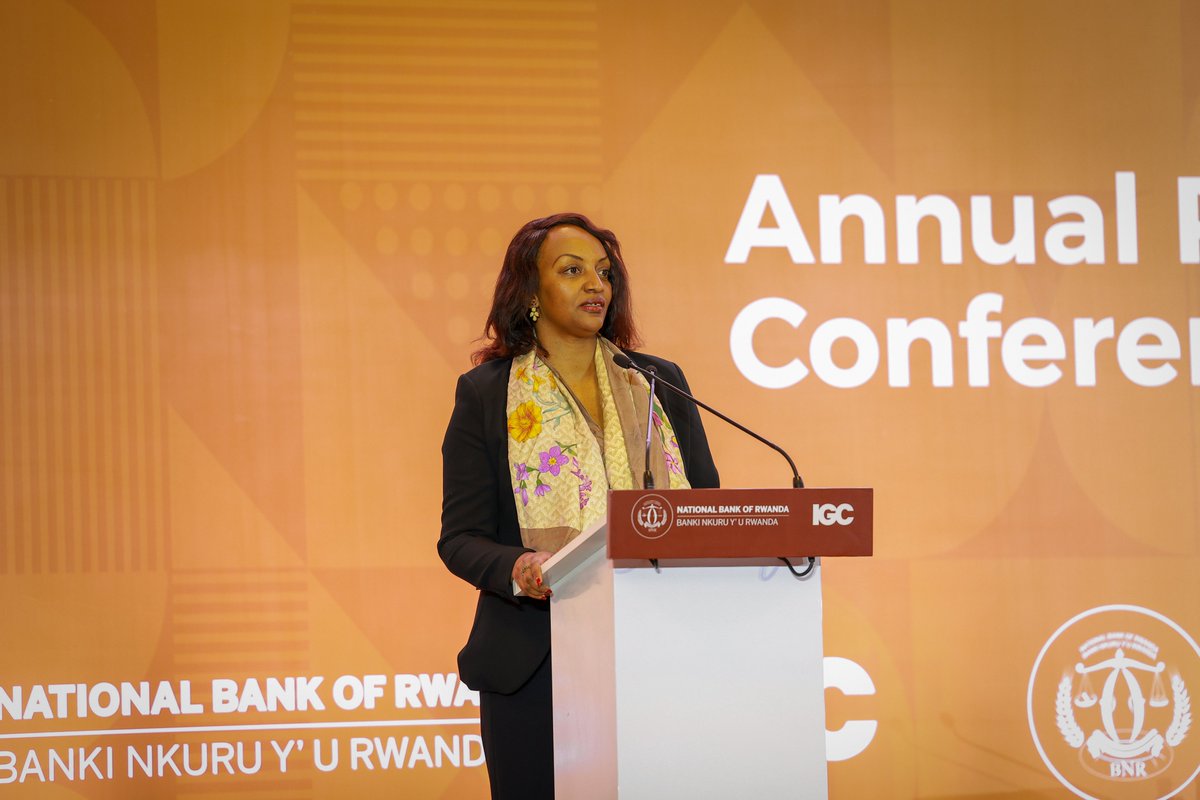
BNR Governor Soraya M. Hakuziyaremye speaking on Thursday
On a continent increasingly buffeted by climate shocks, volatile commodity prices, geopolitical tensions and shifting global financial conditions, Rwanda’s central bank has a message: resilience is no longer simply about surviving crises.
It is about redesigning economies to withstand them.
In an era defined by overlapping crises — inflationary waves, climate shocks, debt pressures and geopolitical fragmentation — Rwanda’s central bank is advancing a central argument: economic resilience is no longer a national ambition.
It is a global necessity.
There were the central themes of a two-day gathering organized by the National Bank of Rwanda (BNR), which brought together government officials, economists, researchers, journalists and policymakers to debate one of the defining economic questions facing Africa today: how countries can move from vulnerability to resilience.
The event, held under the banner of the National Bank of Rwanda Media Open Day and the NBR–IGC Research Conference 2026, reflected a growing effort by the central bank to engage more directly with the media and wider public on complex economic issues.
“Resilience, therefore, is not only about responding to crises; it is about building the structural conditions for sustained, inclusive, and sustainable growth,” Governor Soraya M. Hakuziyaremye told participants.
“That is a fundamentally different, and demanding standard.”
Ab Intellectual Conversation
While the Governor anchored the domestic policy message, the discussion quickly widened into a broader international conversation on how economies absorb shocks and manage uncertainty in an interconnected world.
Professor Christopher Adams of the International Growth Centre said the complexity of modern macroeconomic management is increasing as global and domestic shocks collide.
“As monetary frameworks in many lower-income countries evolve, the coordination between fiscal and monetary policy is becoming more complex and more consequential,” he said.
He warned that weak coordination can carry real economic costs.
“Poor policy coordination can exert a drag on investment, competitiveness and growth,” he added.
His remarks reflected a recurring concern among participants: that resilience is increasingly determined not by individual institutions, but by how well they operate together.
Africa’s Constraints
From a broader regional perspective, Professor Haroon Bhorat of the University of Cape Town situated the discussion within Sub-Saharan Africa’s long-term development challenges.
His presentation highlighted persistent constraints including industrialization gaps, demographic pressures, uneven human capital development, and rising sovereign debt risks.
These structural factors, he argued, continue to shape the continent’s growth trajectory and its ability to withstand external shocks.
Other speakers drew on comparative African experience to illustrate different paths to macroeconomic stability.
Professor Joshua Yindenaba Abor of the University of Ghana and a member of the Bank of Ghana’s Monetary Policy Committee pointed to Ghana’s recent reforms aimed at strengthening fiscal discipline and restoring macroeconomic stability.
“Ghana’s approach has focused on strengthening fiscal discipline and economic resilience,” he said.
He cited reforms such as expenditure rationalization and the creation of fiscal oversight mechanisms.
“At the same time, we’ve managed liquidity more effectively and expanded our export base building stronger external buffers,” he said. “This has helped stabilize both our currency and inflation.”
His intervention placed Rwanda’s discussions within a wider continental laboratory of economic experimentation.
Rwanda’s Policy Architecture
Within Rwanda, officials emphasized that resilience is being built through coordinated monetary, fiscal and structural reforms rather than isolated policy actions.
Deputy Governor Nick Barigye underscored the importance of coherence between institutions, arguing that fragmented responses to shocks risk undermining long-term stability.
He said policymakers must move away from siloed decision-making in an environment where global risks are increasingly interconnected.
Technical sessions examined how Rwanda’s economy is affected by both external shocks and domestic vulnerabilities.
Chief economist Thierry Kalisa noted that inflation dynamics are shaped by global commodity cycles as well as local supply disruptions, particularly in agriculture.
He said monetary policy must carefully distinguish between temporary shocks and persistent inflationary pressures that require intervention under the inflation-targeting framework.
From the fiscal side, officials from the Ministry of Finance emphasized the importance of building buffers, improving efficiency in public spending, and strengthening domestic revenue collection to enhance shock absorption capacity.
Trade policymakers, meanwhile, stressed export diversification as a central pillar of long-term resilience in a landlocked economy dependent on external markets.
A Global Policy Dialogue
Beyond Rwanda’s borders, the conference featured contributions from international economists and researchers who framed the country’s experience within global macroeconomic debates.
Professor Adams’ intervention from the International Growth Centre was complemented by broader comparative perspectives that linked Rwanda’s policy challenges to wider questions facing emerging economies.
The discussions reflected a growing trend in central banking: the use of international research partnerships to inform domestic policy decisions in an era of heightened uncertainty.
By the end of the two-day gathering, the conversation had moved beyond technical policy frameworks into a broader reflection on how economies can prepare for shocks that are increasingly global in origin but national in impact.
Whether through fiscal buffers, institutional coordination, export diversification or regional cooperation, participants returned repeatedly to a single idea: resilience is no longer a reactive strategy.
It is becoming the core architecture of economic policy itself.
Visited 1 times, 1 visit(s) today