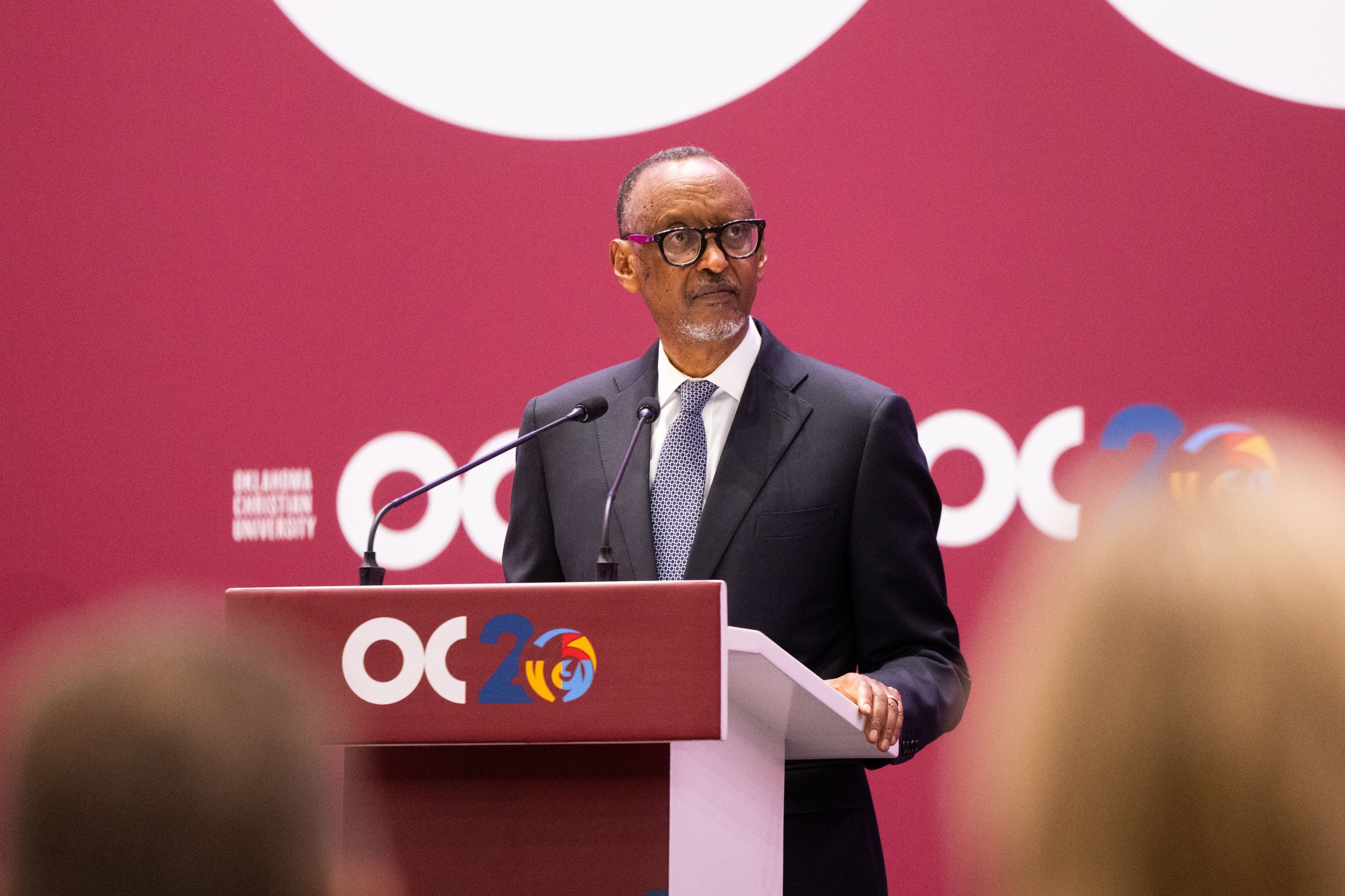
BK Group PLC officials
BK Group PLC marked its 60th anniversary Friday morning by launching its inaugural Investor Forum in Kigali, shifting its focus from past achievements to an aggressive, pan-African future.
Held alongside the group’s 2026 Annual General Meeting (AGM), the high-level gathering traded traditional backward-looking corporate reporting for an urgent debate: how to build a new financial architecture capable of funding Africa’s next growth frontier.
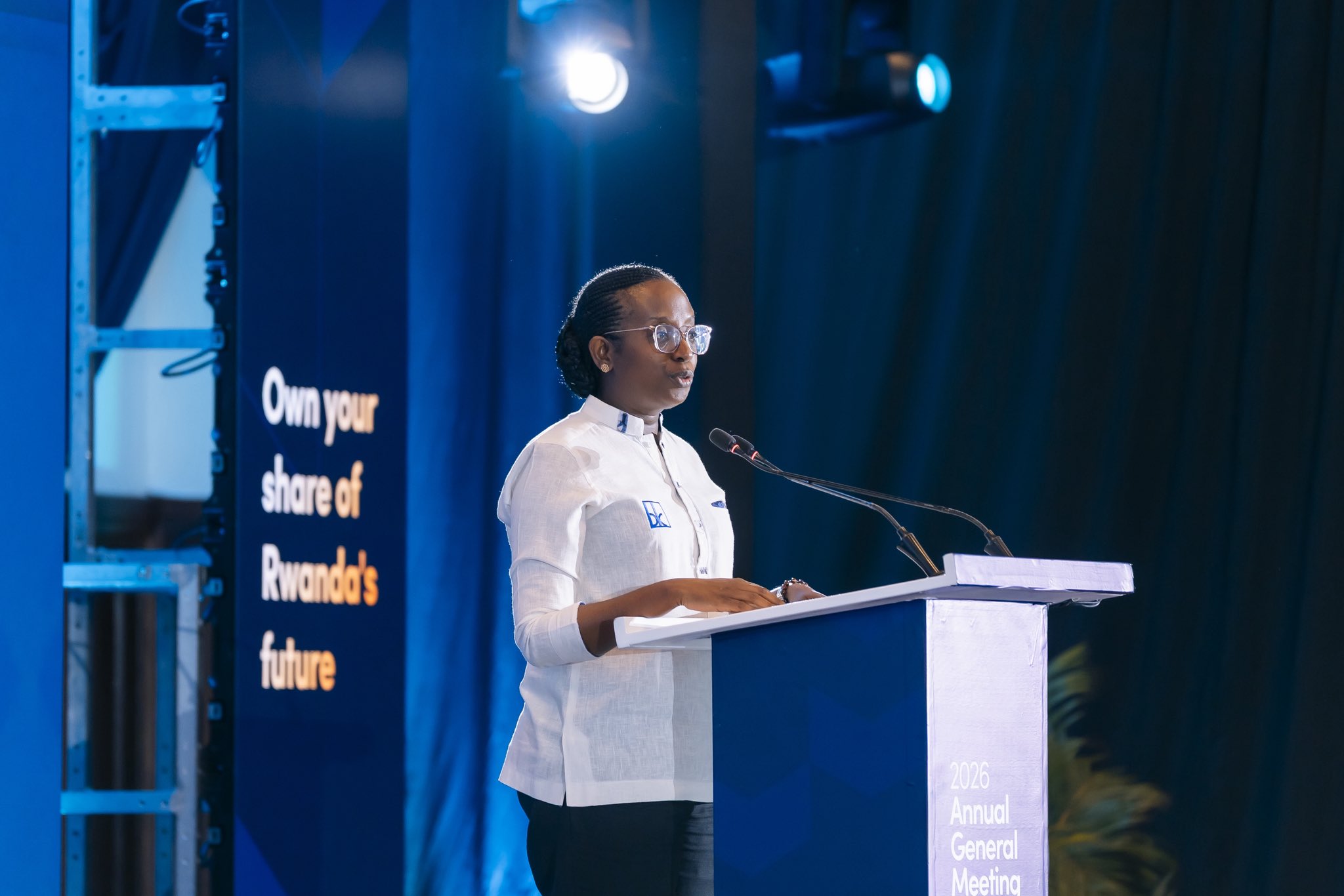
Dr. Diane Karusisi, Chief Executive Officer of the Bank of Kigali, set the tone early by challenging shareholders and institutional investors to look past the bank’s stellar 2025 performance.
“This afternoon we are shifting the conversation. It’s no longer about the past, it’s about the future,” Dr. Karusisi declared.
Dr. Diane Karusisi at the 2026 BK Investor Forum
She noted that while banking sector loans successfully built Rwanda’s manufacturing, mining, and real estate sectors over the last two decades, the next 60 years demand a fundamental shift toward capital markets.
“The growth we are seeing in Rwanda is small, but we see more growth opportunities on the continent,” Karusisi stated, pointing to major regional infrastructure projects like upcoming refinery builds in East Africa.
“We want capital markets to be able to support us, provide the information, so we can channel our savings into these productive investments that are going to transform the continent.”
To frame this continental reality, the forum turned to Dr. Monique Nsanzabaganwa, a seasoned economist, Board Member at AfriCatalyst, and former Deputy Chairperson of the African Union Commission.
In her keynote address, Dr. Nsanzabaganwa connected local banking strategy directly to systemic continental reforms, including the recently endorsed G20 Africa Expert Panel Report, the Africa Forward Summit in Nairobi, and recent global meetings in Kigali.
“Today, we are not here to be told what BK Group has done,” Dr. Nsanzabaganwa told the room. “We are here to ask what Rwanda and Africa are now ready to finance… Africa’s time is here and capital has noticed.”
Drawing on her decades of experience leading Rwanda’s ministries of trade and economic planning, as well as the National Bank of Rwanda, Dr. Nsanzabaganwa brought a clear-eyed data perspective to the forum.
While the African Development Bank (AfDB) projects East Africa to lead the continent with a resilient 4% growth rate this year, she bluntly reminded attendees that this is less than half of what the African Union’s Agenda 2063 mandates.
The Diagnosis: A Channel Problem, Not a Money Problem
Dr. Monique Nsanzabaganwa
Dr. Nsanzabaganwa directly challenged the prevailing narrative that Africa suffers from an inescapable $1.3 trillion annual “financing gap.” She argued that while the number is correct, the framing is incomplete because Africa does not have a capital problem, it has a channel problem.
To back her thesis, she highlighted the unprecedented scale of domestic capital already sitting inside the continent. There is 4 trillion dollars in combined financial capital within African pension funds, insurance firms, commercial banks, and household savings.
An additional 1.5 trillion dollars is retrievable through taxation efficiencies, curbing illicit financial flows, carbon markets, and diaspora bonds. Furthermore, diaspora remittances reached 90 billion dollars in 2023 alone, consistently outperforming foreign development aid, which fell by 28% in 2025.
Despite this massive 4 trillion dollar pool, strategic asset allocations remain skewed toward short-term, low-risk sovereign papers rather than productive sectors. Dr. Nsanzabaganwa blamed unfair risk premiums driven by international financial regulations and conventional credit ratings.
As a result, African infrastructure projects face excessively high capital charges despite a remarkably low average default rate of just 1.9%—compared to 4.6% in Western Europe and up to 12% in Eastern Europe.
Five Key Pillars for Continental Scale
With 12 to 15 million young Africans entering the labor market annually and the economy only absorbing 3 million, Dr. Nsanzabaganwa warned that an ecosystem overhaul is urgently required for regional stability. As head of the African Strategic Investment Alliance, she outlined five necessary interventions to accelerate inclusive growth.
The strategy requires systemic ecosystem interventions that integrate training, market access, and digital payments into a single pathway. It also calls for productive, long-term investments that shift capital directly into infrastructure and deeper industrial capacity.
To achieve true scale, the continent must build win-win partnerships through collaborative, cross-border investment platforms. This must be supported by the effective channeling of domestic financing to transform stagnant domestic savings into patient capital.
Finally, the blueprint demands the intentional inclusion of micro, small, and medium enterprises (MSMEs). This will bring grassroots, youth, and women-led enterprises—who currently face a 330 billion dollar annual financing gap—directly into formal value chains.
Rwanda’s Investable Value Proposition
Turning her focus to the host nation, Dr. Nsanzabaganwa highlighted Rwanda’s current economic performance as proof that structural discipline pays off.
In 2025, Rwanda recorded a staggering 9.4% GDP growth rate, adult financial inclusion hit 96%, and the banking sector crossed RFw 8.7 trillion in assets—growing 20% year-on-year with a robust capital adequacy ratio comfortably above 20%.
Acknowledging recent IMF Article 4 assessments, she was candid about macroeconomic hurdles ahead, including the critical need to rebuild fiscal buffers, deepen domestic revenue mobilization, and maintain exchange rate flexibility.
“Investors do not require a risk-free environment. They require a risk-understandable environment,” she remarked. “The story to investors in this room is not that Rwanda is perfect… the story is that Rwanda is honest about its position, disciplined about its choices, and consistent about its direction.”
The Challenge to BK Group
BK Group PLC investors
In her closing charge, Dr. Nsanzabaganwa placed a unique institutional responsibility on BK Group PLC as it steps into its seventh decade.
Now a powerhouse holding company spanning banking, insurance, digital finance, and capital markets with dual regional stock listings, the group must look beyond commercial banking.
She challenged BK Group and its shareholders to build the financial highway that converts Rwanda’s 96% financial inclusion rate into long-term, productive capital. This capital must service the African Continental Free Trade Area (AfCFTA), which is projected to boost intra-African trade by 10% to $230 billion this year.
“Capital follows confidence, confidence is built by institutions, institutions are made by choices,” Dr. Nsanzabaganwa concluded.
“The choice in this room today is whether Africa’s capital will be deployed by Africans into Africa for Africans at the scale our future demands. I believe it can be, I believe it must be, and I believe Rwanda is one of the markets where it will be.”