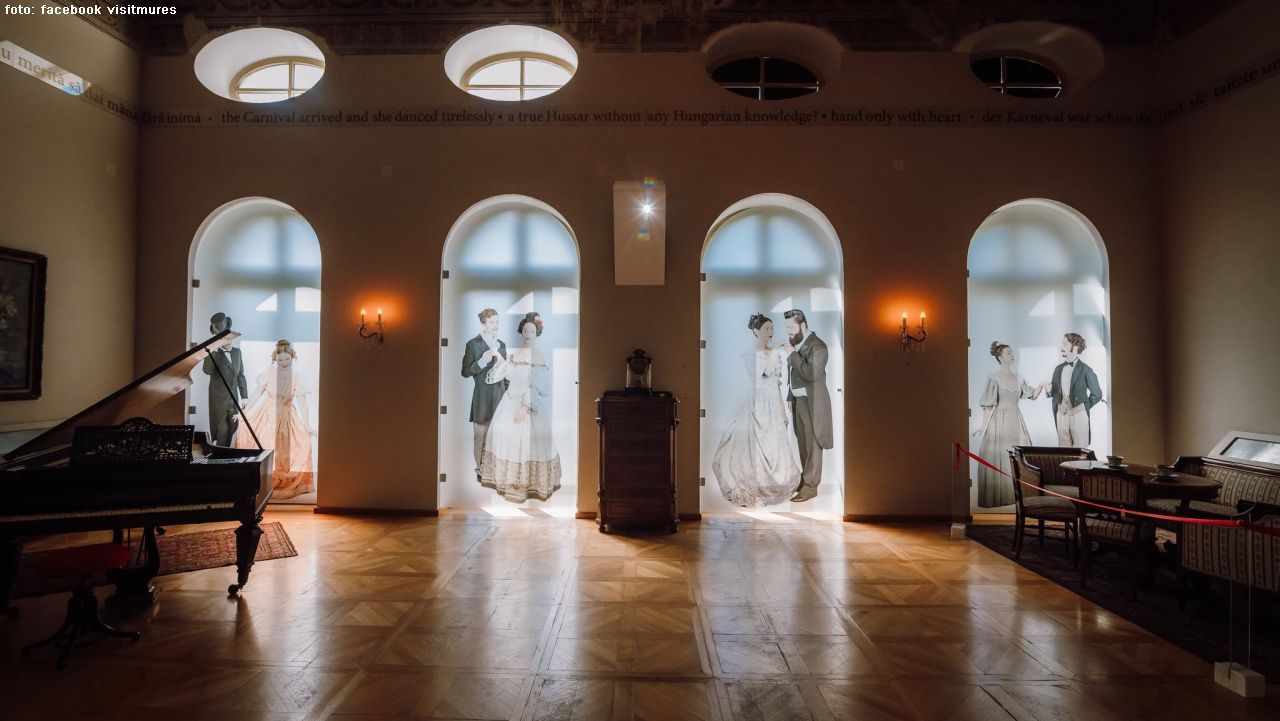
Transylvania is home to a remarkable collection of noble residences that draw visitors not only for their architectural significance, but also for the lesser-known stories of the families who once lived within their walls.
Castelul Rhedey sursa foto facebookvisitmures
Daniel Onea,
29.10.2026, 14:00
In Mureș County, two such historic landmarks offer contrasting glimpses into the region’s past: Bethlen Castle in the village of Criș, a Renaissance manor that has served as a setting for major film productions, and Rhédey Castle in Sângeorgiu de Pădure, where a love story began that would eventually connect a Transylvanian noble family to the British Royal Family.
Our first stop is the village of Criș, part of the Daneș commune, less than 20 kilometres from the medieval citadel of Sighișoara. Here stands the ancestral residence of the noble Bethlen family, a fortified complex featuring defensive walls, bastions and a striking arcaded loggia, built in the distinctive style of the Transylvanian Renaissance and recently revived through an extensive restoration programme. The Bethlen family played a prominent role in the political and military history of Transylvania. Visitors entering the castle can still see the family coat of arms carved into its stonework. The origins of the emblem blend local legend with authentic medieval history. Zólya Levente, archaeologist and castle custodian, explains the connection:
“According to legend, members of the family defeated a man-eating serpent that lived in the marshes and later adopted the serpent as their heraldic symbol. In some respects, history mirrors the legend. The family has used this coat of arms since the mid-15th century. At that time, the head of the family, Gergely Bethlen, took part in King Sigismund’s military campaign in Northern Italy, where he fought against the armies of the Sforza and Visconti families. The Visconti coat of arms also featured a serpent, remarkably similar to ours, holding a child in its mouth. In effect, they defeated the ‘man-eating serpent’ and adopted its emblem. It is a fascinating story.”
The authentic architecture of Bethlen Castle, together with its inner courtyard and imposing defensive walls, has attracted filmmakers from Romania and abroad for decades. Productions filmed here have ranged from classic Romanian historical epics, such as Mihai Viteazul, to projects backed by major Hollywood studios. Some of the sets created specifically for filming have been preserved and today form part of the visitor experience.
“In the basement there is a prison where, before noticing anything else, I invite visitors to touch the bars and discover what material they are made from. That is one of the castle’s mysteries. Numerous productions have been filmed here. Director Sergiu Nicolaescu shot four or five films at the castle, and projects continued long after 2000. In this very prison, in 2011, Universal Pictures housed werewolves during the filming of Werewolf: The Beast Among Us. I am convinced the castle never originally contained such a prison, because it was a family residence rather than the administrative seat of a county, where dozens of prisoners might have been held. Nevertheless, we decided to keep the set because it looks intriguing and certainly gives visitors something to think about.”
Beyond its fortified buildings, the estate at Criș was once renowned for its landscaped gardens. Historical photographs and archival records show that the grounds once included a large park populated even by exotic species of plants. Zólya Levente outlines the history of this remarkable green space.
“The park surrounding the castle covers almost three hectares. Fortunately, some of the original trees from the 19th-century English garden have survived. At one point, a gardener from the Imperial Court in Vienna was brought here, which demonstrates that this was no ordinary garden. In one photograph of the estate, palm trees and banana plants can clearly be seen. I have no idea how they managed to grow them in this climate, but the gardener must have been exceptionally skilled. I also know that an orangery once stood behind the castle.”
Elsewhere in Mureș County, on the banks of the Târnava Mică River in the town of Sângeorgiu de Pădure, stands Rhédey Castle. Unlike the fortress at Criș, this building was never intended for military purposes. Instead, it was designed as an elegant and comfortable noble residence, typical of the early 19th century. Visitors can explore its history through holograms, virtual reality headsets and multimedia installations as they move through the twelve themed rooms of the exhibition The Mysteries of the Rhédey Residence. The exhibition was developed with European funding following extensive historical research. At its heart lies the life story of Countess Claudia Rhédey, whose romance with Duke Alexander von Württemberg defied the social conventions of the era. Gaspar Peter, a guide at the castle, explains how the story began.
“Claudia Zsuzsanna Rhédey was born in this castle on 17 September 1812. It served as the family’s summer residence, while their permanent home was in Cluj. She was baptised and confirmed here, and she is buried in the crypt beneath the Reformed Church across the road. She was a remarkably beautiful young woman who received an excellent education. At the age of seventeen, while living in Cluj, she became seriously ill. The doctors there saved her life, but her parents decided to send her to Vienna, where Europe’s finest physicians were practising at the time, so that she could fully recover. The Viennese doctors prescribed horseback riding as part of her treatment. During one of those rides, according to her diary, she noticed an intriguing young man: Alexander von Württemberg, one of the princes of the Kingdom of Württemberg in Germany. It was love at first sight. They wished to marry, but the prince’s family regarded the Rhédeys as being of lower rank and strongly opposed the match.”
Despite the initial opposition, the couple married in 1835. Following the marriage, Claudia Rhédey was granted the title of Countess of Hohenstein, although their children were excluded from the line of succession to the Württemberg throne. Her life ended tragically in 1841, when she died in a riding accident at the age of just 29. Through her descendants, however, the family from Sângeorgiu de Pădure became part of European royal history. Claudia Rhédey’s granddaughter, Mary of Teck, went on to become Queen of the United Kingdom as the wife of King George V. She was also the great-grandmother of the current British monarch, King Charles III, who has himself visited Sângeorgiu de Pădure to pay tribute to his Transylvanian roots.
Today, both castles in Mureș County are open to visitors, offering a chance to discover the architecture, legends and noble heritage that have shaped the history of Transylvania across the centuries. (VP)