Banat is preparing to become a European Region of Gastronomy. At the same time, our everyday choices are increasingly shaped by climate change or, conversely, can have a profound impact on the environment.
Реміснича гастрономія «La pas»!
Ana-Maria Cononovici,
27.10.2026, 14:00
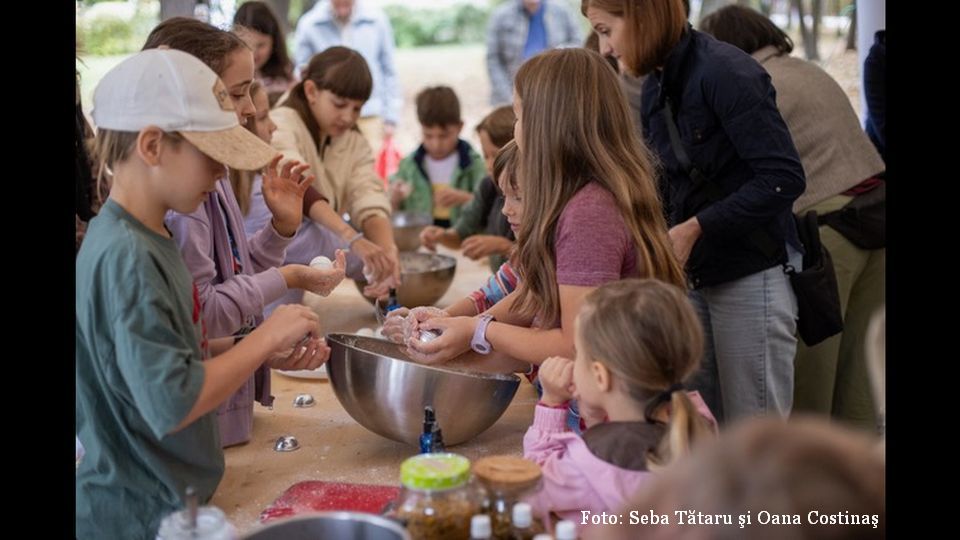
Against this backdrop, Timișoara’s La Pas Festival celebrated its sixth edition this October. These were the ingredients brought together in the garden of the French Cultural Institute in Timișoara, the host venue for this year’s festival.
The European Climate Pact community took part through a series of discussions examining the pressure food systems place on planetary boundaries and exploring ways to encourage more responsible consumption habits. Visitors also had the chance to try the Climate Wheel, an engaging quiz for both children and adults that helps participants understand which everyday decisions are influenced by climate change and which, in turn, can significantly affect the environment. On this occasion, gastronomy served as a starting point for conversations about how food is produced and consumed, its connection to local identity, and the relationship between these issues and the effects of climate change.
Teodor Frolu, founder of the Creative Traditions platform and a member of the European Climate Pact team, helped us better understand the link between gastronomy and the environment:
“Very often, when we think about the European Climate Pact, we tend to focus on issues such as global warming, pollution and environmental degradation. Yet one of the major environmental challenges is intensive agriculture. On the one hand, there is the industrialization of farming, with fertilizers that, often without us realizing it, have a significant impact on groundwater and environmental quality. On the other hand, we are witnessing food production that is sometimes excessive. Too much is purchased, far less is consumed, and enormous quantities end up being thrown away. Rather than making more efficient use of natural resources, all these processes contribute to their depletion. This is why the idea of relying on so-called short food supply chains, local products, seasonal produce, and artisan goods made in much smaller quantities at a local level, offers an alternative to food that is transported from one corner of the world to another without taking into account the environmental impact it generates.”
Teodor Frolu added:
“For many years, the La Pas Festival has championed local products, local producers and artisan food production. This year, it brought the European Climate Pact into the spotlight as an important theme linked to the traditions upon which this Timișoara festival was built. As the name itself suggests, ‘La Pas’ is an invitation to return to a more balanced pace of life, an invitation to slow down and enjoy the things that life, nature, our communities and our interactions with others have to offer. I believe it provides a particularly interesting starting point, one that encourages us to appreciate the beautiful things around us. Beginning with gastronomy, it extends into areas such as art, craftsmanship and nature-based experiences offered by various organizations and by some of the most interesting places in and around Timișoara.”
The event also saw the launch of a new call for Local Gastronomic Points seeking to earn the title of LPG, Guardian of Creative Traditions. The deadline for registration on the traditiicreative.ro platform is 31 October 2026. The title of LPG, Guardian of Creative Traditions, recognizes initiatives that demonstrate how local gastronomy can become a living cultural expression and a valuable community resource through a creative interpretation of the relationship between food, heritage, people and places, without reducing heritage to a mere tourist attraction or an idealized image of the past.
Teodor Frolu also highlighted some of the festival participants:
“Participants included Local Gastronomic Points from the Hațeg Country region, organizations such as Rewilding Europe, whose work has led to the reintroduction of bison and other species once lost from Romania’s biodiversity into certain areas of the country, as well as a wide range of producers. Among them were Grădina Culorilor, whose cheeses have won awards in France, alongside small-scale jewelry makers and beekeepers. It was a remarkably diverse gathering in a beautiful setting, the garden of the French Cultural Institute.”
Banat secured the title of European Region of Gastronomy for 2028 following a complex evaluation process conducted by specialists from the International Institute of Gastronomy, Culture, Arts and Tourism. The designation involves the implementation of a dedicated programme aimed at promoting the region’s tourism potential and supporting sustainable economic development through the multicultural gastronomy of its three counties: Timiș, Arad and Caraș-Severin. The project’s main pillars include supporting small producers and the HoReCa sector, shortening supply chains, promoting slow tourism, strengthening urban-rural markets, and advancing educational initiatives and campaigns focused on health and biodiversity.
Our interviewee also noted that those interested in becoming involved with the Climate Pact can apply via the European Climate Pact website until 31 October, as the selection process for new European Climate Pact Ambassadors is currently open. (VP)