Eid celebrations for students connected to conflict-affected regions are being reshaped by travel disruptions, with many in Qatar finding ways to stay connected and maintain traditions from afar.
On the first day of every Eid that Jana has spent in Lebanon, her great-aunt’s house fills with her father’s extended family and traditional dishes.
Jana, a first-year student at the American University of Beirut, said her family usually travels from Qatar to Lebanon for the holiday, even though she studies there during the year.
The houses are packed, she said, and she usually forgets the faces of those she has already greeted.
Jana said she is willing to travel from university to her grandmother’s home to see her immediate family. She also asked her uncle to drive her two roommates to their families, as they had no other way to get there.
“It’s such an important day,” Jana said. “We’re all trying to make it work as much as possible.”
This will be the first Eid Jana celebrates without her parents and younger brother. Travel disruptions have forced her parents to observe the holiday from Qatar.
“I’m just going to spend the whole day on call with them to make up for it,” Jana said. She added that this Eid will be quieter, with fewer family members around.
For university students who grew up in Qatar but whose families live in conflict zones, Eid has been affected by regional instability and travel disruptions. Flight cancellations and airspace closures have affected hundreds of international flights, including those operated by Qatar Airways, leaving many students unable to return home or join extended family gatherings.
According to the World Health Organization, conflict and displacement can worsen anxiety, depression, and post-traumatic stress among people exposed to prolonged stress or separation.
For this generation, the holiday has become less about reunion and celebration and more about maintaining connection from afar while coping with the emotional weight of insecurity and distance.
Students in Qatar
Rand, a Lebanese student living in Education City dorms in Doha, usually celebrates Eid in Lebanon with prayers, visiting relatives, and connecting with family abroad. Travel disruptions mean this will be her first Eid spent away from her family.
“Being in a country that’s relatively safe while my people and my family are back home struggling is one of the heaviest feelings I have ever felt,” she said.
“I’m always checking the news, texting them, asking if they’re okay,” Rand said. “I have lived this war in 2024 and I know how it feels.”
She said she plans to celebrate Eid quietly and gently, respecting those affected while maintaining her own traditions from afar.
Research shows that survivor’s guilt, the feeling of distress from being safe while others suffer, is common in people connected to traumatic events and is often linked to anxiety, grief, and post-traumatic stress.
From February 28 to March 3, 2026, 1,128 of 1,306 flights at Hamad International Airport were cancelled, according to the Oman Daily Observer.
Zachary Wright, associate dean for faculty affairs at Northwestern University in Qatar and professor in residence of history and religious studies, said he recently went out despite his anxieties to do some Eid shopping for his children.
“I was surprised to find the malls very full and most people getting ready for the end of Ramadan as normal,” he said.
He added that while he could not comment on the wisdom of shopping during heightened security tensions, the experience reminded him that Eid remains a time of celebration and gratitude.
“The core blessing of Eid can never be denied,” Wright said. “We are blessed to be alive, blessed to have loved ones, blessed to have community, blessed to have provision. We are thankful this Eid as any Eid.”
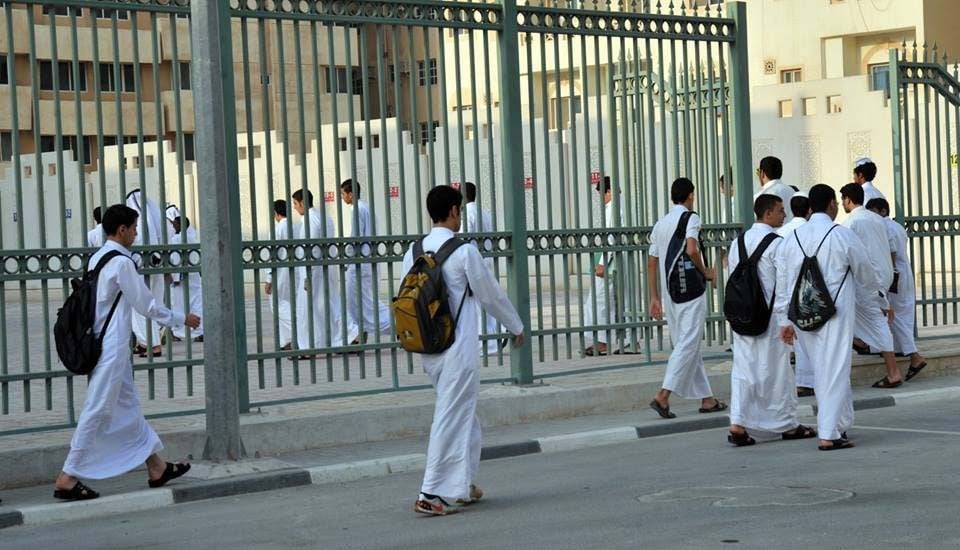
Lolwa Al-Misned, a Qatari student at Northwestern University in Qatar, said Eid is usually spent going door to door to visit family.
“It’s one of our most beautiful traditions. This year, we don’t know how that will happen. Especially if we get an alert while we are on our way, it will be difficult to find a place to shelter in a short amount of time,” she said.
Instead, she and her family are planning a smaller gathering at home with close relatives who live nearby. “It definitely won’t be the same, but we are still going to do the best we can to celebrate in a safe way for everyone.”
“There are days, especially when I hear about what’s happening back home, I feel almost undeserving of this safety,” Hadi Zamzam, a Lebanese computer engineering student in Qatar, said. “I’m very grateful for the safety I’m living in and the fact I’m not entirely worried that something will hit the roof of our apartment.”
“What do I have over the martyrs in Lebanon, and I’ll expand this to those in Palestine and Sudan and Yemen and Congo and Syria, other than sheer geographical luck?”
Haya, a Palestinian student living in Qatar, said Eid remains important despite the ongoing challenges. “I do think Eid should be celebrated regardless. It’s more about spending time with your family after a really long month of fasting,” Haya said.
At the same time, she acknowledged the disparities in experience. “I understand why some people would say that Eid shouldn’t be celebrated for the sake of less privileged people,” Haya said. “A lot of the mosques in Gaza have been destroyed. Their Eid is basically a celebration of longing and loss.”
For the majority of Ramadan, Jana has been in her dorm room at AUB in Beirut for her safety.
“Ramadan, to me is iftar with the family, and setting the table and sitting together,” Jana said. “I didn’t really get to have that this year. That’s why I’m really trying to make Eid work.”
“We’re resilient for a reason, and it’s not a good reason,” Jana said.
Ibrahim Abusharif, a professor at Northwestern University in Qatar whose research focuses on religious studies and the decolonisation of storytelling, said that for people experiencing displacement or instability, Eid can take on an even deeper meaning.
“For people living through displacement or instability, Eid offers a needed sense of grounding,” Abusharif said.
Pako Elseehy is a student journalist at Northwestern University Qatar whose reporting focuses on sports, human-interest stories, and visual storytelling through photography.
Aliya Dinderbay is a student journalist at Northwestern University Qatar whose reporting focuses on lifestyle, fashion, and human interest stories.