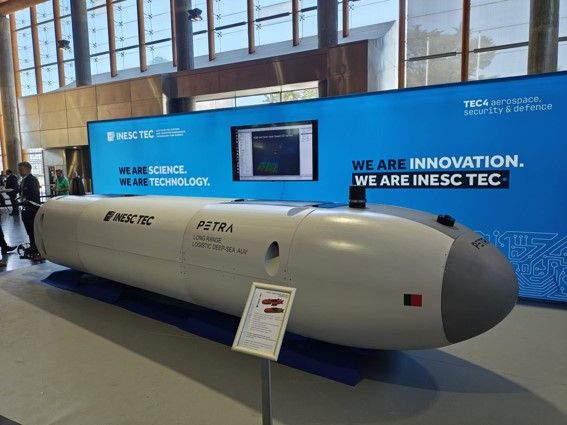
The development of the underwater robot PETRA by INESC TEC is one of them. However, the more I think about this technology, the more I become convinced that it represents something much greater than a scientific advance. It represents an opportunity for Portugal to occupy a strategic space in an economy that is being born underwater.
I immediately remembered a conversation I had earlier this year during the SIS2026, in Cascais. At that time, there was talk of a problem that rarely reaches the public debate. Portugal has a privileged geographical position in the Atlantic, receives more and more investment in digital infrastructure, data centres, and international connectivity, but still lacks a robust capacity to monitor and intervene quickly in submarine cables and other critical infrastructures located on the seabed.
The topic gains even more relevance when we realise that the digital economy depends much less on what we see and much more on what we do not see. When we talk about cloud, artificial intelligence, data centres, financial transactions or global communications, we are really talking about physical infrastructures spread across the ocean. Submarine cables are now as important to the world economy as motorways, airports or electricity grids. Without them, much of the modern world simply stops.
The question I ask myself is simple: are the data industry, telecommunications operators and large investors in digital infrastructures already looking at this? Because they should be. The world is increasingly concerned about the security of critical infrastructure. Incidents in recent years in various regions have shown that submarine cables are no longer just a technical issue but a strategic, economic and even geopolitical issue.
Portugal has been positioning itself as an Atlantic gateway to the new digital economy. There is talk of data centres, artificial intelligence, new data corridors and large international investments. All of this is positive. But building is only half the work. Protecting and monitoring will be increasingly important. And perhaps it is precisely here that an unexpected opportunity arises for the country.
For decades, we looked at the sea as a space linked to tourism, fishing or ports. The twenty-first century is changing that reality. The sea has become a technological platform. It is where data, energy, and critical infrastructure that sustain the global economy circulate. In a country that has one of the largest maritime areas in Europe, perhaps the time has come to think of the ocean not just as a geographical boundary, but as a technological and strategic asset.
PETRA may just be a robot in development. But it can also be a sign of something bigger. A sign that Portugal has the capacity to create relevant technology on an international scale and that the economy of the future may pass through both national laboratories and the Atlantic fund. At a time when the country is looking to assert itself in the new digital economy, it is perhaps important to realise that the competitive advantage will not only be in the data that circulates through the cables, but also in the ability to protect, monitor and manage the infrastructures that make it possible.