Keep our news free from ads and paywalls by making a donation to support our work!
Notes from Poland is run by a small editorial team and is published by an independent, non-profit foundation that is funded through donations from our readers. We cannot do what we do without your support.
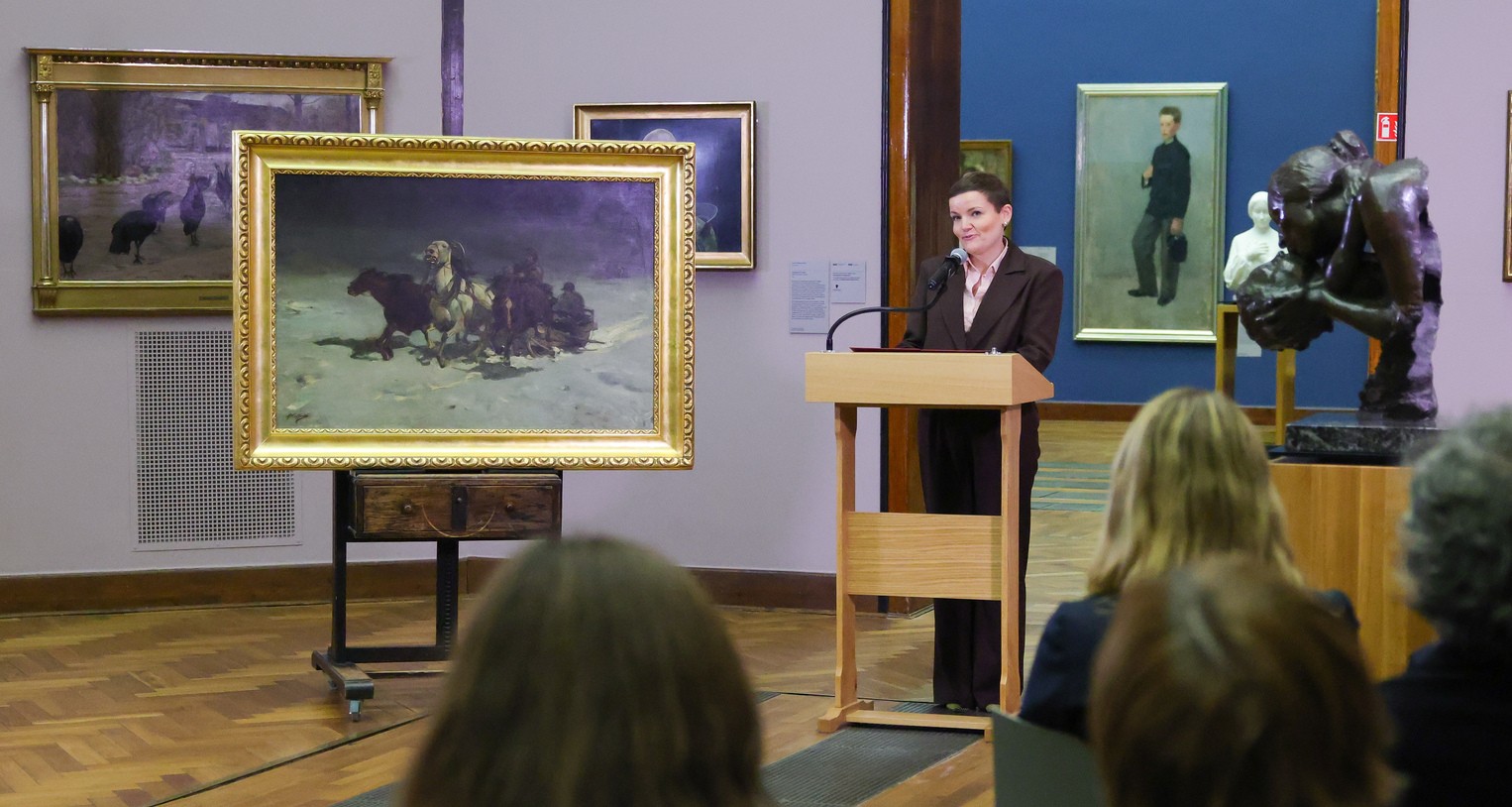
A Polish painting looted by Nazi Germany during World War Two, and which once hung in an SS officers’ club, has been returned by its owner, who donated it to the National Museum in Warsaw.
“History is coming home,” said culture minister Marta Cienkowska, celebrating the return of Alfred Wierusz-Kowalski’s Winter – Napoleon’s Retreat from Moscow, which she described as “one of the most significant wartime losses in Polish painting”.
Her ministry is responsible for seeking the return of tens of thousands of artworks and other cultural items that were looted during the war and remain unaccounted for.
Kolejny sukces restytucyjny! Odzyskaliśmy jedną z cenniejszych i najbardziej znanych strat wojennych malarstwa polskiego. Obraz „Zima – Odwrót Napoleona spod Moskwy” Alfreda Wierusza-Kowalskiego trafił dziś do zbiorów Muzeum Narodowego w Warszawie.
To efekt naszej współpracy z… pic.twitter.com/Y0wDIBgIGG
— Ministerstwo Kultury i Dziedzictwa Narodowego (@kultura_gov_pl) September 28, 2026
Wierusz-Kowalski, who was active in the late 19th and early 20th centuries, was a renowned realist painter whose work often featured animals alongside people. His Winter – Napoleon’s Retreat from Moscow had, by the 1930s, become part of the collection of Andrzej Rotwand, a wealthy banker and industrialist.
In June 1939, it was featured in an exhibition organised by the Society for the Encouragement of Fine Arts in Warsaw, which occupied the building that is now the famous Zachęta National Gallery of Art.
However, the exhibition was brought to an abrupt end when Nazi Germany invaded Poland on 1 September 1939. The works on display, along with other items from the gallery, were seized by the occupiers, with many used to decorate the offices and apartments of German officials.
Winter – Napoleon’s Retreat from Moscow was displayed in club for high-ranking SS and police officers located in Warsaw’s Blanka Palace. The same building also housed Warsaw’s German-installed commissioner, Helmut Otto, and mayor, Ludwig Leist.
No information has been released as to the fate of the painting in the immediate aftermath of the war. However, it eventually came into the possession of Ewa Tsonis, who has now handed it back.
Speaking at a ceremony in the National Museum in Warsaw, Tsonis said that her late father, Michał Stefan Koryzna, had purchased the painting in the 1960s from Desa, a major gallery and auction house, in the city of Kraków.
“I grew up with this painting. It was greatly appreciated and loved in our family,” she said. However, after recently conducting research into the painting’s history, she became aware of its provenance and notified the culture ministry.
Ewa Tsonis (right) alongside the painting with culture minister Marta Cienkowska (centre) and the director of the national museum in Warsaw, Agnieszka Lajus
Experts from the National Museum in Warsaw confirmed the identity of the painting, which remains in good condition and in its original frame. Tsonis then donated the work to the museum.
“Restitution is not possible without the cooperation of many people and institutions – both on the side of the state and on the part of the owners of the works,” said Cienkowska, who thanked Tsonis for her “incredibly responsible and civic-minded attitude”.
“Such attitudes are still rare but, because we constantly talk about restitution – we search for lost works and strive to recover them – we are increasingly approached by people who own lost objects and feel a sense of responsibility for cultural heritage.”
Cienkowska noted that the culture ministry has so far secured the return of over 920 works, with around 200 more restitution cases currently underway in 18 countries.
Germany has agreed to return to Poland a collection of 73 medieval documents that were looted during WWII.
The culture minister has hailed it as “the most important and valuable return of stolen cultural heritage in modern Polish history” https://t.co/GxHQ8A0jyr
— Notes from Poland 🇵🇱 (@notesfrompoland) December 1, 2025
However, that is still just a small fraction of the over 60,000 missing items listed in the ministry’s database of missing works, which includes seven further paintings by Wierusz-Kowalski.
Two other works from Rotwand’s collection – Italian Woman by Anna Bilińska and Mother with Children by Kazimierz Alchimowicz – were also hung in the SS officers’ club during the war and today remain missing.
Poland has in recent years stepped up efforts to secure the return of historical and cultural items looted during the German and Soviet occupations.
In 2022, it appealed to UNESCO for help in securing the return of cultural items that remain missing after being looted by Nazi Germany. It also launched a campaign seeking the return of thousands of items that ended up in Russia after the war.
Notes from Poland is run by a small editorial team and published by an independent, non-profit foundation that is funded through donations from our readers. We cannot do what we do without your support.
Main image credit: MKiDN (under CC BY-SA 4.0)
Daniel Tilles is editor-in-chief of Notes from Poland. He has written on Polish affairs for a wide range of publications, including Foreign Policy, POLITICO Europe, EUobserver and Dziennik Gazeta Prawna.