Your support helps us to tell the story
From reproductive rights to climate change to Big Tech, The Independent is on the ground when the story is developing. Whether it’s investigating the financials of Elon Musk’s pro-Trump PAC or producing our latest documentary, ‘The A Word’, which shines a light on the American women fighting for reproductive rights, we know how important it is to parse out the facts from the messaging.
At such a critical moment in US history, we need reporters on the ground. Your donation allows us to keep sending journalists to speak to both sides of the story.
The Independent is trusted by Americans across the entire political spectrum. And unlike many other quality news outlets, we choose not to lock Americans out of our reporting and analysis with paywalls. We believe quality journalism should be available to everyone, paid for by those who can afford it.
Your support makes all the difference.Read more
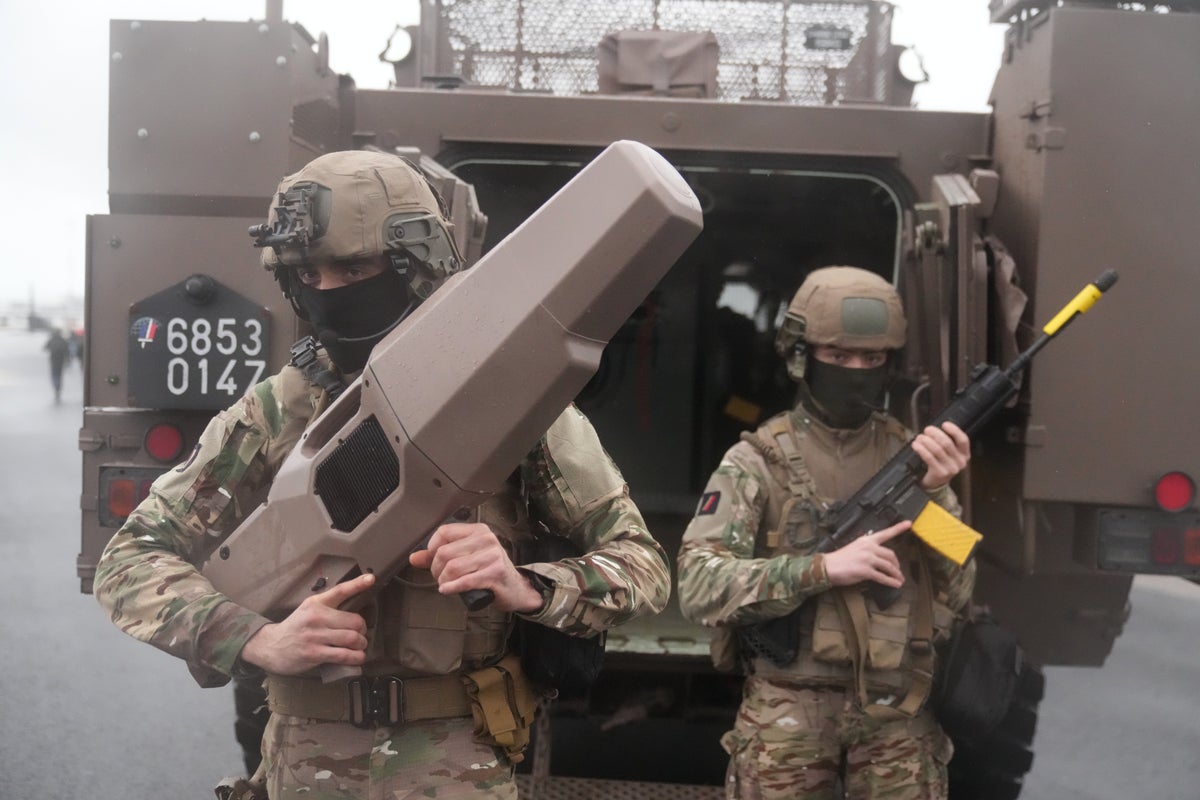
Five European nations have announced a new program to produce low-cost air defense systems and autonomous drones using Ukrainian expertise hard-won over the past four years of war against Russia.
Friday’s initiative of the E5 nations — France, Poland, Germany, the United Kingdom and Italy — comes as one of many European efforts to bolster defense along their borders, like a “ drone wall ” with Russia and Ukraine to better detect, track and intercept drones violating Europe’s airspace.
Both Moscow and Kyiv have cutting-edge drone warfare capabilities forged in the grim laboratory of war where battlefield innovations have rewritten modern battle tactics. Poland is already working with Ukraine on drone technology in joint military training programs and manufacturing projects.
Those efforts were sparked by a spate of incidents in which Europe’s borders and airports have been tested by rogue drones. Russia has been blamed for some of them but denies that anything was done on purpose or that it played a role.
“The UK and our E5 partners are stepping up — investing together in the next generation of air defense and autonomous systems to strengthen NATO’s shield,” said Luke Pollard, Britain’s minister for defense readiness and industry.
“We have some of the best kit on the entire planet for shooting down air threats. The problem is to be effective at shooting down relatively low-cost missiles, drones, and other threats facing us,” he said. “We need to make sure that we’re matching the cost of the threats with the cost of defense.”
Poland’s defense minister, Władysław Kosiniak-Kamysz, said the group of countries signed an agreement to jointly invest in the production and procurement of drone-based strike capabilities as well as cheap drone defense systems in a program called called Low-Cost Effectors and Autonomous Platforms, or LEAP.
“Combat technologies and techniques are changing rapidly — we must respond quickly and appropriately,” Kosiniak-Kamysz said. “We also signed a crucial commitment regarding the joint development of drone-based strike capabilities, low-cost joint production, and joint procurement of drone effectors, i.e, combat payloads, using artificial intelligence.”
When Russian drones entered Polish airspace in September 2025, Warsaw and its NATO allies used multimillion-dollar jets to respond to drones that cost thousands and that ended up crashing into the Polish countryside. Low-cost kinetic or electronic effectors would allow the detection and destruction of drones at a fraction of the price.
Europe has scrambled to arm itself in the wake of U.S. President Donald Trump’s deep criticism of NATO, European defense spending and once iron-clad alliances. The EU has ramped up spending and is openly questioning even deeper military projects.
“Europe’s security is more uncertain than it has been in decades,” said Kaja Kallas, the EU’s foreign policy chief, citing Russian aggression, instability in the Middle East, China and a “redefined” alliance with the U.S. She said that the low-cost interceptor program exemplifies the European commitment to its own security.
“If we want to keep our country safe, we must strengthen our hard power. The good news is that we are already investing record sums in defense. Europe is stepping up. but it’s not about competing with NATO. It’s about making Europe stronger within NATO. A stronger Europe makes the alliance also stronger.”
Yet the 32-nation military alliance has been shaken by Trump’s second administration. Most recently, his repeated threats to seize Greenland, a semiautonomous territory of NATO ally Denmark, and disparaging remarks about his NATO allies’ troops in Afghanistan drew another outcry.
While tensions over Greenland have subsided for now, the infighting has seriously undercut the ability of the world’s biggest security alliance to deter adversaries.
——
McNeil reported from Brussels.