
KHERSON, Ukraine – The past year, in the de-occupied Ukrainian territories of the Kherson region, has become a period of real terror from the sky for the civilians. Systematic drone attacks have become a round-the-clock phenomenon. In August and September, the Kherson region was attacked by Russian drones at an average of more than 2,500 per week. In just the first seven months of this year, 847 civilians were affected — 79 of them killed, according to the Regional Military Administration.
The Dnipro district and nearby villages are separated from Russian military positions only by the Dnipro River. This allows them to continuously shell areas from which Ukrainian forces drove them out in November 2022. Russians began using UAVs (unmanned aerial vehicles) on a mass scale a year ago, publishing their “hunts” on social media. The United Nations Independent International Commission of Inquiry on Ukraine qualifies this conduct as a “crime against humanity.”
Hunted from the sky
Sixty-six-year-old Tetiana Karmazina’s house is located close to the river. On March 30, 2025, she went outside to look for her dog. She did not hear the drone’s engine, but when she reached the nearest intersection, she noticed it above her.
“It was either on the roof of a house or on a tree — and as soon as I came out, it immediately took off. I saw a red light and immediately realized that a bomb would be dropped. And that’s exactly what happened,” recalls Tetiana.
The explosive fell directly at her feet. Her right foot was torn off, and her left was badly mangled by shrapnel. With her phone left at home, she had to crawl back.
“I probably crawled for an hour and a half. The dog came to me at the gate, didn’t recognize me, and started biting my hands. The gate was locked; I couldn’t open it for a long time.”
Her right leg was amputated below the knee. She is now preparing for a prosthesis fitting. Before the injury, Tetiana walked 10 kilometers every day — something she now greatly misses.
HUNTED DOWN. A screenshot from a Russian Telegram channel showing a person on a bicycle, who Anastasia recognized as herself. Screenshot from Anastasia Pavlenko
In September 2024, an image filmed from a drone appeared on a Russian Telegram channel: a person on a bicycle riding down a country road. The caption stated that a Russian operator had recorded a “Ukrainian Armed Forces soldier” before dropping a munition.
Twenty-four-year-old Anastasiia Pavlenko recognized herself in it. The woman had never served in the Armed Forces — she is a mother of two small children from Antonivka who had missed her bus that day.
“It took off from a roof and started chasing me. I turned my handlebars right and left. Then it realized there was a ditch on my right, meaning I could no longer turn that way. I steered left, and it flew aside, filmed me, and then dropped a munition.”
ATTACKED. Anastasia Pavlenko shows her wounded stomach. Photo from Anastasia Pavlenko’s personal archive
Anastasiia sustained a severe blast injury and underwent several operations to remove shrapnel. One fragment remained in her leg, forcing her to use crutches, and when the pain worsened, a wheelchair. Recently, doctors found another fragment in her lung.
The scale and methods of attacks
In the first seven months of 2025 alone, Russians used 16,322 strike drones of various types against the de-occupied territories of Kherson region. A total of 847 civilians were affected, 79 of whom died. Seven hundred sixty-eight people were injured, including 11 children. In August 2025, the intensity increased sharply — up to 2,500 drones per week. At night the drones use thermal imagers. Although Ukrainian forces shoot down 80 per cent of enemy drones, over the past month and a half, drone attacks have killed 15 people and injured 118. Prior to that, in the second half of 2024, 47 residents were killed and 578 wounded, including eight children.
Residents describe a double-strike tactic: drones often arrive in pairs. After one drone drops an explosive on a person, the second loiters to prevent anyone from helping the wounded. Because of this, emergency services cannot respond to calls quickly.
Sixty-five-year-old paramedic Oleksii Alferov knows this firsthand. On April 17, 2025, his crew responded to a call for a person struck by a drone. They placed the wounded person in the ambulance and set off for the hospital. They had driven roughly 300 meters when an explosion occurred.
TARGETING MEDICAL RESPONDERS. An ambulance in Kherson is damaged by explosives dropped from a drone. Photo from Oleksiy Alferov’s personal archive
“Most likely that drone was in waiting mode. It was a direct hit on the vehicle, into the passenger compartment. The car was destroyed, utterly ruined,” Oleksii says. The vehicle bore clear markings.
**
Since de-occupation in November 2022, regional authorities have evacuated more than 47,000 people from Kherson and surrounding districts.
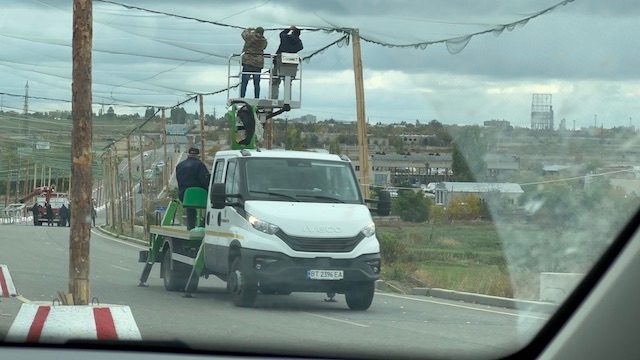
At the end of August 2025, Russians tried to paralyze the M-14 highway between Kherson and Mykolaiv, attacking civilian cars. Authorities deployed countermeasures, and traffic resumed, but nobody guarantees complete safety. Now, over 10 kilometers of highway as well as central streets of the city is covered by anti-drone nets, which gives limited protection.
UN findings: crimes against humanity
Until December 2024, the Kherson regional oncology dispensary operated in the area near the rover and served 34,000 cancer patients. But from autumn 2024, Russian UAVs began arriving regularly, hunting staff and patients. On November 26, 2024, a lab technician was killed. The team decided to relocate. “In their Telegram channels the Russians wrote that there were military personnel there,” says director Iryna Sokur. “But we never had anyone there except oncology patients. And our oncology patients are mostly elderly people.”
In May 2025, the United Nations Independent International Commission of Inquiry on Ukraine published a report concluding that Russian armed forces committed crimes against humanity in the form of killings and attacks on civilians with the intent of “spreading terror,” and “forcing thousands of people to abandon their homes.” The report notes that the public dissemination of video recordings of attacks and threatening texts announcing further strikes increased public fear, and that the online publication in Russian Telegram channels of footage showing the killing and wounding of civilians constitutes “a war crime in the form of an affront to human dignity.”
“I spent two and a half months in the hospital — every day, new victims of drones were admitted,” says Tetiana Karmazina. “For them this is the most exciting work — to make us break down, to make us beg, probably, for our authorities to give up Kherson. But we will not break down, we don’t want anything, we endure everything from them. And they strike only at civilians.” – Rappler.com
This article was prepared by The Public Interest Journalism Lab within The Reckoning Project, an initiative of Ukrainian and international journalists, analysts, and lawyers. Since March 2022, the team has been documenting and analyzing war crimes committed during the Russian war against Ukraine.


![[Two Pronged] Struggling to recover from the holiday blues](https://conven.org/wp-content/uploads/2025/12/Two-Pronged-Struggling-to-recover-from-the-holiday-blues.jpg)
