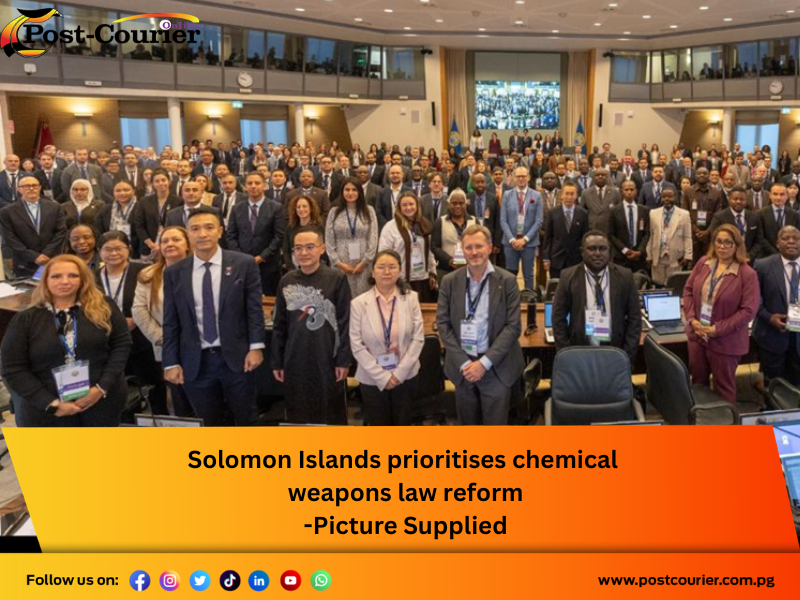
Solomon Islands has identified the enactment of comprehensive national legislation as its top priority in strengthening implementation of the international Chemical Weapons Convention.
The Government reaffirmed its commitment to the Convention during the 28th Annual Meeting of National Authorities, hosted by the Netherlands and organised by the Organisation for the Prohibition of Chemical Weapons (OPCW).
Solomon Islands acceded to the Convention on September 23, 2004, which entered into force for the country on October 23 that year.
However, the Government says existing national laws do not fully meet its obligations under the Convention, particularly in prohibiting chemical weapons-related activities, establishing penalties, strengthening enforcement powers and ensuring compliance with international reporting and verification requirements.
Existing legislation, including the Counter-Terrorism Act 2009, Customs and Excise Act, Pharmacy and Poisons Act and Environment Act 1998, provides a foundation for chemical safety, border controls, licensing and environmental protection.
The Ministry of Foreign Affairs and Trade coordinates implementation with relevant government agencies.
Solomon Islands has received technical and legislative assistance from the OPCW, including a review of its draft implementing legislation by the organisation’s Technical Secretariat in April 2026.
Its representatives have also participated in OPCW legal drafting and capacity-building programmes, while customs officers attended regional training in Brisbane in September 2025.
The Government has outlined six priorities to strengthen implementation, including completing and enacting national legislation, strengthening the National Authority, improving chemical declarations and reporting, and tightening controls over the import, export, storage and handling of relevant chemicals.
Other priorities include improving preparedness for chemical incidents and continuing to access OPCW technical and capacity-building support.
Solomon Islands also highlighted the work of its Unexploded Ordnance (UXO) Office and Explosive Ordnance Disposal Team in addressing unexploded ordnance left from the Second World War.
Potential chemical remnants have been confirmed at Alligator Creek, with the Government working with the OPCW to explore possible assistance for assessment and clearance.
National UXO legislation is also being developed, while the launch of the Information Management System for Mine Action (IMSMA CORE) in July has strengthened coordination, information management and public safety.
The Government said full implementation of the Chemical Weapons Convention was essential not only to meet its international obligations but also to protect national security, public health and the environment.
It reaffirmed its commitment to strengthening national institutions, improving coordination among government agencies and working with the OPCW and other States Parties to meet its obligations.
The Government’s stated implementation pathway is to draft, adopt, enact, operationalise and report on the required national measures.