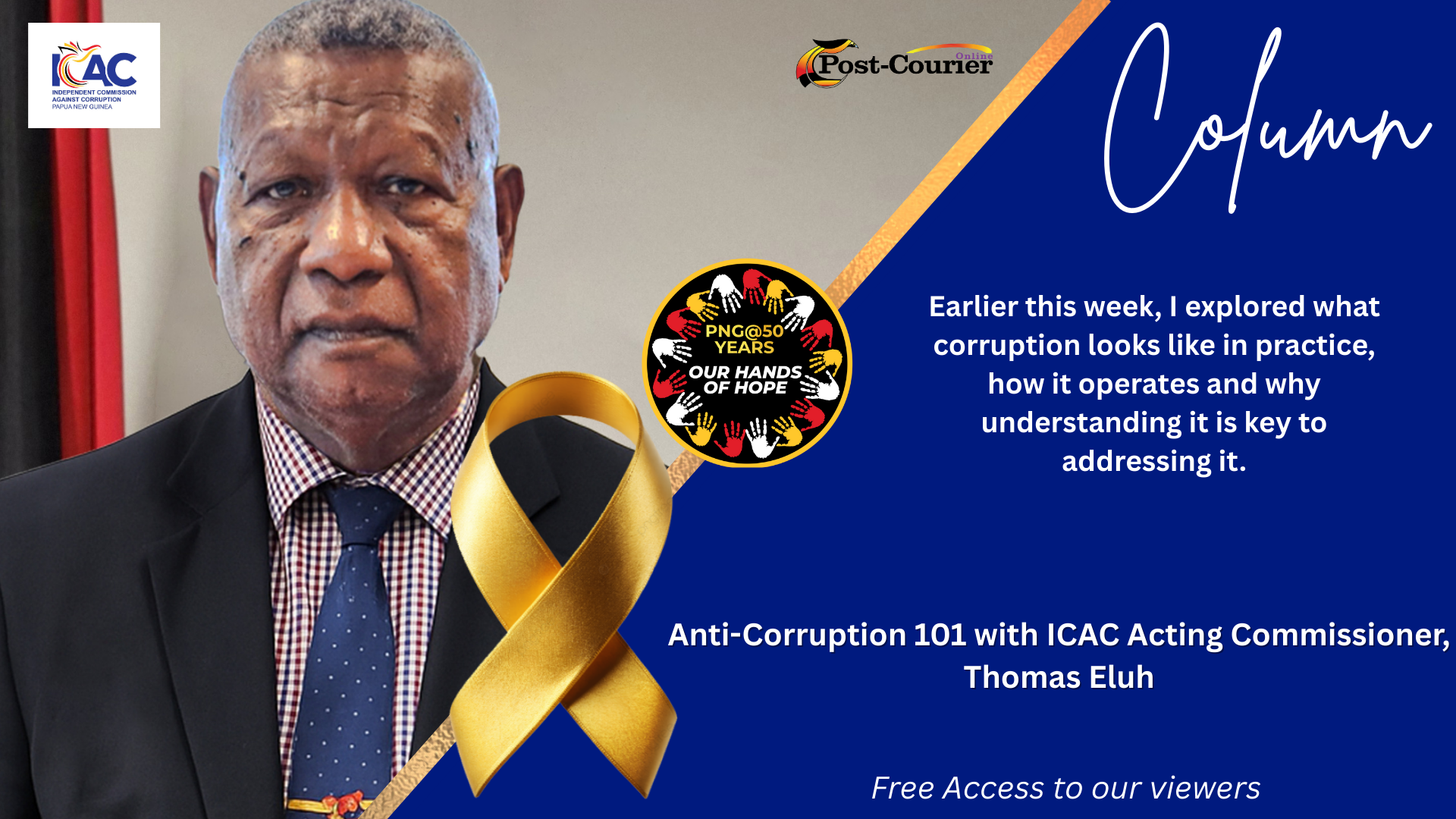
Earlier this week, I explored what corruption looks like in practice—how it operates and why understanding it is key to addressing it. Today, I want to focus on its real impacts in Papua New Guinea and why this fight demands collective responsibility.
Corruption Is Not a Distant Problem
Too often, corruption is spoken of as something far removed from everyday life—confined to government offices, boardrooms, or high-level transactions. But the truth is this:
Corruption affects every single one of us.
It is not limited to one sector. It spreads across many areas, creating a web of consequences that weaken the country and harm us, the people.
How Corruption Impacts Different Sectors
1. Leadership and Politics
When leaders entrusted to act in the public interest instead make decisions for personal or political gain, the consequences ripple across every sector. Policies become self-serving rather than people-focused, weakening institutions and eroding trust in democratic principles. This lack of integrity undermines governance, fuels corruption, and creates a culture where accountability is absent.
2. Economy: Business and Investment
Corruption discourages investors—both local and international. Small businesses face unfair competition when corrupt actors win contracts or licenses without merit. This slows job creation and limits economic growth. For a country like PNG, with enormous potential in agriculture, tourism, fisheries, and SMEs, corruption acts as a heavy anchor holding back progress. It distorts markets, raises the cost of doing business, and drives up prices, making life harder for ordinary citizens.
3. Loss of Revenue and Reputation
Corruption drains government revenue through tax evasion, money laundering, and fraud. Beyond financial loss, it damages PNG’s reputation and reduces confidence among partners and investors.
4. Law and Justice
When corruption infiltrates courts and law enforcement, justice is no longer guaranteed. Cases are delayed, manipulated, or dismissed, allowing wrongdoers to walk free while victims are denied fairness. Enforcement bodies such as the police become ineffective when resources are mismanaged or decisions influenced by bribery and favoritism. Instead of protecting citizens, these institutions risk becoming part of the problem, eroding public confidence and fueling frustration, sometimes leading to vigilante justice.
The Effects on Essential Services
Ultimately, the impacts of corruption are felt most by ordinary citizens in the services they rely on every day:
- When procurement processes are manipulated, roads and bridges meant for rural communities never materialize.
- When funds for school infrastructure disappear, students sit on bare floors in overcrowded classrooms.
- When health budgets are misused, clinics close and sick mothers and children walk long distances for basic care.
- When law enforcement lacks resources, communities suffer from unchecked crime and injustice.
These are not mere bureaucratic failures; they are direct consequences of corruption. And the ripple effect is devastating:
- Poor services deepen inequality, leaving rural and vulnerable communities behind.
- Frustration grows, eroding trust in government and institutions.
- A cycle of poverty takes hold, stalling national progress and limiting opportunities for future generations.
The Role of ICAC—and All of Us
The Independent Commission Against Corruption (ICAC) was established because the people of Papua New Guinea demanded change. But ICAC alone cannot fix this problem. Every citizen, every public servant, every business, and every leader has a role to play.
A Call to Action
The impacts of corruption are real, personal, and far-reaching. But so too is our ability to stop it. Together, we can build a nation where integrity becomes our strongest foundation—and where every kina spent truly benefits the people of Papua New Guinea.