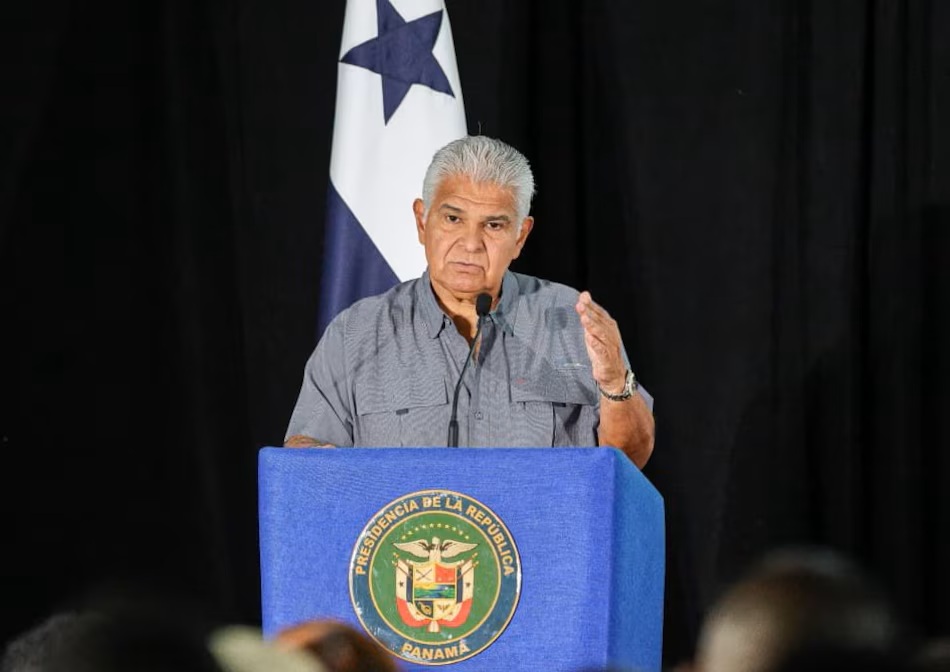
This Monday, August 31, President José Raúl Mulino stated that he was unaware of the reasons why the Panama Maritime Authority (AMP) restricted public access to information on all port concessions and other administrative processes in the maritime sector until 2036. “I respectfully ask you to reconsider that,” he wrote in X, referring to the controversial AMP resolution published in the Official Gazette on Friday, August 28. The resolution, although being made public now, is not new: it was adopted five months earlier by the board of directors of the AMP, chaired by lawyer and Deputy Minister of the Presidency, Virna Luque Ferro pictured below, a close associate of Mulino.
In fact, when Mulino was Minister of Public Security, between 2009 and 2014, she was the Secretary General of that ministry, until she was appointed Director of Customs (a position that kept her within Mulino’s sphere of influence). The contrast also occurs at a relevant time for the Panamanian port business, as the AMP is looking for an operator for three ports: Balboa, Cristóbal and Isla Margarita. Until last night, the resolution repudiated by Mulino (No. 12 of 2026) was still in effect, although the State Secretariat of Communication informed La Prensa that there would be imminent action: “Vice Minister Luque took note and the corresponding steps will be taken for greater transparency.”
The Deputy Minister and the Resolution.
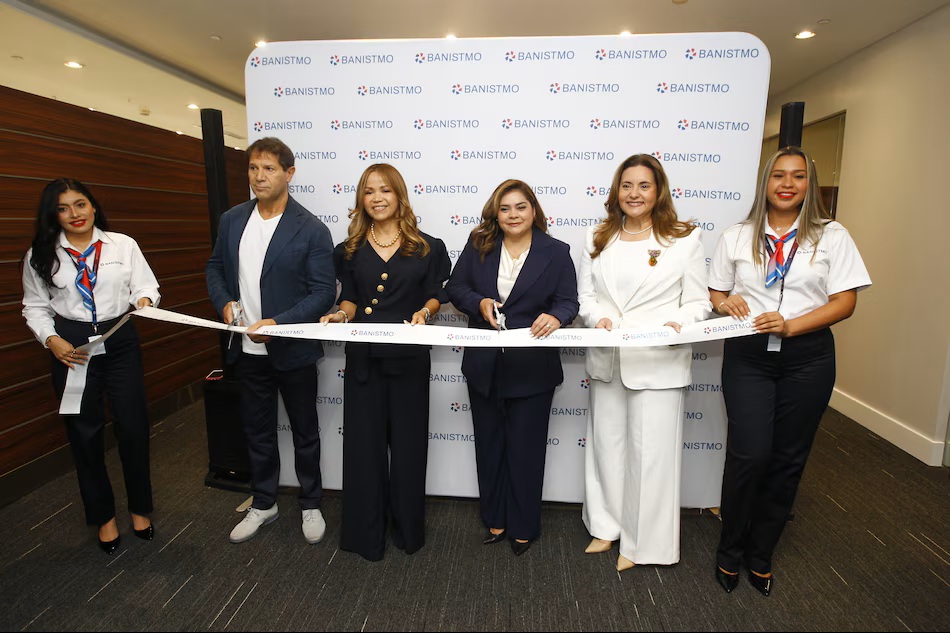
The resolution of the controversy bears the signature of Virna Luque Ferro, Vice Minister of the Presidency, and Luis Roquebert pictured below, administrator of the AMP. Because of the close relationship with Mulino, some doubt that the president was unaware of the AMP’s intentions. “We’re not buying this nonsense. Here is the signature of your Deputy Minister of the Presidency. I wonder why you don’t communicate with us,” said Representative Alexandra Brenes, who also called for Roquebert’s removal from office. “It’s time to replace him.” That opinion was supported by her colleague Janine Prado.
Luque pictured below is part of Mulino’s inner circle. She has held the position since July 1, 2024, when the president took office. She is a lawyer with master’s degrees in comparative law and maritime law. Her experience in the public sector includes serving as Secretary General of the Ministry of Security when the current president headed that ministry during Ricardo Martinelli’s administration (2009-2014), and she was a member of the Patriotic Union, a political group where she worked alongside Mulino. Her brother is Julio Luque Ferro, whom the president appointed as Panama’s ambassador to Bolivia.
Virna Luque Ferro pictured below, serves as the Deputy Minister of the Presidency of Panama under President José Raúl Mulino.
Background and Education.
Profession: Lawyer and political scientist.
Education: Law degree and a master’s degree in Maritime Law from Universidad Santa María la Antigua, plus a master’s degree in Comparative Law from the University of San Diego.
Key Public Roles.
Deputy Minister of the Presidency: Appointed in July 2024 alongside Minister Juan Carlos Orillac.
Past Positions: Director General of Customs, Director General of Foreign Policy at the Ministry of Foreign Affairs, and legal advisor to the Social Security Fund.
Mulino has always been involved in maritime law. He holds a master’s degree from Tulane University and practiced in this field as a founding partner of the law firm Fábrega, Barsallo, Molino y Mulino, which later became known as Fábrega, Molino y Mulino. The legal profession also stayed in the family. José Raúl Mulino Cohen, the president’s son, is a founding partner of Mulino & Mulino, a law firm specializing, according to its website, in maritime, shipping, and admiralty law. Verónica, Mulino’s youngest daughter, also works at the firm. The reservation approved by the AMP, therefore, occurs in an area that the president has known for decades, while his administration designs the future of the country’s main ports.
The Advisor Leading the Transition.
After the Supreme Court of Justice (CSJ) ruling that expelled Panama Ports Company (PPC) from Balboa and Cristóbal, the Executive placed the former administrator of the Panama Canal Authority (ACP), Alberto Alemán Zubieta, at the center of the transition process. Alemán Zubieta is one of the president’s star advisors, specializing in maritime and logistics development. He was appointed on June 10, 2024, along with Miguel Antonio Bernal, who focuses on constitutional matters; Alberto Vallarino, who handles financial issues; and Roberto Brenes, who is in charge of economic affairs.
Alberto Alemán Zubieta, advisor to the Executive Branch on maritime and logistics issues.
Alemán Zubieta also participated in the development project of the Barú port, in Chiriquí. On January 30, 2026, one day after the Supreme Court declared the PPC contract law unconstitutional, Mulino appointed him leader of a multidisciplinary technical team in charge of leading the transition in the ports of Balboa and Cristóbal. The presidential instruction sought to avoid improvisation in a process that the president himself described as strategic.
The Law Firm and One of the New Operators.
Another connection between Mulino’s circle and the port business involves lawyer Aníbal Galindo, who coordinated the transition team for the then president-elect in 2024. Galindo is a founding partner, since 1985, of the law firm Alemán, Cordero, Galindo & Lee (Alcogal), according to the biography published by the firm on its website. Incidentally, the website notes that he is currently on leave.
Anibal Galindo, advisor to President José Raúl Mulino.
Galindo specializes in corporate law, mergers, public tenders, and concession contracts. Alcogal represents APM Terminals Panama, a subsidiary of Maersk pictured below, a company to which the government awarded an 18-month contract to manage the port of Balboa, one of those previously operated by PPC. This is not the first time the firm has appeared on the side of a large-scale state concession. According to the history published on the firm’s website, Alcogal represented Kansas City Railway and Mi-Jack Products Inc. in the Panama Railroad concession contract. In conversation with news media, Galindo explained that his role as Mulino’s advisor does not correspond to a specific issue.
“The president usually asks his advisors for opinions and criteria on the issues that the president deems appropriate,” he said. Regarding his connection to Alcogal pictured below, he stated that he distanced himself from the firm after his appointment as advisor: “I do not participate in the management of any of the companies linked to Alcogal. Nor do I participate in legal matters at Alcogal due to my separation.” He added that, at 71 years of age, he is already retired from the firm and has not yet decided whether the separation will be temporary or permanent. Galindo highlighted a 45-year career in maritime issues, including the registration of ships and legal advice to Colón Container Terminal (CCT) for nearly four decades.
“We have been legal advisors for probably, that is, for 40 years on maritime issues,” he emphasized, but denied any presidential mandate in the AMP resolution that is now the focus of public attention. “I have not been tasked by the president with any maritime issues related to the government. Furthermore, the Balboa and Cristóbal issues have been handled by a commission appointed by the president, of which I am not a member. Consequently, I have no opinion on them and nothing to do with them,” he stated. “I have no conflict, I can assure you of that,” he added.
The State’s Seat on the PPC Board.
The relationship of the presidential entourage with the port business goes beyond the post-PPC transition. While the PPC concession was in effect, Mulino appointed Roberto Brenes, one of his economic advisors, to the company’s board of directors, through Executive Decree No. 439, dated July 25, 2024, replacing José Alejandro Rojas Pardini, who held that position during the government of Laurentino Cortizo (2019-2024).
Roberto Brenes, Financial Advisor to President José Raúl Mulino.
Brenes is a banker, coffee farmer, former president of the Panamanian Association of Business Executives (Apede) and former vice president of the Panama Stock Exchange.
The Ruling that Changed the Scene.
PPC operated the ports of Balboa and Cristóbal from 1997 until the full Supreme Court declared its contract unconstitutional. The ruling was unanimous and determined that Law 5 of January 16, 1997, which approved the PPC concession contract, violated eight articles of the Constitution. The ruling also annulled subsequent contractual addenda and two AMP resolutions from 2023 that had authorized extending the concession until 2047.
Port of Balboa, Located on the Pacific Side of the Panama Canal.
The sentence became final on February 23, after its publication in the Official Gazette, and left PPC without legal grounds to continue operating the terminals. The company, a subsidiary of Hong Kong-based CK Hutchison, initiated international arbitration against the Panamanian state and is claiming compensation exceeding $1.5 billion. On that same February 23, the Cabinet Council formalized temporary 18-month contracts with APM Terminals, a subsidiary of Maersk, to manage Balboa, and with Terminal Investment Limited (TiL), the port arm of Mediterranean Shipping Company (MSC), for Cristóbal. The Comptroller General of the Republic endorsed the temporary contracts. The scheme seeks to keep the terminals operational while the State defines the definitive concession model.
Five Ports, a New Dispute.
Mulino has already announced the next chapter of this story. During the Maritime Convention of the Americas 2026, and in other forums, he recalled that Panama is preparing the tender for five port terminals. Balboa and Cristóbal will be put out to tender separately once the transition process is complete. Isla Margarita pictured above, in the province of Colón, is expected to be put out to tender before the end of 2026, according to the schedule announced by the president. This process is complemented by Corozal and Telfers, two projects directly promoted by the Panama Canal Authority (ACP), on the Pacific and Atlantic sides, respectively. This means the country’s port map is in flux. It must be defined who will operate the main terminals, under what conditions, for how long, and with what obligations for the State and the concessionaires. It is in the midst of this process that the AMP decided to restrict for a decade public access to information on concessions, licenses, administrative investigations and commercial, contractual and technical documentation.
Audio transcript
Your browser does not support the audio element.
00:00
/
12:21