By Lyn Bishop
Founder of Quetzal Cacao
Finca Las Heliconias, Chiriqui, Panama
As growers plan new orchards, a 2026 study shows that Panama’s cacao is more diverse than many people realize
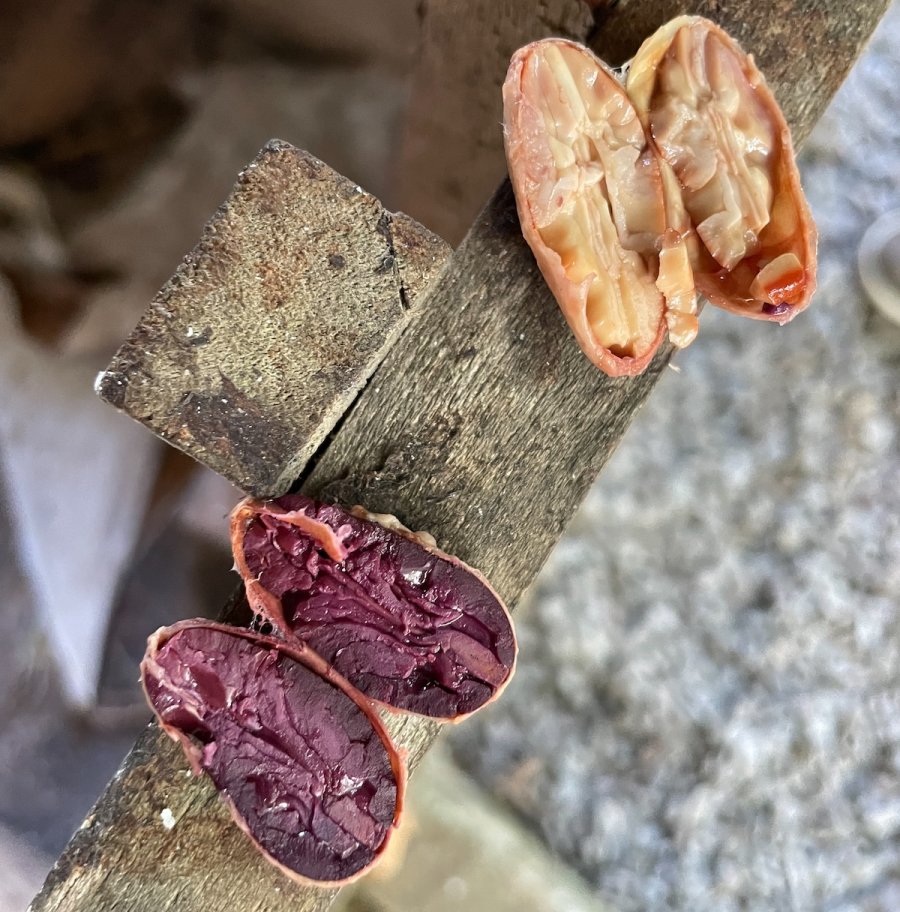
When we open a ripe cacao pod on my farm in Chiriquí, the fresh beans are covered in sweet white pulp. Inside, most are purple. In recent harvests, however, we are finding more beans with centers that range from soft pink to pale cream, and some are almost white.
These beans come from trees we planted five years ago using seeds from a living collection of local cacao. Over more than 50 years, a dedicated collector gathered cacao from Alanje, Divalá, and other parts of Panama. The trees we grew from those seeds are only now reaching maturity and showing us what the collection may hold.
Color alone cannot prove a tree’s ancestry. DNA testing is needed. Still, when a pattern appears across several harvests, it deserves attention.
A new genetic study gives Panama many reasons to look more closely.
Panama Is Entering a Cacao Rush
From where I stand in Chiriquí, Panama is in the early stages of what feels like a cacao gold rush.
Through our farm and consulting work, I am hearing from more growers who are considering cacao. They ask what to plant, how to establish an orchard, and how to handle the harvest. Nurseries, researchers, government agencies, and private growers are also paying closer attention.
The interest makes sense. Panama has watched its specialty coffee sector, including the rise of the Geisha variety, become one of the country’s best-known agricultural success stories. Many growers believe fine cacao could follow a similar path.
MIDA is developing a National Cacao Plan for 2025–2029 and promoting fine-flavor cacao, stronger production, and closer links between farms, processing, and markets.[1]
This new attention raises a question that will shape Panama’s cacao for decades:
What cacao will we plant?
Cacao Is Not One Uniform Crop
Most people meet cacao only after it has become chocolate. By then, beans from many trees, farms, or countries may have been mixed together.
In the field, the differences are easy to see. Pods vary in color, shape, size, and texture. Beans can differ in pigment, bitterness, acidity, fat, and flavor. Some trees produce heavily. Others produce less and may carry unusual qualities.
Genetics are part of the reason. Place and farm care also matter. After harvest, fermentation, drying, and roasting help determine which flavors reach the finished chocolate.
Coffee drinkers already understand this idea. Geisha does not taste like every other coffee. Cacao works in much the same way.
What Is Criollo Ancestry?
Criollo is one recognized genetic group within cacao’s larger family tree. It is closely connected with cacao cultivated in Mesoamerica long before chocolate became a global product.
Criollo beans often contain less purple pigment and may offer delicate flavors. The trees can also be less vigorous and more vulnerable to disease. Criollo ancestry carries possibilities as well as farming challenges.
Most cacao grown today has mixed ancestry. Finding cacao with very strong Criollo ancestry is unusual.
That is what makes the new research from Panama so interesting.
What Researchers Found in Herrera and Bocas del Toro
The study, published in July 2026, examined 80 cacao trees from 16 farms in Bocas del Toro and Herrera. Researchers tested DNA from the trees and compared it with established cacao reference groups.[2]
The cacao sampled in Bocas del Toro held a broad mixture of ancestry, reflecting a long history of local trees, introduced material, seeds planted by farmers, and grafting.
Herrera was different. Its cacao was mainly connected with Criollo and Amelonado. At one Herrera farm, five trees showed more than 99 percent Criollo ancestry in both their root and leaf samples.
In simple terms, their DNA was overwhelmingly connected with the Criollo reference group used in the study. The researchers described this strongly Criollo material as rare.
The finding does not promise extraordinary chocolate. It does show that Panama holds unusual cacao worthy of deeper study. These trees may help researchers learn more about flavor, local adaptation, disease response, and cacao’s history in Panama.
Panama may not have one cacao story. Different regions may hold different genetic histories and different possibilities.
Why the Timing Matters
Panama is preparing to establish more cacao orchards while much of the cacao already growing here has never been genetically studied or tasted separately.
A cacao orchard can produce for decades. The trees chosen today will shape future harvests, flavors, and breeding material.
Farmers need productive trees that can handle disease and repay the years of work required to establish an orchard. Improved commercial varieties can help meet those needs.
The concern begins when many new orchards use the same narrow group of planting material before Panama has learned what its local cacao may offer. A more uniform crop could leave less room for rare flavors, local adaptation, and traits that may become useful in the future.
The study calls for the protection and further study of locally distinct cacao populations before they are displaced by more uniform commercial material. It also says Panama’s diversity may support breeding, climate adaptation, and the development of the national industry.[2]
The race to plant Panama’s cacao future may be moving faster than the work of understanding its cacao past.
Panama Already Has Deep Cacao Knowledge
Panama’s official agricultural census recorded 2,847 hectares of cacao in the 2023/24 agricultural year. Bocas del Toro and the Comarca Ngäbe Buglé together accounted for more than 91 percent of that area.[3]
Farmers and Indigenous communities in Bocas del Toro and the Comarca Ngäbe Buglé have spent many years planting, pruning, harvesting, fermenting, drying, and selling cacao. Their experience should be central as interest spreads to other parts of the country.
A young tree can be planted in an afternoon. Learning how to grow and process good cacao takes years.
What Cacao Can Learn From Panama’s Coffee Success
Geisha coffee had been growing in Panama before most people understood its value. In 2004, a Geisha lot from Hacienda La Esmeralda won the Best of Panama competition and drew international attention.[4]
The tree alone did not create that success. Growers separated lots, tasted carefully, improved processing, and built a respected system for judging quality. Best of Panama gave exceptional coffees a place to be recognized and connected with buyers.
Cacao will need the same care. A rare tree can remain invisible when all its beans are mixed into a larger harvest. Its flavor may never be tasted, and its useful traits may never be studied.
Growing more cacao is only one part of the opportunity. Panama must also learn how to recognize what makes its cacao distinct.
Helping Panama Earn a Place on the World Cacao Map
The future of Panama’s cacao is already being shaped orchard by orchard. Nurseries choose which plants to offer. Projects choose which genetics to distribute. Farmers decide what to plant, what to graft, and which local trees deserve another season.
Some local trees will prove ordinary. Others may carry qualities that Panama will need in the future. We can only learn the difference by paying attention.
One of my clearest goals is to help Panama earn a place on the world cacao map. In the international fine-cacao conversations I follow, Panama is still mentioned far less often than its coffee reputation might lead us to expect.
That will change through shared work among farmers, Indigenous communities, researchers, nurseries, processors, chocolate makers, and buyers.
The new research gives us an important clue. Part of Panama’s future cacao identity may already be growing in Bocas del Toro, Herrera, Chiriquí, and other regions that have barely been studied.
The planting decisions are already being made. They will shape what Panama grows, what it protects, and what the world may one day recognize.
Before we fill new orchards with the same few choices, we should learn what is already rooted here.
———–
Lyn Bishop grows cacao at Finca Las Heliconias in Chiriquí Province, Panama, where she founded Quetzal Cacao, a tree-to-bar chocolate company. Through The Hearth, she shares what the trees, the wider organic farm, and the foods growing there are teaching her.
Pull up a seat at our table. The Hearth is a private circle rooted in our regenerative farm in Panama, for those who value real cacao, seasonal craft, and life lived with intention. Visit lynbishop.com/hearth.
Sources
[1] MIDA’s National Cacao Plan 2025–2029 brings public and private organizations together to strengthen Panama’s cacao value chain. MIDA has also emphasized fine-flavor cacao, genetic selection, processing, and market development.
[2] Natalie Ferro-Lozano, Luis C. Mejia, Thomas W. Kuyper, and Guusje Bonnema, “Contrasting germplasm composition and propagation practices in the two major cacao-growing areas in Panama,” published July 11, 2026 in Genetic Resources and Crop Evolution.
[3] Panama agricultural census, Table 7, agricultural year 2023/24. The census records 2,846.68 hectares nationally and 2,066.51 hectares in Bocas del Toro. The combined Bocas del Toro and Comarca Ngäbe Buglé total is more than 91 percent of the recorded national area.
[4] The Specialty Coffee Association of Panama states that Hacienda La Esmeralda’s Geisha first competed and won at Best of Panama in 2004. Best of Panama describes its role as identifying and validating exceptional Panamanian coffee through structured evaluation and blind tasting.