Musandam – In the far northern reaches of Oman, where Musandam’s cliffs rise like guardians over deep blue channels, a new generation of environmental science is taking shape…
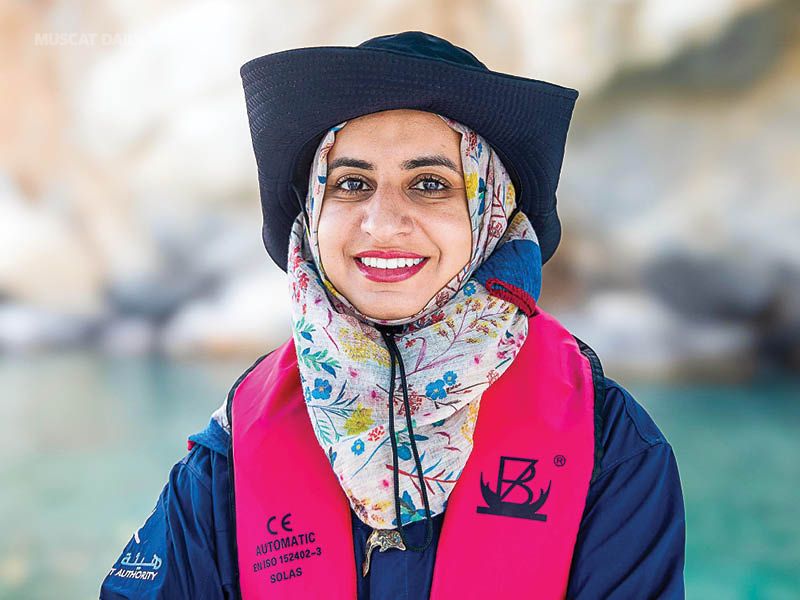
Leading this quiet revolution is Aida al Jabri, a marine environment specialist whose work is helping Oman map, understand and safeguard its marine mammals with unprecedented precision. As head of the national survey project in Musandam, Aida blends scientific rigour with a deep personal connection to the sea, steering a young Omani research team through one of the most comprehensive marine studies carried out in the sultanate. Her leadership not only advances environmental knowledge but also signals the growing role of Omani women at the forefront of future-focused scientific exploration.
Her childhood fascination with the sea shaped her career path. “The ocean has always felt alive,” she said in her reflections to Muscat Daily. “It speaks to those who listen.” This early connection inspired her to pursue marine science and ultimately embrace conservation work as a responsibility to future generations.
Leading the project came with challenges. The first task was training her team and identifying each member’s strengths to ensure work was distributed effectively. Motivating the group, especially during long hours under harsh weather, required trust, shared purpose, and constant reminders of why their work mattered. To Aida, true leadership meant working beside her team, not above them.
Her journey also mirrors a broader transformation in Oman. She believes Omani women are no longer merely participating in scientific fields — they are leading them. They are producing research, shaping conservation priorities, and playing a transformative role in environmental sciences across the country.
Memorable moments
Among the project’s most memorable moments was the sighting of a Bryde’s whale swimming gently alongside her calf — a moment Aida describes as ‘indescribable joy’. Another was encountering a massive group of Spinner dolphins leaping in perfect synchrony against a calm sunset near Lima, a scene she says felt ‘as if time had slowed’.
The project’s significance lies not in claiming new species sightings, but in conducting Musandam’s first structured, long-term marine mammal survey led entirely by an Omani team. While fishermen have long known of the region’s dolphin diversity, this study provides the first systematic documentation of species distribution, group sizes, and behavioural patterns.
Researchers recorded large, recurrent Spinner dolphin groups — sometimes in the hundreds or thousands — consistently returning to the same coastal areas year after year. The team also confirmed the presence of the Indian Ocean humpback dolphin, Long-beaked Common Dolphin, and Indo-Pacific Bottlenose Dolphin.
Most sightings occurred close to the coastline, though some were recorded in waters deeper than 100m. The data suggest that parts of Musandam serve as preferred feeding or resting grounds for dolphin populations. Researchers also observed rare behaviours, including playful acrobatics by Spinner dolphins and unusual social interactions from Indian Ocean humpback dolphins, a species still classified as endangered.
Digital tools played a major role in the project’s success. The Spinner Dolphin App streamlined the team’s data collection and allowed fishermen and tourism operators to report their own sightings, dramatically expanding the project’s coverage. Hydrophone recordings captured dolphin vocalisations and their interactions with vessel noise, offering valuable insight into communication patterns and human impact. Ocean sensors helped researchers understand environmental conditions such as water temperature, salinity, pH, and oxygen levels.
Aida believes these findings will support national marine conservation strategies, particularly in identifying priority habitats, regulating tourism activity, and guiding long-term protection efforts for endangered species like the Indian Ocean humpback dolphin.
Equally important was the community’s role. Fishermen, boat captains, women artisans and local families contributed knowledge, creativity, and logistical support. School students showed excitement and curiosity, while rural women engaged deeply with conservation themes, blending cultural identity with environmental awareness. These collaborations, Aida says, created a sense of shared responsibility and strengthened the project’s impact.
Aida hopes to expand marine mammal monitoring to other governorates and develop training programmes that empower local field research teams in each wilayat. Building local capacity, she believes, ensures conservation becomes “a living, community-led practice.”
Reflecting on the experience, she says the whales, dolphins, golden sea and — above all — the welcoming people of Musandam will stay with her forever. “The fishermen who guided us, the families who shared their kindness, the deep connection everyone has with the sea… these were the true anchors of our work.”
Quote
The ocean needs your curiosity, your courage, and your voice. Start wherever you are — your presence in science matters
Aida al Jabri