Norwegians continue to face among the highest food prices in the world, and they keep going up at the grocery store. It’s been a political issue for years, but government officials still refuse to address the main reason a cucumber can cost more than twice as much as in Sweden: Norway’s own high tariffs on food imports that protect Norwegian farmers and food producers.
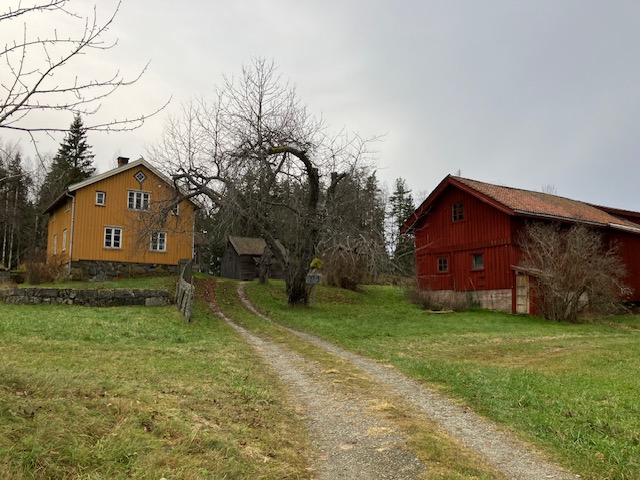
Norway has a long tradition of small farms all over the country that its farming lobby is determined to maintain, while even larger, more modern farms can’t compete with foreign agriculture. Politicians have gone along with slapping huge tariffs on imports of food, to protect Norwegian agriculture, even as they complain about new tariffs from the US and elsewhere. PHOTO: NewsinEnglish.no/Nina Berglund
Tariffs are again a big issue internationally, not least since US President Donald Trump took office earlier this year and quickly slapped punitive tariffs on trading partners all over the world. Norway was hit, too, and Norwegian government officials complained almost as loudly as others.
Last week Norway was hit by another tariff, this time from a less likely source: the European Union (EU). Norway’s long-standing trade agreement with the EU that gives it access to the EU’s inner market didn’t protect it from the EU’s new looming tariffs on metal alloys, and Norwegian officials complained again.
They’re reluctant, however, to examine or make any changes in tariffs of their own, not least those that have long been imposed on agriculture and food imports. It’s getting trickier now for Norway to defend its own protectionism, especially at a time when solidarity with the rest of Europe has become so much more important for security and defense reason.
Norwegian dairy products are among those protected by tariffs on imports, and prices keep rising. A box containing 250 grams of butter, meanwhile, now costs NOK 36.90 (nearly USD 4) even at “low-price” grocery chains. PHOTO: NewsinEnglish.no
Norwegian consumers, meanwhile, have been complaining for decades about Norway’s high food prices. They’ve been rising even higher over the past year: A package of eight slices (125 grams) of Arla cheese from Denmark, along with a package of the Norwegian dairy conglomerate Tine’s sliced Norvegia cheese, have both jumped nearly 30 percent, from NOK 24.90 (USD 2.20 at the time) to NOK 31.90 (USD 3.12) last week, even at the so-called “low price” grocery chains KIWI and REMA. A package of the same cheese at higher-end chains like Meny and Coop was priced at as much as 41.90.
The price of a package of small specialty potatoes from a Norwegian producer near Tønsberg, meanwhile, has also jumped from NOK 24.90 to 29.90 and even 34.90 during the past year, before suddenly “dropping” back to 29.90 at the generally higher-priced Meny chain. A quart of low-fat milk has risen to more than NOK 20 at all the grocery chains in Norway, while the prices of fish, meat and poultry have all soared. Lamb filets have cost more than NOK 700 (USD 70) a kilo even during high season this past autumn, equal to around USD 35 per pound. Even a bunch of locally grown spring onions (vårløk) has cost more than NOK 30, compared to the low NOK 20s last year.
It should come as no surprise, then, that the numbers of Norwegian consumers driving over the border to shop in lower-priced Sweden have risen yet again. State statistics bureau SSB (Statistics Norway) recently released figures showing that Norwegians spent NOK 8.9 billion at border-area stores in Sweden during the first nine months of this year. That’s up 11 percent from the same period last year.
Bacon is among the grocery items in Sweden that are much cheaper than in Norway. Pork and other meat produced in Norway is covered by tariffs that extend into three digits. PHOTO: NewsinEnglish.no/Morten Møst
SSB calculated that Norwegian shoppers spent by far the most (NOK 3.5 billion in Sweden in the third quarter alone) on food and other grocery items (NOK 1.1 billion), plus another NOK 151 million on chocolate and sweets and NOK 755 million on both alcoholic and non-alcoholic beverages. The number of Norwegians’ day-trips over the border rose by 21.7 percent from the third quarter of 2024 to the end of the third quarter this year. An estimated 1.53 million day trips were made over the border in the third quarter of 2025 alone.
That’s quite a lot, given Norway’s total population of just 5.6 million. For large portions of the country it’s too far to drive to make a day-trip to Sweden. Most of the Norwegians shopping in Sweden live in and around the Oslo area, especially in Østfold and Innland counties, both of which are ironically large farming areas.
More Norwegian politicians are now complaining about the high prices that prompt so many Norwegians to shop in Sweden and spend more money while there, even after the Norwegian krone has weakened against Sweden’s. In addition to Norway’s tariffs, the high Norwegian prices are fueled by a number of factors including higher taxes on tobacco and alcohol in Norway, higher wage and business costs in Norway and even the closure of most Norwegian grocery stores on Sundays (when Swedish stores remain open).
It’s the high tariffs on food imports that are grabbing more attention, and some Members of Parliament in opposition now want to examine them. Decades of both Labour- and Conservatives-led governments have failed to do so, however, and the newly re-elected Labour government remains unwilling.
Newspaper Aftenposten reported earlier this month on how even the government’s own economists in the finance ministry have stated that the most important reasons for the price differences between Norway and Sweden are the differences in tariffs. Norway’s high tariffs protect Norwegian food producers from foreign competition, and even prevent foreign grocery store chains from entering the country. The foreign grocery chains can’t take their own supply chains with them, and that prevents them from establishing themselves in Norway.
Norwegian grocery chains still get most of the blame for high prices because there are so few of them and they are all highly profitable, presumably at the customers’ expense. Their supply chains are also directly linked to the protected Norwegian food producers like dairy conglomerate TINE, meat and poultry producers Gilde and Prior and others. The farmers providing their products are protected by tariffs. Lamb imported from New Zealand, for example, is subject to the tariffs that make it as expensive in Norway as Norwegian lamb.
Neither Trade Minister Cecilie Myrseth of the Labour nor her predecessor, Jan Christian Vestre, have been willing to examine the effect of Norway’s own agriculture tariffs on food prices. They are thus likely to remain high. PHOTO: NFD/David Berg Tvetene
Current Trade Minister Cecilie Myrseth has, like her predecessors, launched investigations and angrily called in the grocery retailers and wholesalers to explain themselves. Newspaper Dagens Næringsliv (DN) called it her “PR show” in August and claimed the grocery chains “have nothing to fear” because Myrseth won’t or can’t try to break up the huge companies like NorgesGruppen that own both wholesalers and retailers. There have also been proposals to lower Norway’s 15 percent tax on food, but that’s expensive for the state and unlikely to help consumers for long if actual food prices keep rising.
Nor does Myrseth want to address the biggest obstacle to lower prices, and that’s Norway’s tariffs on agriculture. Norway has a powerful farm lobby and no government has dared to study in detail how the tariffs keep food prices high. Myrseth all but admitted to Aftenposten that she won’t either. Norway’s agriculture policy, she said, is “based on many considerations,” not least keeping the country’s outlying areas populated. Farming, however uneconomical, can help do so, and can also ensure food supplies from north to south. It’s only within the latitude of the tariffs that the government can try to improve competition.
That can also make it harder for Norway to complain about tariffs from abroad. Norway has been getting a taste of its own medicine when the US and EU impose tariffs of their own. When asked directly by Aftenposten whether the government’s tariff policy “is a bigger problem for prices and competition than that posed by the high profitability of the grocery chains,” Myrseth didn’t answer.
Consumer flight to Sweden is thus bound to continue. Some Norwegian real estate developers are profiting on it though: They own much of the commercial property where the Swedish stores are located.
NewsinEnglish.no/Nina Berglund