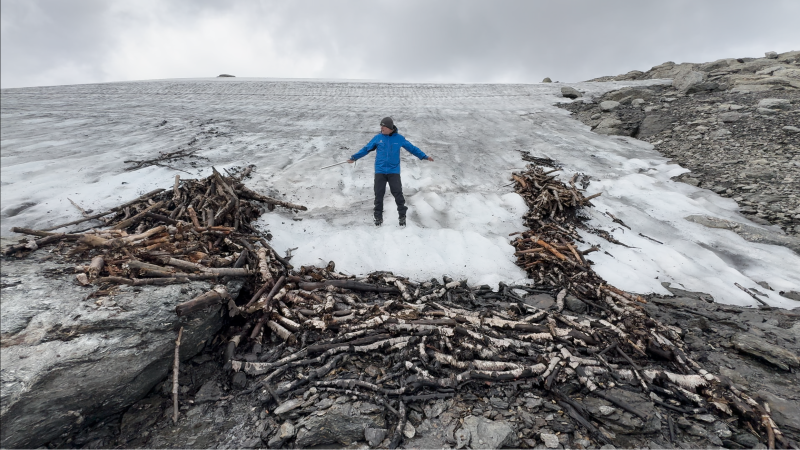
Climate change is widely viewed as destructive and worrisome, but in Norway it’s also leading to discoveries of treasures emerging from melting ice. A team of archaeologists and researchers has been striking pay dirt, quite literally, in the mountains of Aurland this autumn.
Researcher and archaeologist Leif Inge Åstveit has spent much of this autumn mapping and documenting a remarkable discovery in the mountains of Aurland in Western Norway. It has literally emerged from ice that’s been melting at an elevation of 1,400 meters (4,620 feet). PHOTO: Thomas Bruen Olsen/Universitetsmuseet, UiB
The vast area is perhaps best known for its scenic fjord and breathtaking viewpoints. Long ago its vast mountain plateaus were also clearly an important reindeer hunting and trapping area. Last year, local resident Helge Titland was out hiking in the area and came across lots of birch logs lying near an ice field.
“Helge did what he was supposed to do,” according to archaeologist and researcher Leif Inge Åstveit at the University Museum of Bergen. Titland reported what he’d found to local authorities and one of the logs was dated. “Its age was surprisingly high, more than 1,500 years old,” Åstveit said. That prompted archaeologists from both the museum and the local Vestland County to quickly make a trek up to the site.
This decorative pin carved from a reindeer antler was found in melting ice on the Aurlandfjellet plateau near the hunting and trapping facility. PHOTO: Thomas Bruen Olsen / Universitetsmuseet, UiB
There the archaeologists found what they call a large trapping “facility” constructed with the “exceptionally” well-preserved birch tree branches and, lying around it, reindeer antlers that date to the early part of the 6th century, around 520 AD.
That’s prior to the Viking age, but the archaeologists have also found signs that the hunters and trappers working in the area were already relatively prosperous. In addition to the remnants of the pen where reindeer were trapped and slaughtered, they found a variety of artifacts including what they call “an exquisitely designed clothing pin” and iron spearheads, among other items.
One of the spearheads found at the site, with some of its wooden shaft intact. The breakage indicates how dramatic it must have been to use it to kill trapped reindeer. PHOTO: Leif Inge Åstveit/Universitetsmuseet, UiB
“These are items we would never find in ordinary excavations,” said Åstveit. The pin was carved from an antler into the shape of a miniature axe. He suspects a hunter lost it at the time but the ice preserved it.
Other items found in the area can be directly linked to the hunting and trapping activity, including several of the iron spearheads, spear shafts and arrow shafts of wood, along with parts of at least three bows. Archaeologist Øystein Skår from Vestland County said they think the reindeer were steered into a sluice of sorts that was built with logs and the tree branches, forming a vast V-shaped fence that ended in the trapping area, where the reindeeer were killed with arrows and spears.
Åstveit and colleague Thomas Bruen Olsen were also impressed by what they call a “beautfully crafted” oar that features intricate ornamentation. They don’t know why it was carried up to the mountain plateau, since it’s far from the fjord below, and its purpose remains unclear.
Leif Inge Åstveit holding the oar that he and his colleagues also found near the trapping site. It remains a mystery why it was brought up the mountainside. PHOTO: Thomas Bruen Olsen/Universitetsmuseet, UiB
They link the unique preservation conditions to “to the fact that the facility was in use at the onset of a cooling period around the mid-6th century.” They believe increasingly colder temperatures led to the site being covered by snow year-round, rendering it non-functional over time. Then it was all “encapsulated” in ice, given the excellent condition of the antlers. They were frozen shortly after the site ceased operations.
Norway’s wild reindeer have been back in the news lately, as state officials try to preserve the country’s remaining herds and keep the public from disturbing them in any way. Åstveit told Norwegian Broadcasting (NRK) that the prosperity of Aurland and nearby Lærdal at the time may have come from the hunting and trapping of reindeer. They also have uncovered indications of how sophisticated the hunting was, leading them to believe it was very important and meant much more to the local population than they’d earlier thought.
The antlers found at the 1,500-year-old hunting hunting and trapping site in Aurland are extremely well-preserved. PHOTO: Leif Inge Åstveit/Universitetsmuseet, UiB
Åstveit, the team from Bergen and archaeologist Skår from Vestland County spent most of this past autumn at the site. They also found that many of the well-preserved antlers still lying around the site show signs of “cut marks” that provide deeper insight into how the hunting process occurred and how the animal carcasses were processed.
“The mass trapping facility is literally melting out of the ice in front of our eyes,” Åstveit said, “and is probably unique in both Norwegian and European contexts.” He added that it “opens up entirely new interpretations and understandings of how these facilities functioned.”
It’s not the first time melting ice has revealed treasures in Norway, including well-preserved leather clothing and shoes, old skis and even the remains of a small plane crash in 1972. Melting glaciers in Norway may reveal other ancient items, even though the receding glaciers are mostly viewed as a sad result of climate change that can also prompt flooding and other disruptions.
The Aurland trapping discovery, however, provides insight into the significance that reindeer hunting may have had within a broader social context during the Early Iron Age. Åstveit also hopes the well-preserved antler- and wood materials “will contribute significantly to research in the coming years.”
NewsinEnglish.no/Nina Berglund