One of the team’s most surprising discoveries was what local villagers called “white aubergines”, whose seeds they obtained during one of their collecting missions.
In reality, the fruit was not white but green. When the researchers planted the seeds in experimental plots at the faculty, they were astonished to see a bush covered in sharp thorns extending not only along the stems but even on the flowers.
“Only later did we realise these were among the oldest aubergine varieties known historically. One of the earliest goals of plant breeders had been to eliminate precisely these undesirable traits,” Jankulovska says.
To determine whether newly collected seeds represented distinct varieties or duplicates, the team had to carry out molecular analyses, tests that are costly and which they often paid for out of their own pockets.
The researchers were equally fascinated by the diversity of beans, eventually assembling a collection of more than 2,200 samples.
The white bean commonly found in supermarkets represents only a tiny fraction of that diversity.
Their collection includes green beans and varieties displaying an extraordinary range of shapes and colours, like purple, black, brown and beige, as well as striking bright pink beans that have now become almost impossible to find in villages.
Two years ago, to study their characteristics, the researchers planted around 400 bean varieties on a one-hectare experimental field.
From May until December, a handful of women from the department spent their days in the field. And nature had one more surprise in store.
Bean plants normally produce leaves made up of three leaflets. Yet among the collected seeds, they discovered plants bearing four, five, or even more leaflets.
“It is the first time such a phenomenon has been documented anywhere in the world,” Jankulovska says.
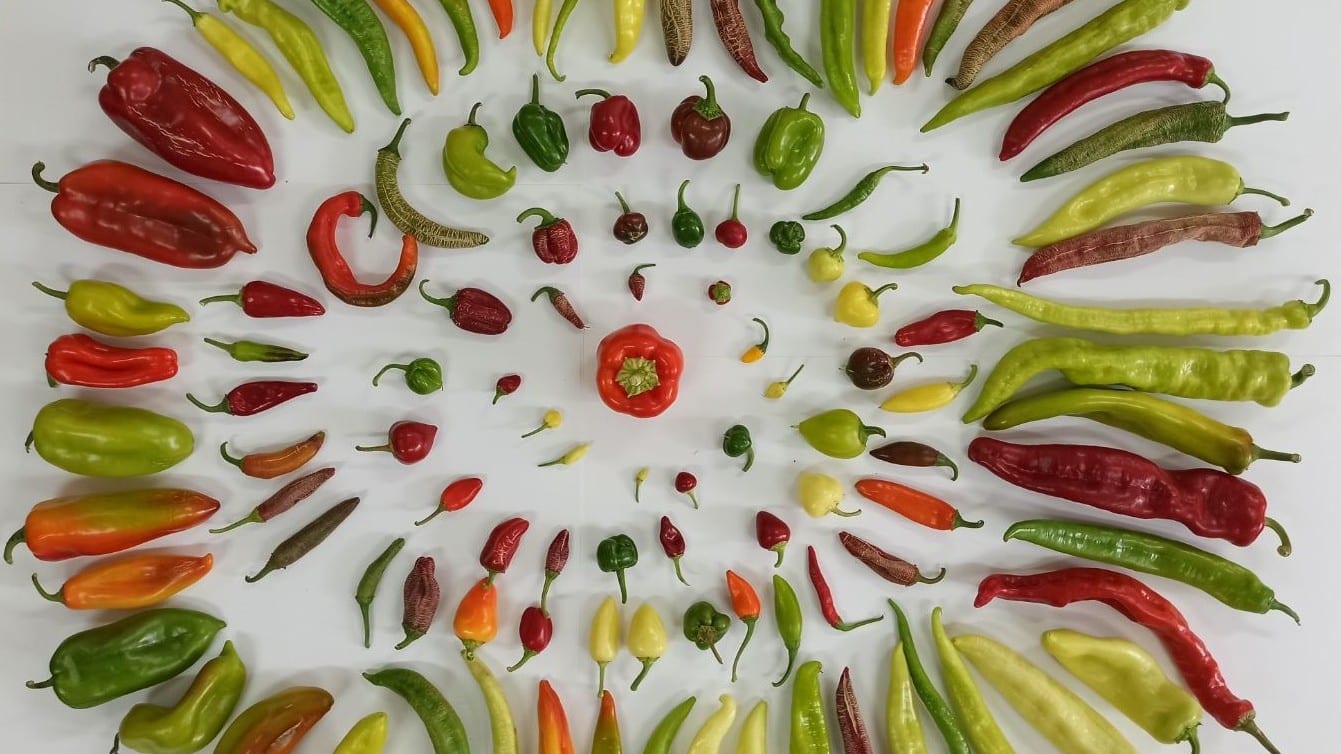
Following the publication of a monography on North Macedonia’s bean varieties, the team plans to produce similar publications on peppers and tomatoes.
There are still some villages they have not visited. They plan to in hope something worth saving is still there. But that is where the gathering mission will likely end.
The researchers have already accepted that they will not be able to rescue everything they once hoped to conserve.
So far, they have sent more than 5,000 seed samples to foreign gene banks, confident that they will remain safely preserved there and permanently identified as originating from North Macedonia.
Within the country, seed collections are maintained at the national gene bank at the Agricultural Institute, which currently holds 721 accessions representing 43 botanical species.
Additional collections are kept at the Faculty of Agriculture in Stip and at the Tobacco Institute in Prilep.
Even so, these collections are considerably smaller than the material gathered by Jankulovska’s department.
“If we, ourselves do not collect, study, preserve and continue using our local varieties, nobody will need to steal them from us – we will lose them through our own neglect,” Jankulovska warns.
She says she has lost count of the promises of support and words of encouragement offered over the years by both public institutions and private companies.
None of those promises has translated into meaningful action.
She finds it difficult to understand how, when preserving Macedonian identity has become such a prominent public issue, something fundamentally tied to that identity continues to be overlooked.
“These seeds carry the memory of the past. They preserve traditional recipes, local knowledge, and the way of life of people in specific rural communities,” the professor says.