Recent commercial satellite imagery indicates an ongoing effort to repurpose a coastal cargo ship at the Sinpho South Shipyard, where submarine construction and conversion activities have been the norm.
Imagery from March 25, 2026 revealed the maneuvering of a recently stripped-down coastal freighter toward the launch rails of the yard’s second largest construction hall (north construction hall) from which the Sinpo-C class ballistic missile submarine (SSB), also known as the Hero Kim Kun Ok, had been launched in September 2023. Imagery taken later the same day showed the bow of the freighter on the launch rails preparing to move the vessel into the hall. Imagery from March 29 revealed that while the ship had been moved onto the incline building rails, the vessel had not been moved inside, although its bow had been removed.
What is planned for this vessel is unclear. What is clear is that modernization and expansion of the Sinpho complex continues, portending a larger production and basing capability. At the same time, progress has been slow not only on those construction efforts, but also in the building, launching, and sending to sea of new classes of SSBs. Whether this is a matter of changing government priorities or the lack of materials, funds, and/or technology remains in question.
Tracing the Ship’s Movements
The cargo ship, a bulk carrier, was first seen at Sinpho when it arrived in the harbor on February 14, 2026. By February 17, the vessel was berthed stern-to-port at the launch quay that supports the larger of the two construction halls.
The vessel measured approximately 96 meters long with a beam of approximately 16 meters. The ship was configured with two cargo hatches, a bridge house located aft, and a king post mounted near the bow ahead of the forward hatch.
Figure 1. Imagery from March 3, 2026 shows the vessel prior to reconfiguration. Image © 2026 Planet Labs, PBC cc-by-nc-sa 4.0. For media licensing options, please contact [email protected].
Disassembly of the vessel began approximately a month later, when imagery from March 15 revealed the bridge house had been removed and the cargo hatch covers opened. A mobile crane and a flat-bed semi-truck were parked on the quay astern of the vessel.
On March 19, the mobile crane was active alongside the stern of the vessel. The upper deck plates covering the engine compartment had been removed, as had both cargo hatch covers, revealing an empty lower deck. By the following day, the ship had been turned 180 degrees with the bow now facing portside. Disassembly of the upper deck, including the removal of the king post, continued through March 24. On March 25, the vessel was seen being maneuvered towards the launch rails of the north construction hall—the same hall and rails used in the construction and launch of North Korea’s Sinpo-C SSB in 2023.
Figure 2. On imagery from March 25, both cargo hatch covers had been removed and the vessel turned towards construction hall launch rails. Satellite image ©2026 Vantor.
Imagery from March 29 confirmed what was thought to be the case—that the vessel, as presently configured, could not be moved inside the hall. The north construction hall is fitted with two pairs of launch rails, equally spaced, with total door opening of 30 meters. With the ship’s beam at 16 meters and being positioned on the south pair of rails, it was clear it would not fit. However, by March 29, the ship’s bow had been removed suggesting that, at minimum, it would be refitted with a narrower one.
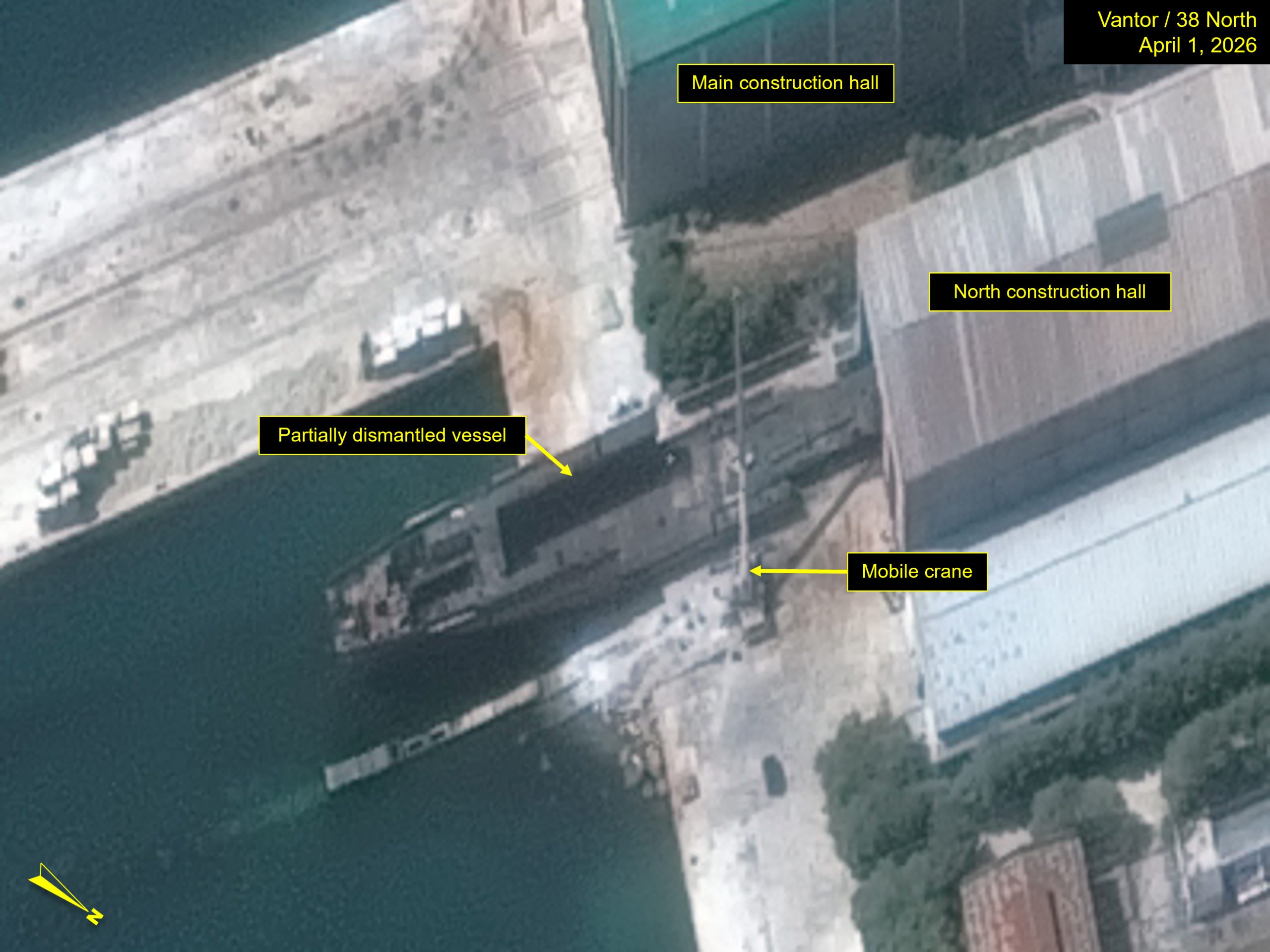
Imagery from April 1 revealed another unexpected development: the sides of the vessel’s hull were being removed, allowing the remaining keel, approximately 6.5 meters in width, to pass into the hall. By April 3, only 36 meters of the vessel remained outside the hall. It appears that the intent is to keep the ship’s keel and power plant intact as they work to repurpose the vessel. As the disassembly continues, it is unclear where the removed hull plates have been stored, although it is likely they will be reused in support of this project or another in the future.
Figure 3. Imagery from April 1 reveals the sides of the vessel’s hull were removed, allowing it to partially pass into the hall. Satellite image ©2026 Vantor.
While it is clear the main components of the vessel will be repurposed, the end product remains unknown. This shipyard has been dedicated to naval vessel construction and repair, and in the past decade, also to forward North Korea’s ballistic missile program. It has seen the launch of the Sinpo-B Class SSB (GORAE-class), a testbed for North Korea’s submarines, and most recently, the Sinpo-C SSB, a converted and reconfigured Romeo-class diesel submarine fitted with an array of missiles. A second submarine of the latter class is anticipated, and North Korean media has shown photos of an alleged nuclear-powered submarine being built in the larger hall.
The fitting jigs used to shape submarine and surface ship hulls may hold a partial clue for what might reemerge from the north hall. Adjacent to the larger, main construction hall, there is a component staging area. There, what appear to be U-shaped jigs are present. This differs from the round jigs seen in the past which have been associated with the round hull designs of submarines.
For large ships, refurbishment or reconfiguring activity would typically be performed in a graving dock or on open building ways supported by overhead cranes. At Sinpho, there is a dual-purposed graving dock located on the northeast side of the complex. That dry dock has been used to repair and fit-out both the Sinpo-B and Sinpo-C SSBs, as well as other attack-class submarines. But it also used to service the local fishing fleet. The graving dock is 175 meters long, but following the fitting out of the Sinpo-C SSB in 2024, a floating platform approximately 45 meters long, was moved into the dock and positioned at its north end. The platform’s presence and other modification taking place to the graving dock itself, may have precluded its use for the ongoing conversions to this cargo vessel.
At this time, we can only speculate as to how the vessel might be modified and repurposed. Among the possibilities are: a tender or replenishment ship for a growing SSB fleet, an arsenal ship fitted with missiles or possibly drones, the latter which are proving their worth in recent years as intelligence collectors and weapons systems, and then less likely, a space debris recovery ship or an assault/landing craft mother ship. And of course, there are other possibilities.
The Drydock
Following the fitting out of the Hero Kim Kun Ok SSB, which departed the dry dock in December 2024, new construction activity began at the dock. The dock is a two-level design; the levels equally divided along its north/south axis. The dock is approximately 175-by-60 meters, with half approximately 28 meters wide, with low spacing wall separating them. The lower basin occupies the east half of the dock and serves as the primary area for the repair of vessels. The fill gate is fitted to the deeper basin.
By January 1, 2025, 30 posts had been erected along the center line wall, and as previously mentioned, a floating platform had been moved into the graving dock where it has remained positioned at the north end of the east section. A gridded structure had been placed on the floor of the dock just prior to the platform’s arrival and is located beneath the platform. The purpose of the posts remains unclear, but they are reminiscent of the style used in building of the new construction hall at the Nampho Shipyard, and are likely intended to support a future covering over the entire east side of the dock. The purpose and presence of the floating platform remain unclear.
On March 9, 2026, ten 7-meter-long crates appeared on the floor of the dock, and tens of elongated items had been neatly arranged on top of the platform. By March 19, the 7-meter crates had been removed and by March 20, five small fishing boats had been moved into the basin. However, the objects on the floating platform remain. The appearance of the fishing boats suggests dual-use of the dock remains important, and while the purpose of the objects on the floating platform is unclear, they may represent building materials to be used in the construction of a future covering for the graving dock.
Figure 4. Fishing boats moved into the drydock by March 25. A floating platform with unknown objects on top of it remains in the drydock, as well. Satellite image ©2026 Vantor.
Due to the lengthy period the Sinpo-C SSB had spent fitting out in the dock, and noting that after the initial first few weeks of fitting out, the submarine was covered with tarps to either preclude viewing of the work being done or to serve as weather protection, the construction of a more permanent structure seems logical when one of the SSBs is moved in for repair.
Construction Progress in the South Portion of Sinpho
Construction continues along the shipyard’s south shoreline. Modifications have been underway since August 2013 when construction of a coastline seawall began. By July 2014, construction had begun on what is likely to become a submarine storage/repair hall protected by the adjacent mountain side, and a concrete pier to serve as a breakwater for the new harbor.
The hall construction coincided with the launch of the experimental Sinpo-B SSB. The pace of construction has been slow, particularly when compared to many of Kim Jong Un’s other strategic projects. While few changes are observed since 38 North’s last shipyard update on September 6, 2024, there are a few notable advances. First and foremost, the L-shaped pier, which will serve as both berthing space and a breakwater to protect the newly formed harbor, is now complete. It extends 140 meters out from the shoreline and pivots to the east another 280 meters. Tetrapods have been installed along its seaward sides to protect the structure. In addition, hundreds of tetrapods have been installed along the coastal road leading to the shipyard.
Figure 5. Overview of activity at the L-shaped pier on imagery from April 1, 2026. Satellite image ©2026 Vantor.
There has been little change to the storage and maintenance hall, which will eventually be earth covered although some backfilling is evident. But while some earth has been pushed up to its walls, no roof structure has been added. In addition, there are two new administration/support facilities located 450 and 720 meters east, respectively, along the coastal road. The first is presently a four-building complex and the second, six. Two buildings at the first location have been under construction for over two years. The others at this and further location began in the past six months. Construction at the latter facility continues with walls raised, but the roof has yet to be added.
Figure 6. Imagery from April 1 shows tetrapods near the construction of the semi-underground storage and repair hall. Satellite image ©2026 Vantor.
Figure 7. Overview of activity at administration and support facilities on imagery from April 1, 2026. Satellite image ©2026 Vantor.