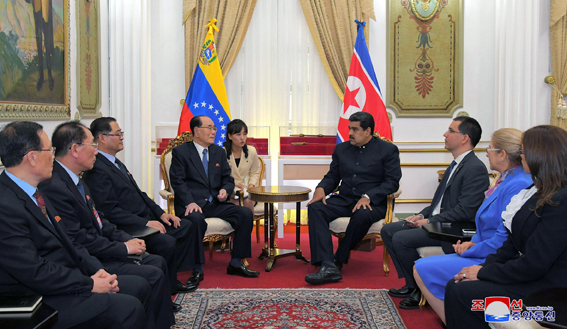
Image from 2019 talks between Kim Yong Nam and Nicolas Maduro. (Source: Korean Central News Agency)
How does North Korea view the Trump administration’s escalation of pressure on Venezuela’s Maduro regime? This is a relevant question, given the parallel between the two countries’ anti-US—or what Pyongyang likes to call “anti-imperialist, independent”—positions. Moreover, North Korea still invokes US “interference” in Iraq, Libya, and Afghanistan as examples of what could happen if a country does not have the power to defend itself.[1]
North Korea has not issued an official statement yet, but it is closely monitoring the situation by regularly publishing news reports. Past examples, though not directly comparable, suggest North Korea will release an official position through the Foreign Ministry within days if Washington launches military action against Venezuela.
Why Does North Korea Care?
North Korea and Venezuela forged diplomatic ties in 1974. The relationship strengthened during Kim Jong Un’s reign, exemplified by the opening of the North Korean and Venezuelan Embassies in Caracas in 2015 and Pyongyang in 2019. North Korea’s titular head Kim Yong Nam’s meeting with President Nicolas Maduro in Caracas in 2018 was another milestone in bilateral relations.[2]
The relationship aside, the ongoing US-Venezuela tensions are of interest to Pyongyang because they are indicative of how it, too, may become a target of the United States. As noted above, North Korea frequently cites past examples of US interventions that have led to regime change. It is in this same vein that North Korean media closely followed US overtures toward Greenland, the Panama Canal, and the Gaza Strip earlier this year.
Venezuela’s tensions with the United States have been a prevalent theme in North Korean media for years. However, from early August 2025, when US-Venezuela tensions rose significantly, to November 20, reports mentioning “Venezuela” or the “Caribbean” in the country’s top two newspapers—the Party daily Rodong Sinmun and the cabinet daily Minju Joson—numbered 124, reaching their highest volume in five years. This represented double the number of mentions during the same period in 2023 and 2024, and four to six times the number during the same period in 2021 and 2022.[3] The significant rise in volume reflects the regime’s heightened interest in the US-Venezuela situation. These reports are predominantly straight news coverage introducing Venezuela’s reactions to US actions, along with criticism from Venezuelan, Russian, and Chinese officials toward the United States.[4] While these are factual news reports without explicit commentary, Pyongyang’s consistent presentation of these countries’ positions suggests North Korean alignment with their views.
One Minju Joson article published in early November—the most direct North Korean criticism of US actions toward Venezuela observed—best reflects its view of the ongoing situation. After criticizing the United States for “escalating regional tensions day by day” by increasing its military presence in the Caribbean, the article says:
In this situation, voices are strongly resonating from countries in the region that while it is Venezuela that is facing difficulties today due to the United States, tomorrow, other countries in the region could become targets, and that it is very important for Latin American countries to strengthen unity in response to US hegemonic actions.
The international community is closely watching with deep concern the situation in the Caribbean region, where tensions are escalating day by day.[5]
Possible Next Step
Articles and straight news reports are generally considered the lowest tier in a hierarchy of North Korean communication vehicles. North Korea typically uses these less authoritative vehicles to signal interest in an issue while maintaining distance from it. By contrast, a Foreign Ministry pronouncement, far more authoritative than news reports or articles, reflects stronger regime commitment to the message.[6]
If the United States carries out military action against Venezuela, North Korea will likely issue a Foreign Ministry statement within days. While past US-led operations against Iraq, Libya, and Afghanistan occurred under different circumstances and are not directly comparable to the current situation, they may be useful to recall, as North Korea continues to cite them as negative examples of US-led regime change, and its response pattern has been consistent. The North Korean Foreign Ministry issued a spokesperson’s “answer [taedap; 대답]” to KCNA one day after the 2001 retaliation against Afghanistan, two days after the 2003 invasion of Iraq, and three days after the 2011 intervention in Libya.