This research draws on Project Anthracite, a multiyear initiative funded by Global Affairs Canada and led by RUSI and VERTIC, with support from 38 North. The project uses open-source tools to assess whether North Korea’s chemical industry could support a chemical weapons program, including analysis of translated North Korean scientific literature.
Introduction: An Underexamined Risk?
North Korea’s nuclear and missile programs dominate headlines, but another potential WMD risk receives far less sustained scrutiny: chemical weapons (CW). Many governments assess that Pyongyang maintains a CW capability, yet open-source analysis of this area has lagged significantly behind attention to its nuclear program.
In operational terms, chemical weapons could offer North Korea distinct advantages. Even the credible threat of use could slow advancing forces, forcing troops into protective equipment that degrades mobility, endurance, and communication. This creates a plausible role for CW as a coercive or last-resort tool, particularly in scenarios where regime survival is at stake.
North Korea has also demonstrated a willingness to use chemical agents. The 2017 assassination of Kim Jong-Nam using VX in Kuala Lumpur highlighted both capability and intent in a high-profile context.
A further complication is institutional: North Korea is not a party to the Chemical Weapons Convention (CWC). As a result, it is not subject to routine declarations or inspections, leaving analysts reliant on indirect indicators and open-source triangulation.
Project Anthracite: An OSINT Approach to a “Hard Target”
To help narrow this gap, Project Anthracite uses satellite imagery and other open-source tools to build a networked view of North Korea’s chemical industry and assess if it could plausibly support a CW program. It starts from a basic (and historically consistent) premise: that CW programs are not built in isolation but rely on established chemical industry for support in terms of feedstocks, bulk intermediates, specialty reagents, corrosion-resistant plant, and a trained workforce capable of running processes reliably.
Figure 1. Abundant domestic anthracite coal resources provide North Korea with ready access to a wide range of chemical feedstocks and industrial precursors. (Source: American Chemical Society)
Project Anthracite ultimately assessed that North Korea’s raw materials and basic industrial technology strongly support the premise that North Korea could produce simpler agents, such as sulfur mustard, while more complex nerve-agent pathways typically demand additional capabilities that may be less visible in open sources.
This article builds on that baseline by looking at one OSINT stream that is easy to overlook but can be surprisingly informative: domestic technical literature such as patents and science/engineering journals.
The previously-published raw-materials mapping, which identified chemicals and industrial processes of most relevance for CW feasibility, was used as a framework upon which to assess the relevance of patents or published articles. Specifically, we were looking for indicators of competence in niche areas of chemistry which could support a CW program, indicators of research to optimize industrial process important for the production of precursor chemicals and other feedstocks required for a CW program as well as indicators of existing industrial plant and other capabilities that could support a CW program. Sources of the patents and articles were:
- A large dataset of over 30,000 machine-translated North Korean patents, used to triage signs of dual-use chemicals, processes and facilities.
A Practical Lens: “Industrial Plausibility,” not “Smoking Guns”
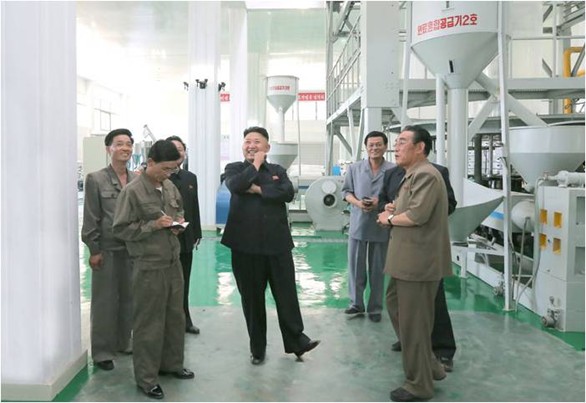
A mistake that analysts sometimes make is to treat CW capabilities as a binary (“they can” vs. “they cannot”). In reality, sustained CW production, especially at militarily significant scales, depends on multiple factors: feedstocks, building-block chemical production processes (most notably chlorine-related chemistry), corrosion-resistant equipment, and trained personnel. Industrial sites, such as the Namhung Youth Chemical Complex, which has been previously associated with a potential CW program, includes a coal-gasification plant, which can turn anthracite coal into useful upstream precursors such as ethylene.
Figure 2. Kim Jong Un providing field guidance to the Namhung Youth Chemical Complex on June 20, 2013. (Source: Rodong Sinmun)
That is why patents and journals are useful: they often reveal what a technical community is trying to do in practice, what problems they are solving, what reagents they claim to handle, and whether they are working at the level of “one-off synthesis” or looking to optimize and improve existing processes.
But they also have limitations. Patents can be aspirational, filed for bureaucratic credit, or never implemented. Journals can be selective or shaped by political incentives. The right way to use them is as signposts: they help us identify where capabilities are plausible, where they appear thin, and where we need to use future OSINT efforts to look harder.
This approach is particularly relevant for North Korea because CWC transparency tools do not apply; they sit outside the international verification regime and are under no obligation to declare dual-use production.
Sulfur Mustard: Why it Sits at the Center of Feasibility Assessments
Of the classical CW agents, sulfur mustard has been the focus of many of our discussions. It is a particularly insidious chemical weapon that causes severe injuries and long-term harm, but the industrial requirements are significantly less demanding than other classical CW like nerve agents. Despite being a chemical weapon associated with the First World War, there are still examples of its recent use. Indeed, the chemical industry and the raw materials that North Korea has at its disposal could support the production of sulfur mustard, and this is also supported by North Korean patents and scientific literature.
Two Useful “Capability Indicators” From North Korean Journals
Production of sulfur mustard is reliant on access to precursors; two such precursors are 2-chloroethanol and sodium sulfide, which are not controlled under the CWC’s Annex on Chemicals, but are included on the Australia Group precursor control list.
Figure 3. The Most Common Production Routes for Sulfur Mustard. (Source: Project Anthracite Team)
Synthesis of 2-chloroethanol was documented in many journal articles. One particularly good example is a 2018 paper in Hwahak-kwa Hwahak Konghak titled “Synthesis of 2-Chloroethanol From Ethylene Glycol” which frames 2-chloroethanol (ethylene chlorohydrin) as a legitimate industrial intermediate and reports applied work focused on improving conditions and yield and infers existing capability to produce 2-chloroethanol on an industrial scale.[1]
Synthesis of sodium sulfide was also documented in many journal articles, with one particularly good example being a 2024 paper in the Kim Il Sung Chonghap Taehak Hakpo: Hwahak titled “Preparation of Sodium Sulfide from Barite and Makite.” The paper describes a process-oriented method for producing sodium sulfide from mineral raw materials and discusses optimization to improve yield and recovery.[2]
Again, neither paper “proves” prohibited activity. Their value is that they add texture to the feasibility picture: they show applied research on production of dual-use chemicals on an industrial scale and are consistent with the type of capabilities their chemical industry would need to sustain downstream processing and production chains.
Other Indicators: Phosphorus Chemistry, Pharmaceuticals, and Pesticides
Beyond sulfur mustard, several translated journal articles provide supporting context for technical competence in adjacent domains. These should be treated as “in passing” indicators, which included:
- A 2022 paper on the synthesis of PMIDA (herbicide intermediate) referenced industrial-grade phosphorus trichloride (PCl₃) and reports yield-focused process optimization.[3]
- A 2021 paper on adefovir (antiviral drug) describes pharmaceutical synthesis optimization and purification work consistent with fine-chemical capability.[4]
- A 2022 paper on fenitrothion (insecticide) describes synthetic methodology consistent with competence in organophosphorus chemistry, which underpins most CW chemistry.[5]
- A 2021 paper framed around flame-retardant chemistry reports synthesis and process considerations for organophosphates production, an additional indicator of organophosphorus chemistry competence.[6]
Individually, these are not decisive. Collectively, they suggest pockets of specialist scientific and technical competence in areas which could also support a CW program.
Patent Screening: What the Large Dataset Shows (and Does Not)
Project Anthracite’s patent screening examined more than 30,000 North Korean patents to identify those relevant to capabilities that could support a CW program. We were clear from the outset about the limitation of patents: the dataset likely represented an unclassified snapshot whilst prominent North Korea experts assessed that a classified patent corpus likely exists and would be more relevant to sensitive or dual-use capabilities.
Only about 1.1% of patents were judged to have any relevance. The vast majority focused on recycling and agrarian technology, patterns consistent with the juche principle.
The screening did identify patents that signal capability in important areas such as corrosive/reactive chemical handling. Notably, multiple relevant patents were associated with the Heungnam Pharmaceutical Factory which implies that it is a highly capable plant able to handle highly corrosive materials. This would suggest a corrosion-resistant plant suitable for more complex chemical synthesis, which would mean higher levels of competence. The facility is worthy of closer scrutiny.
The value of this kind of screening is practical: it helps analysts prioritize sites, chemicals, and competencies for deeper OSINT follow-up, rather than trying to infer everything from a single indicator.
Conclusion
This article does not claim to prove CW production. Project Anthracite’s raw-materials mapping is explicit in this regard: it cannot determine whether North Korea is producing CW agents but instead provides a feasibility baseline and identifies indicators worth monitoring. Patents and journals also do not resolve intent: patents can be aspirational, journals can be selective, and sensitive work may sit in classified reports.
But capability matters even without confirmed intent, especially when North Korea is outside the CWC’s verification regime and when CW can provide coercive operational effects not to mention indiscriminate harm and suffering to civilian populations.
North Korea’s CW risk deserves more sustained attention than it typically receives. CW is uniquely troubling in humanitarian terms and imposes real operational friction, potentially slowing tempo and shaping escalation dynamics. North Korea has demonstrated willingness to use a chemical warfare agent in a high-profile context, and its non-membership in the CWC increases uncertainty by removing routine declaration and inspection mechanisms.
Project Anthracite offers a disciplined OSINT framework for narrowing that uncertainty by treating CW potential as an industrial plausibility question: mapping from feedstocks to platform capabilities and high-risk precursor downstream processing and production chains. Patent screening and domestic journals add corroborating texture: they do not prove intent, but they provide capability indicators that help define what North Korea’s chemical industry could plausibly support in a crisis.
Taken together, the most striking insight from this analysis is not the presence of any single “smoking gun,” but the convergence of multiple, discrete indicators that point towards embedded industrial capability. The journal literature highlights applied, optimization-focused research on dual-use intermediates such as 2‑chloroethanol and sodium sulfide which infers activity far beyond laboratory-scale experimentation, while related work in organophosphorus chemistry, pharmaceuticals, and pesticides reinforces the presence of specialist technical expertise transferable to CW-relevant research and development. In parallel, patent screening identifies subtle but meaningful signals of infrastructure capable of handling corrosive and reactive chemistries, including facilities meriting closer scrutiny. Considered together, these indicators strongly suggest a scientific and industrial base that is not uniformly advanced, but sufficiently capable of supporting the production of simpler chemical warfare agents, and potentially more sophisticated capabilities under the right conditions. This underscores the value of cumulative, pattern-based multi-source OSINT, and its value in supporting assessments of hard and complex targets such as North Korea.