The text of North Korea’s (Democratic People’s Republic of Korea; DPRK) latest constitution recently surfaced in South Korea, making it the first publicly available constitution since the September 2023 revision.[1] A review of this law shows the country made changes across a broad range of areas, from Kim Jong Un’s state leadership to economic, social, and cultural policies. Most of them, if not all, merit further research given the importance of this foundational legal document. However, one of the most consequential elements is what the revised constitution suggests about Pyongyang’s longer-term design vis-à-vis Seoul.
The constitution largely confirms what Kim Jong Un himself had previewed in his December 2023 proclamation of a two-state policy and his follow-on calls in January 2024 for constitutional revisions. It treats South Korea (referred to specifically as the “Republic of Korea,” or the ROK, in the document) as a separate state across its “southern border” by adding a territorial clause and removing the longstanding constitutional unification framework. However, the revised text stops short of codifying some of Kim’s more explicit early 2024 formulations, namely: 1) the territorial clause remains vague and does not mention the contested maritime border, the Northern Limit Line (NLL); and 2) it does not define Seoul as the “primary foe” or a “hostile state.” This has given way to some positive assessments that North Korea may be aiming for “peaceful coexistence.” South Korea’s National Intelligence Service, for instance, even suggested the constitution “significantly toned down hostility” and signaled the intent to “maintain the status quo” rather than adopt an offensive posture.
However, when viewed in tandem with broader trends and the context in which it was revised, the new constitutional provisions on defense industry development and military preparedness, combined with Kim’s increased anti-South Korea rhetoric and his sharply increased military- and defense-related public appearances since the Ninth Party Congress, all suggest that Pyongyang is laying the groundwork not for “peaceful coexistence” but rather for a prolonged period of hostile two-state coexistence.
What the Constitution Says… And Doesn’t
It is worth comparing North Korea’s latest constitution with the revisions Kim Jong Un called for in a January 2024 speech to the Supreme People’s Assembly (SPA). Kim said these issues should be deliberated on at the “next SPA,” which would have been October 2024, though these changes could have been made at any time from October 2024 to March 2026. [2][3]
These changes are notable less for what they say than for what they omit.
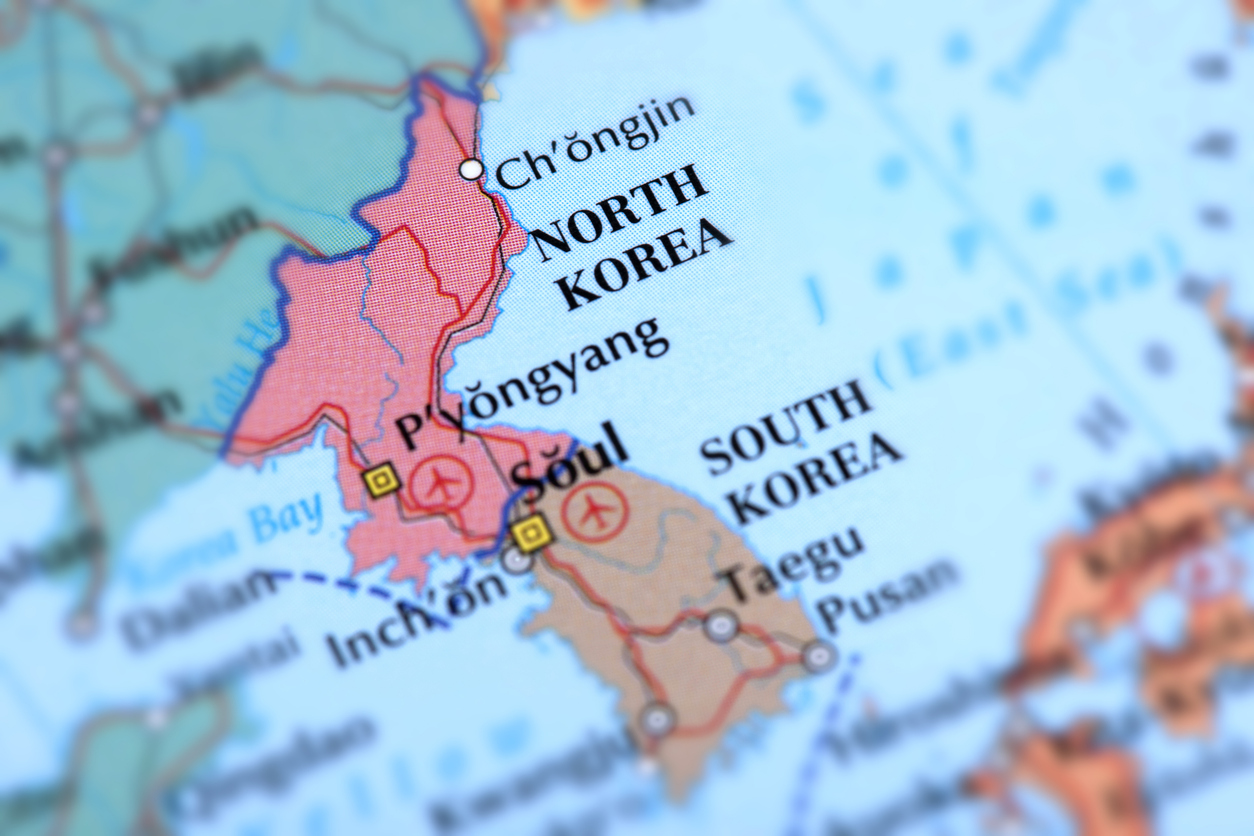
First, although the constitution now includes a territorial clause defining North Korean territory, it does so in ambiguous terms: it simply describes the DPRK as bordering China and Russia to the north, the ROK to the south and the territorial waters and airspace as “established on that basis.” By omitting any mention of the NLL, North Korea also left unresolved key questions regarding this maritime boundary, which it has historically rejected and which has long been one of the Peninsula’s most dangerous flashpoints.
Second, even while codifying Kim Jong Un’s two-state policy by removing reunification and one-nation wording, the revised constitution avoided using the explicitly hostile language that Kim Jong Un used in January 2024, such as references to “occupying, subjugating and reclaiming the ROK and annex[ing] it” in the event of a war, or defining South Korea as an enemy. The latter omission is especially notable because North Korean state media in October 2024, shortly after the SPA had revised the constitution, reported that the law “stipulates the ROK as a completely hostile state.”
“Peaceful Coexistence” or “Hostile Coexistence”?
At a glance, the ambiguities of the territorial clause and the omission of explicitly hostile language could suggest Pyongyang is intentionally preserving strategic flexibility. However, the constitution should be viewed holistically, both in conjunction with the spirit of the law and the broader trends in North Korea’s public messaging. A review of both point to North Korea’s preparation for continued hostile, rather than peaceful, coexistence with Seoul.
The constitution includes some new provisions that receive comparatively less public attention but are nonetheless important. Newly added Articles 60 and 61 stipulate:[4]
Article 60: The state shall develop defense science and technology and continuously raise the level of the Juche-orientation, modernization, and scientization of the defense industry.
Article 61: The state shall establish a culture of giving importance to military affairs throughout the entire society and ensure thorough preparation for an all-people war of resistance.
These reflect Kim Jong Un’s broader policy direction since 2023, namely his repeated calls for “war,” “combat,” or “fight” preparations since a Workers’ Party of Korea (WPK) Central Military Commission meeting in early 2023 raised the issue of “more strictly perfecting the preparedness for war,” and his unusual attention to the munitions and defense industries since August that year. The emphasis on defense science and technology and the defense industry is also consistent with the 2021 WPK Charter preamble, which stated that the Party “shall continuously consolidate the country’s defense capabilities by … developing a self-supporting defense industry.”[5] The constitution further reinforces this priority by referencing the defense industry also in the preamble itself.
Article 61 is significant in that it elevates ongoing “war of resistance” preparation efforts to the constitution. In December 2023—shortly before Kim brought up “all-people war of resistance”—North Korea enacted a “Law on the Organization and Operation of the People’s Unit [also known as inminban].” Article 21 of this law stipulated inminban leaders’ role in “preparations for an “all-people war of resistance.”[6]
Similarly, North Korea’s position toward South Korea hardened during and after the February 2026 Ninth Party Congress, where it defined domestic and foreign policy goals for the next five years.
Though not codified into the constitution, a summary report of the Party Congress reaffirmed that the “DPRK remains strong and conclusive in its determination and will to regard the ROK just as a very hostile state and eternal enemy” and clarified “the Party’s military and strategic policy of fortifying at an early date the southern borderline adjacent to the ROK.” It then issued the blunt threat of “the ROK’s complete collapse” if it engages in “mischievous acts conducted on the doorstep of a nuclear weapons state.” Kim’s speech to the SPA the following month, where the North made its last round of revisions to the constitution, similarly declared that “we will categorically reject, ignore and treat the ROK with the most explicit words and actions by officially regarding it as the most hostile state.”
Notably, Kim Jong Un’s military- and defense-related public appearances have jumped from 27 percent before the Party Congress, to roughly 64 percent since that event was held.[7] Consistent with the border fortification policy outlined at the Party Congress, his most recent public appearances have explicitly mentioned the planned deployment of “new-type self-propelled gun-howitzers” to the southern border, and a Party policy of “strengthening the first-line units in the southern border and turning the border line into an impregnable fortress.”
Furthermore, since its launch in April 2025, North Korea has conducted multiple tests of the destroyer Choe Hyon in the Yellow Sea (“West Sea”), where the NLL is disputed, with Kim ordering the ship commissioned into the navy in mid-June 2026. Although the territorial clause does not mention the NLL, Kim’s January 2024 speech did reaffirm the country’s longstanding position on this boundary: “As the southern border of our country has been clearly drawn, the illegal ‘northern limit line’ and any other boundary can never be tolerated….” Although the Choe Hyon is intended for deployment with the East Sea Fleet, the ship’s capability tests in the Yellow Sea indicate that militarily challenging the NLL remains a realistic option. In this light, Kim’s remark at the Choe Hyon launch ceremony that North Korea’s preemptive naval strike “is not limited to any place or to any line” feels all the more ominous.
One could argue that the gap between the constitution’s hedged language and state media’s explicitly hostile rhetoric reflects deliberate ambiguity, preserving flexibility for future engagement under different political conditions. However, that reading is difficult to sustain when the constitution’s latest version postdates the Ninth Party Congress—suggesting its provisions align with the Party’s directives.
The more convincing interpretation is that Pyongyang is separating the law from policy: using the constitution as a foundational document that codifies the two-state reality without constraining its operational freedom, while articulating hostility toward South Korea through Kim’s speeches, Party doctrine, and defense policy. In this sense, the omission of language such as “primary foe” or “annex” should not be read as moderation.
Implications and Conclusion
Despite ambiguities and omissions of explicitly hostile formulations, the revised constitution is best understood not as preserving space for future engagement, but as codifying long-term, if not permanent, adversarial coexistence between two sovereign Korean states. That does not preclude future tactical engagement or periods of reduced tension. However, under a hostile coexistence framework, such episodes should be read as tactical instruments, not evidence of a genuine shift in Pyongyang’s long-term posture.
The risk of misreading this is significant. Constitutional ambiguity can look like diplomatic flexibility, but the weight of evidence points consistently in one direction. Treating the omission of explicitly hostile language as a moderating signal, without corroboration from North Korea’s behavior, would be the kind of analytical error that hardens into policy miscalculation.
How much room North Korea has to maneuver within this hostile coexistence framework will depend in part on variables beyond the Peninsula itself. Deepening DPRK-Russia ties have not only increased North Korea’s self-confidence, they have also reportedly reduced Pyongyang’s sensitivity to economic pressure. Perceived weakening of US extended deterrence commitments could embolden Kim Jong Un to test the now-constitutionally-defined “southern border.” Conversely, a stronger and more credible US-ROK alliance may not moderate Pyongyang’s long-term design, but it can constrain the pace and ambition of its execution.
The revised constitution alone does not signal imminent conflict. However, it has made eventual reconciliation far harder to imagine. Sustaining an accurate picture of where North Korea is actually headed, as distinct from where outside observers might hope it might be, is the baseline requirement for any effective response. On the Korean Peninsula, the cost of optimism detached from evidence is too high.