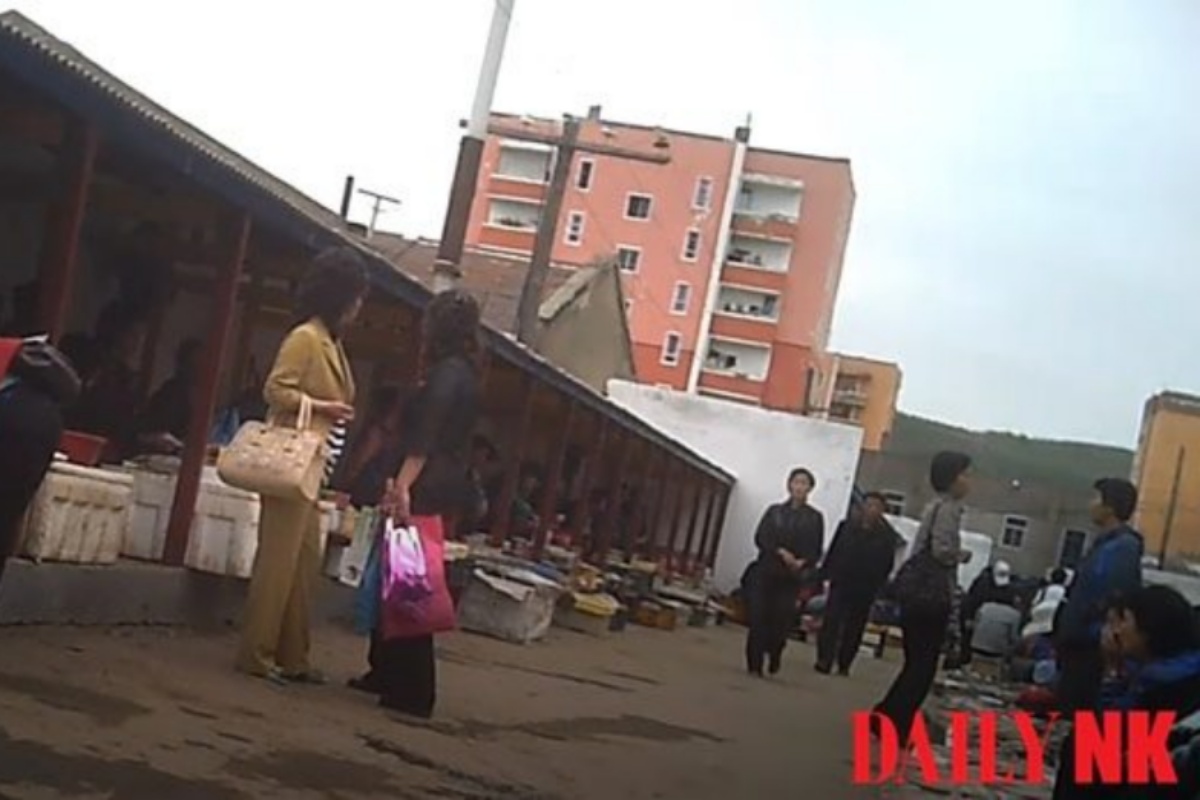
FILE PHOTO: A scene from Rason Market in North Hamgyong province. (Daily NK)
North Korea’s crackdown on private markets is intensifying as the regime designates March a “month of commercial revolution,” triggering sharp price spikes and supply shortages across the country.
A Daily NK source in South Pyongan province reported Tuesday that the provincial people’s committee has declared the state commercial network must “completely overwhelm” the jangmadang, the informal markets that have become a cornerstone of daily economic life in the North. Officials have framed the month as a campaign to bring private distribution channels under state control, in line with directives issued following the ninth congress of the Workers’ Party of Korea (WPK).
According to the source, the cabinet issued instructions on producing so-called “monopoly-indicator goods” — goods designated for exclusive state-channel distribution — and provincial committees concluded that meeting those production targets requires seizing control of distribution networks. City and provincial people’s committees were instructed to enforce strict crackdowns on private circulation of goods.
Pyongsong city, a major national logistics hub, has been singled out for particularly aggressive enforcement. On March 3, the city’s people’s committee convened officials from the commercial department and formally designated private wholesale distribution through the jangmadang as “anti-socialist behavior,” ordering immediate and sustained crackdowns.
Checkpoints, home visits, and mass confiscations
Throughout March, all freight vehicles entering Pyongsong carrying wholesale goods are subject to intensified inspection. Any goods not registered within the state commercial network are subject to on-the-spot confiscation.
Commercial department officials, accompanied by security agents, have been conducting home visits to private wholesalers, demanding that goods previously sold through the jangmadang be turned over to state-run stores at official prices. Security personnel have been stationed outside the homes of wholesalers to monitor their movements.
Faced with the threat of confiscation, many wholesalers have begun hiding their goods or moving them elsewhere. Jangmadang vendors have adapted by conducting sales covertly.
The disruption to supply has been severe. Even staple condiments such as soy sauce and fermented soybean paste have become scarce in the markets, and prices for basic goods have surged three to four times their previous levels — the opposite of what the campaign intended.
The backlash among ordinary North Koreans has been pointed. People familiar with the situation are saying that March is “a month for officials to wring out their loyalty, a month for merchants to play hide-and-seek, and a month for the people to tighten their belts even further.”
Some commercial department officials, the source noted, have quietly voiced concern, acknowledging that while the party’s intentions may be sound, the campaign is making daily life harder for ordinary people.
Daily NK previously reported, citing a source in South Hamgyong province, that household goods sold in the jangmadang have been a primary target of enforcement since the start of the month. Confiscated goods are being transferred to state-run stores — a move analysts say reflects a broader push to absorb jangmadang circulation into the official state commercial network.
Read in Korean
A Note to Readers
Daily NK operates networks of sources inside North Korea who document events in real-time and transmit information through secure channels. Unlike reporting based on state media, satellite imagery, or defector accounts from years past, our journalism comes directly from people currently living under the regime.
We verify reports through multiple independent sources and cross-reference details before publication. Our sources remain anonymous because contact with foreign media is treated as a capital offense in North Korea—discovery means imprisonment or execution.
This network-based approach allows Daily NK to report on developments other outlets cannot access: market trends, policy implementation, public sentiment, and daily realities that never appear in official narratives. Maintaining these secure communication channels and protecting source identities requires specialized protocols and constant vigilance.
Daily NK serves as a bridge between North Koreans and the outside world, documenting what’s happening inside one of the world’s most closed societies.