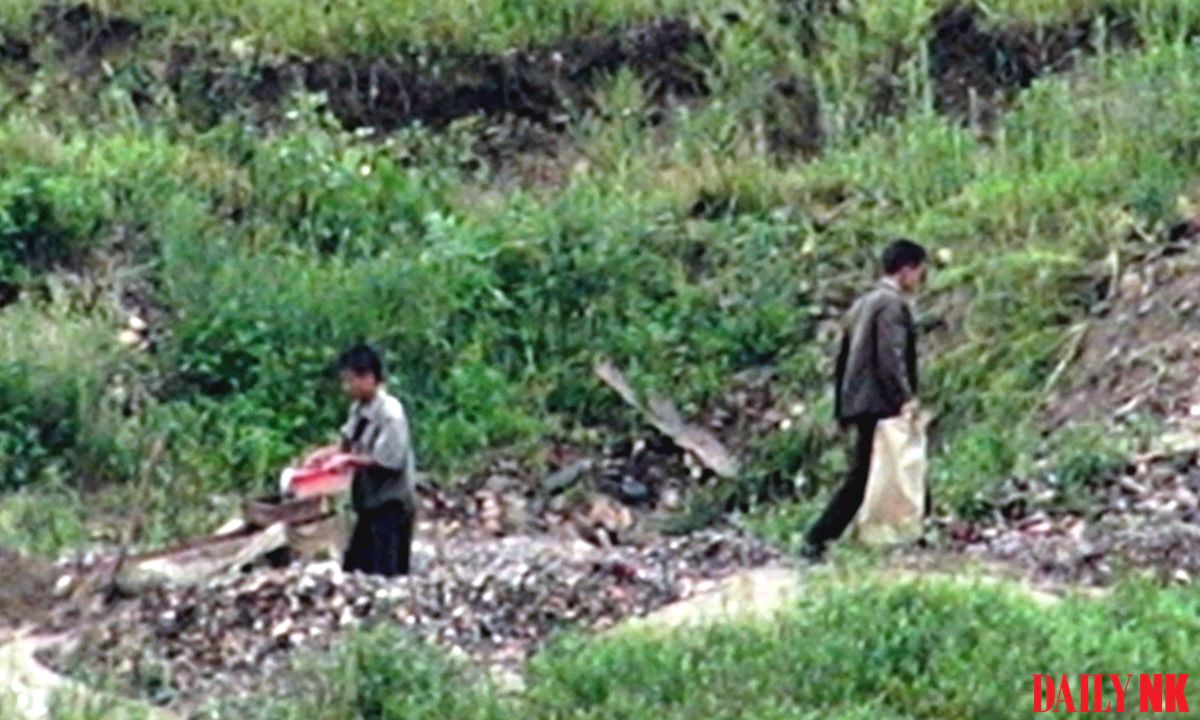
In some parts of North Korea, the number of teenagers heading to gold mining sites has been growing as their families struggle to make ends meet. While young people have sought income from gold mining in the past, multiple sources say the current surge in school-age children joining mining operations is unlike anything seen in previous years.
Multiple Daily NK sources inside North Korea said on Thursday that “the number of people heading to gold mines to make a living has increased sharply” and that “so many families are in such difficult straits that even teenagers who should be in school are being drawn to the mines.”
According to the sources, it has always been the case that people struggling to get by in North Korea turn to gold mining. Those who find it hard to earn money through trade, or who lack the capital to start a business, have long gone to mining sites where physical labor alone can generate income.
That trend is continuing, but sources say what stands out now compared to previous years is that far more teenagers are taking part in the mining.
Teenagers trade classrooms for mining sites
A source in North Hwanghae province said that “children from families in difficult circumstances have no choice but to go out and earn money to help their parents” and that “this is why they are going to the mines instead of school.”
The source added that “even when children do go to school, there is a lot of money required for so-called assignments, and if they cannot complete those assignments, they are sent home.” Because failing to submit assignments means being subjected to criticism at criticism sessions, children from poor families simply give up on attending school altogether.
A source in North Hamgyong province said that A, a 15-year-old boy living in Hoeryong with his grandmother, began mining gold last month because of the family’s difficult financial situation.
“My grandmother is too old to earn money, so we survived the winter by going out to the fields and picking up frozen potatoes,” A said. “When I heard that you could get meals and earn money at the mines, I went right away.”
B, a 17-year-old boy living on the outskirts of Hyesan in Ryanggang province, is also mining near Daebong Mine, earning a daily wage and meals.
A source in Ryanggang province said that “B had barely been attending school because life was so hard, and it has now been two years since he started mining.” The source added that B gives some of what he earns to his parents to help with household expenses, and the family’s situation is slowly improving.
Young adults also flock to mines to build savings
As the livelihood crisis deepens, teenagers are being pushed out of education and into labor. Some homeroom teachers visit the homes of long-absent students, but after seeing the conditions these families are living in, many leave without saying a word.
Meanwhile, sources say the number of people in their 20s and 30s heading to the mines to raise capital has also been growing noticeably. These young adults go to mine gold in order to save up money for starting a business or getting married, and many sell the gold they collect themselves to increase their earnings.
Some young adults who have been mining for the past six months have earned more than 10,000 Chinese yuan (approximately $1,370) in that time. A source said that “if you find a good vein, you can earn far more than other people” and that “since gold is going for around 800 Chinese yuan (approximately $110) per gram, you can save up a significant amount of money in a short period, which is why more and more people are heading to the mines these days.”
Some of these young adults are registering at their workplaces as 8-3 workers, a term referring to people who are formally affiliated with a work unit but do not show up to work, instead conducting their own economic activities and paying a set amount to their workplace, for periods of six months to a year while they mine for gold.
A source said that “young people from well-off families can rely on their parents and do not have to worry as much about money, but those who are not in that position have a strong sense that they must take care of their own livelihoods and marriage costs on their own.” This, the source said, is why young people in their 20s and 30s are flocking to the mines.
The source concluded that “unless the state puts in place real, concrete measures to address the livelihood crisis, the stream of teenagers and young adults heading to the gold mines is unlikely to slow down anytime soon.”
Read in Korean