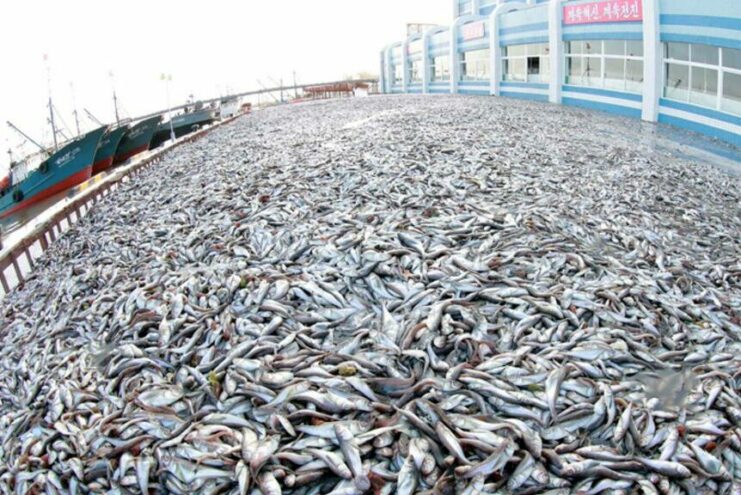
Fish at the Donghae Area Seafood Enterprise. (Screen capture from the North Korean media outlet Seogwang)
North Korea has been promoting the expansion of coastal fish farms as an achievement, but seafood prices in local markets have actually been rising. North Korean people say they are not feeling any effect from the authorities’ seafood production increase policy.
According to a Daily NK source in South Pyongan province on Tuesday, dried seaweed is currently trading at 120,000 North Korean won (around $135 USD) per kilogram in markets around Kaechon. Capelin and anchovies, relatively affordable dried fish commonly used as side dishes in packed lunches, are also trading at around 30,000 North Korean won (around $34 USD) per kilogram.
The source explained that prices were half of what they are now as recently as October of last year, and that the sharp increase has placed a greater financial burden on people.
Why are seafood prices rising?
The rise in seafood prices is attributed to a seasonal decline in fishing activity during winter months, which has reduced supply. The source said that the seaweed currently appearing in local markets was produced last year, and that because last year’s stock has been nearly exhausted, the volume available on the market is low and prices are going up as a result.
On top of that, increased construction mobilization and the expansion of group activities have created greater demand for packed lunches, which in turn has pushed up demand for dried fish and contributed to the price increase. The source noted that capelin and anchovies are traditionally popular as packed lunch side dishes, and that there are suggestions that the noticeable increase in mobilization has driven up demand for dried fish and pushed seafood prices higher.
The sharp increase in prices for seafood that people could once afford easily has made the cost of living feel even worse, according to those on the ground.
Seaweed is a food that new mothers in North Korea consider essential after giving birth, and is also a seafood item that many households eat regularly. Prices vary widely depending on the production region. “True seaweed” harvested from the East Sea is considered to have good flavor and texture and tends to be more expensive, while West Sea seaweed, known as “gompo,” has a comparatively rougher texture and is priced lower.
North Korean people with limited financial means often purchase West Sea seaweed, but now that even those prices have risen, people are lamenting that “it has become hard to find seafood on the dinner table at all.”
North Korea’s aquaculture drive falls short
North Korea has seen declining fish catches since the late 1980s due to a reduction in fish stocks and deteriorating fishing ground conditions. The situation worsened significantly in the 2000s as economic hardship deepened and international sanctions left fishing operations short of the fuel needed to continue.
In response, authorities have been seeking to increase seafood production through aquaculture rather than fishing. North Korea has been working to expand the share of farmed kelp, seaweed and shellfish in overall production, and has been constructing large coastal fish farms as part of this push.
However, shortages of the equipment and technology required to operate fish farms, along with climate change, have kept production volumes low. The fact that farmed species are heavily concentrated in seaweed and other marine algae means the North Korean people are not feeling the effects of the authorities’ seafood production increase policy.
The source said that seaweed, once a common ingredient for soups, now requires real resolve to buy. “They promote the idea that fish farms are expanding and seafood production is increasing, but it has become harder to eat. Whether they are exporting it to earn foreign currency or for some other reason, it is doing little to help the diet of the people,” the source said.
Read in Korean
A Note to Readers
Daily NK operates networks of sources inside North Korea who document events in real-time and transmit information through secure channels. Unlike reporting based on state media, satellite imagery, or defector accounts from years past, our journalism comes directly from people currently living under the regime.
We verify reports through multiple independent sources and cross-reference details before publication. Our sources remain anonymous because contact with foreign media is treated as a capital offense in North Korea—discovery means imprisonment or execution.
This network-based approach allows Daily NK to report on developments other outlets cannot access: market trends, policy implementation, public sentiment, and daily realities that never appear in official narratives. Maintaining these secure communication channels and protecting source identities requires specialized protocols and constant vigilance.
Daily NK serves as a bridge between North Koreans and the outside world, documenting what’s happening inside one of the world’s most closed societies.