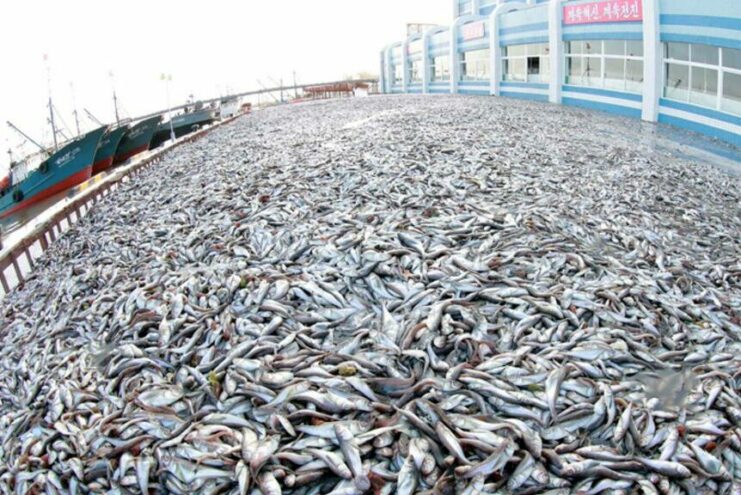
Fish at the Donghae Area Seafood Enterprise. (Screen capture from the North Korean media outlet Seogwang)
Fish farms across North Korea are preparing for the spring fingerling release season, but soaring feed costs and mounting maintenance expenses are pushing facilities toward operating losses. A fingerling is a juvenile fish raised for stocking rivers, lakes, or aquaculture facilities.
“The state is promoting fish farm expansion as a major initiative, but on the ground, the cost burden has grown to unmanageable levels and there are widespread complaints that operations are barely sustainable,” a source in South Pyongan province told Daily NK on Thursday.
Fish farms in Kaechon and other areas of South Pyongan province are currently running two tracks simultaneously: repairing winter damage to facilities and inspecting equipment, while also preparing for the spring fingerling release. The costs for both are falling almost entirely on individual farm units, with little to no state support.
“It costs more to maintain a fish farm than to build one,” the source said. “Feed isn’t being properly supplied, equipment constantly needs repair, and rather than turning a profit, just keeping the farm running is considered a success.”
Feed shortages and aging equipment compound losses
The most acute problem is feed. With basic inputs such as corn and soybeans in short supply, some facilities have turned to substitute feed made from grass, grain husks, and animal waste. Rather than solving the problem, this workaround is generating new ones: poor water quality, sanitation issues, and higher fish mortality rates.
Inadequate electricity supply is compounding the difficulties. Maintaining stable water temperatures requires a reliable power source, and without it, overall operational efficiency has deteriorated sharply.
Aging infrastructure is an additional strain. Pumps, water quality management systems, and other equipment require continuous maintenance and regular parts replacement, but sourcing the necessary materials is difficult. The result is a cycle of makeshift, patch-by-patch repairs that address symptoms without fixing underlying problems.
Despite these conditions, authorities continue pressing fish farms to meet production targets. Facilities are expected to maintain minimum fish stock levels at all times, which the source described as a performance-display requirement driven more by appearance than by operational logic.
“The authorities demand results but pass all the costs down to the farms,” the source said. “Even when fingerlings are released, we can’t raise them properly, so losses only grow.”
The frustration among workers has reached the point where a saying has begun circulating at fish farms: “We’re not raising fish. We’re tending to them.”
Adding to the burden is a restriction on selling fish freely on the market. Farms are required to fulfill designated state supply quotas first, leaving little room to generate revenue through commercial sales even when output exists.
“We work hard to raise fish and then can’t even sell them,” the source said. “So people are saying this is a business that earns nothing and helps no one.”
The source was direct about the broader trajectory. “The state is holding up fish farm expansion as an achievement, but on the ground, feed and equipment problems haven’t been solved, and only output demands are being made. At this rate, increasing production is out of the question. Even maintaining existing fish farms won’t be easy.”
Read in Korean
Reporting from inside North Korea
Daily NK operates networks of sources inside North Korea who document events in real-time and transmit information through secure channels. Unlike reporting based on state media, satellite imagery, or defector accounts from years past, our journalism comes directly from people currently living under the regime. We verify reports through multiple independent sources and cross-reference details before publication.
Our sources remain anonymous because contact with foreign media is treated as a capital offense in North Korea — discovery means imprisonment or execution. This network-based approach allows Daily NK to report on developments other outlets cannot access: market trends, policy implementation, public sentiment, and daily realities that never appear in official narratives.
Maintaining these secure communication channels and protecting source identities requires specialized protocols and constant vigilance. Daily NK serves as a bridge between North Koreans and the outside world, documenting what’s happening inside one of the world’s most closed societies.