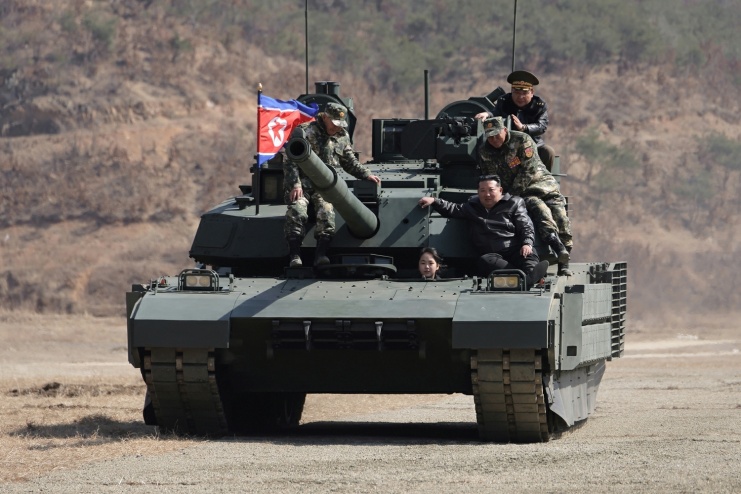
Kim Ju Ae operates a new-model tank during a combined infantry and tank unit tactical exercise at Pyongyang’s 60th Training Base on March 19, 2026, as Kim Jong Un and military officers watch from above. Photo: Rodong Sinmun/News1
A gun barrel ruptured during rapid-fire testing of a new North Korean anti-aircraft gun at a firing range in Chongjin in mid-June 2026, seriously injuring two military officers. Insiders are questioning whether the accident was linked to a rushed development and deployment schedule.
A source in North Hamgyong province told Daily NK on Thursday that the test was conducted jointly by the anti-aircraft artillery testing division of the Academy of Defense Sciences, the artillery weapons inspection division under the Second Economic Committee, and operations staff from the Ninth Corps. The test was organized to conduct a final verification of the new gun’s rapid-fire capability and barrel reliability ahead of operational deployment.
The Academy of Defense Science is North Korea’s premier weapons research and development institution. The Second Economic Committee is the body responsible for overseeing North Korea’s defense industry, including weapons production and inspection. The Ninth Corps is a major combined-arms unit of the Korean People’s Army based in North Hamgyong province.
Unlike earlier anti-aircraft guns, the new model incorporates a design that significantly increases both firing rate and muzzle velocity. During testing, the rising internal pressure and heat generated by sustained fire proved too much for the barrel near the breech, which ruptured. Initial rounds fired without incident, but when the gun transitioned into full rapid-fire mode the side of the barrel tore open. High-temperature gases and metal shrapnel were expelled outward, striking officers who were positioned to the side of the gun to monitor aiming systems and operate manual controls.
The two injured officers were a technical officer from a Ninth Corps anti-aircraft artillery unit and an officer from the Academy of Defense Sciences testing division. Both received emergency treatment on site before being evacuated by rail on the Pyongra Line to a military medical facility in Pyongyang. The source said the technical officer suffered penetrating shrapnel wounds and significant blood loss, while the Academy of Defense Sciences officer sustained severe burns to the face and upper body from the expelled gases. Military physicians were said to believe that while neither man’s life was in danger, a return to active duty was unlikely.
Questions over rushed development
The firing range was immediately placed under full access restrictions following the accident. The damaged gun and all related testing equipment were covered and secured on the spot. Personnel present at the range and Ninth Corps officers were required to sign renewed secrecy pledges regarding the incident, the source said.
An investigation into the cause is underway, examining whether the failure stemmed from a design flaw or from rapid-fire test conditions that were set too aggressively. The artillery weapons inspection division has raised the possibility that domestically produced special steel used in the barrel was not metallurgically consistent enough to withstand the heat and localized stress concentration generated during sustained fire. Insufficient structural strength in the barrel alloy itself, or variations in combustion pressure from the high-performance propellant, are also being examined as potential causes. The Academy of Defense Sciences testing division is conducting a focused technical review of the special steel alloy strength, the breech pressure distribution design, and the combustion characteristics of the propellant.
Within the defense industry sector and the Ninth Corps, there are voices suggesting the accident was not unrelated to a development culture driven by speed and an unrealistic operational deployment timeline. Some engineers have been saying that the rapid-fire test was conducted without adequate load and durability verification because of pressure to meet reporting deadlines, according to the source.
Read in Korean
Reporting from inside North Korea
Daily NK operates networks of sources inside North Korea who document events in real-time and transmit information through secure channels. Unlike reporting based on state media, satellite imagery, or defector accounts from years past, our journalism comes directly from people currently living under the regime. We verify reports through multiple independent sources and cross-reference details before publication.
Our sources remain anonymous because contact with foreign media is treated as a capital offense in North Korea — discovery means imprisonment or execution. This network-based approach allows Daily NK to report on developments other outlets cannot access: market trends, policy implementation, public sentiment, and daily realities that never appear in official narratives.
Maintaining these secure communication channels and protecting source identities requires specialized protocols and constant vigilance. Daily NK serves as a bridge between North Koreans and the outside world, documenting what’s happening inside one of the world’s most closed societies.