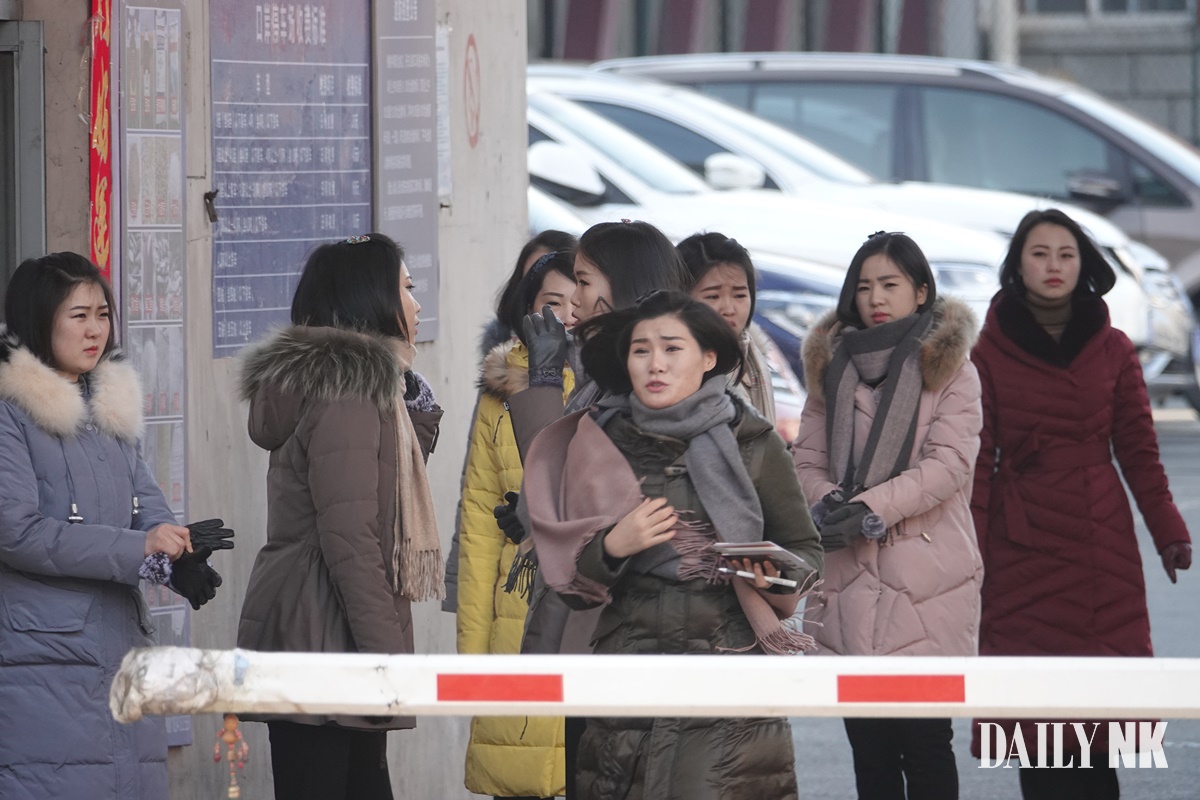
FILE PHOTO: North Korean women leaving a customs office in Dandong, Liaoning Province, China. (Daily NK)
Ryanggang province authorities now require overseas candidates to be married with children, tightening selection criteria as regime seeks to prevent defections by holding family members as leverage.
“Activities to select workers to dispatch to China are now ongoing in Hyesan, but unlike in the past, unmarried and married candidates without children are being excluded,” a Daily NK source in Ryanggang province recently. “If you look at the people being selected for dispatch to China, most are married with children.”
The source said the selection criteria have tightened — in the past, one only needed a good background and ideological soundness to be selected for overseas work, but now, screeners also look at whether candidates are married and have children.
Because of this, unmarried or married people without children who hoped to earn a living overseas are complaining.
“Life is so hard nowadays, so many people want to go overseas to make money,” the source said. “As early as this spring, workers were sent overseas to China regardless of their marital status or whether or not they had children, but this time, candidates must be married and have children, so people who waited for the opportunity are disappointed and dejected.”
New standards aim to prevent defections by holding families hostage
North Korea has long considered dispatching workers overseas as a key means to earn foreign currency. At the same time, however, the authorities have feared that workers might become ideologically alienated or even defect as a result of direct contact with the outside world.
Accordingly, the North Korean authorities sent overseas only those who passed strict ideological vetting and background checks. However, as defections continued despite this, the authorities appear to have bolstered their selection standards.
Some people say they suspect the state “wants to keep their families as hostages.”
“Crossing the border from North Korea has gotten tougher since COVID-19, but cases continue of workers escaping after they’ve been dispatched overseas,” the source said. “In response, the state included marital status and children as selection standards to stop defections by workers dispatched overseas.”
“After successfully blocking defections across the border during COVID-19, the state is now completely blocking defections from overseas by using family members — the workers’ weak link — as hostages,” the source said. “Young people are growing more hopeless as it gets harder to be dispatched overseas, something they used to consider a survival option.”
Read in Korean