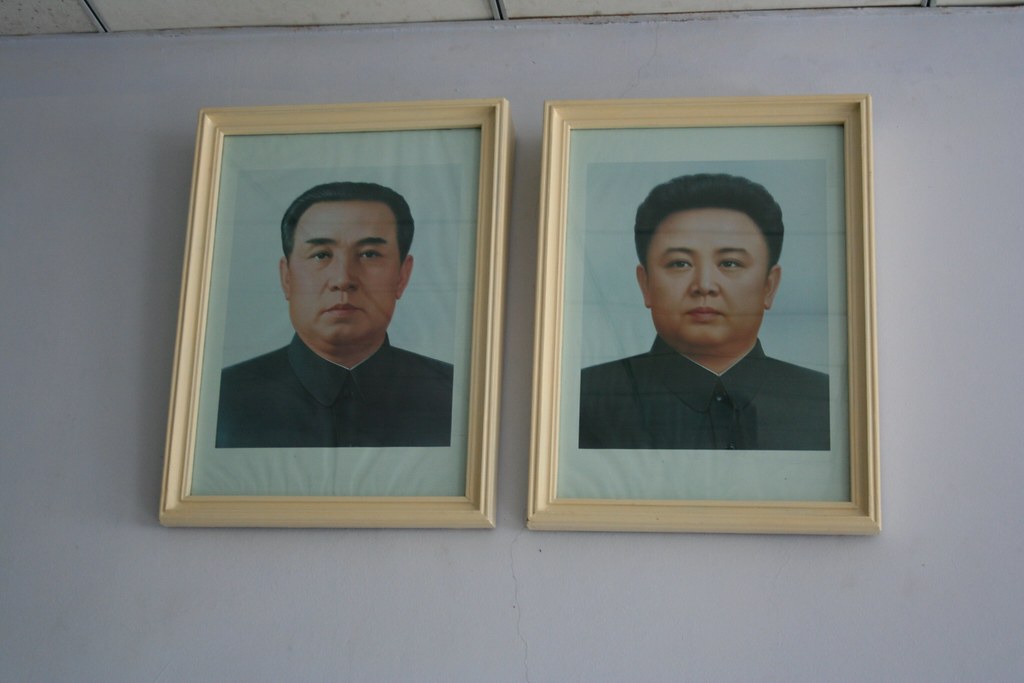
Portraits of KIm Il Sung and Kim Jong Il. (Michael Day, Flickr, Creative Commons)
Amid persistent economic hardship, it is becoming more common for elderly North Koreans to long for the days of Kim Jong Il, as an increasing number of people look back fondly on when it was possible to make a living as a smuggler or market vendor with fewer restrictions from the government.
“Nowadays, older people in the city of Hoeryong often talk about how things were better under the Kim Jong Il. Talk of that sort crops up when so many people are struggling just to keep their families fed,” a source in North Hamgyong province told Daily NK recently.
“Under Kim Jong Il, market conditions were much better than they are today. Ordinary individuals could smuggle goods across the border back then, earning a decent livelihood and even setting a little aside. When people look back on those days, they describe them as a time when it was easier to make a living,” the source added.
There was a fair amount of market activity and private smuggling during the early days of Kim Jong Un. But since the pandemic, private smuggling has basically been stamped out, and the informal marketplaces known as jangmadang in North Korea are gradually withering. In short, North Koreans are in a worse financial situation than ever, the source said.
From smugglers to spies: How survival became a crime
In the past, a fair number of people made a living by selling various goods they smuggled over the border from China. But that livelihood was eliminated when the North Korean authorities closed the border after the outbreak of the coronavirus. Most of those smugglers pivoted to work as remittance brokers, but even that occupation is growing untenable as the authorities crack down on the usage of Chinese-made mobile phones.
“In the past, people caught using a Chinese phone could get off with a few months at a labor camp with the right bribe, but bribes don’t cut it anymore. Chinese phone users are branded as spies and punished harshly. That’s why smugglers of a certain age will tut-tut while remarking that nobody knew how good they had it back then,” the source said.
Veteran vendors at the market are also known to sigh regretfully as they look back on the old days.
“Under Kim Jong Il, everything was much cheaper than it is now, and the markets were so boisterous that earning 5,000 won was no big deal. Nowadays, it’s common to go all day without selling a thing, never mind making 5,000 won. Prices are so high it takes several days to earn enough to buy a kilogram of rice,” the source quoted a vendor as saying.
“The vendors who talk like this tend to be a little older. They often say that the days of the General, who was in charge during the Arduous March, weren’t as tough as they are now. The markets were growing, and people there had found a way to make a living. That’s why they remember those days as a true heaven on earth,” the source said.
In the end, people’s longing for the days of Kim Jong Il appears to go beyond mere sentimentality and imply dissatisfaction with the current rule of Kim Jong Un, including the poor economic conditions. Since social restrictions are growing ever tighter, North Koreans’ mental anxiety is breeding animus against the regime.
“The impression I’ve gotten during all these years since the time of Kim Il Sung is that life keeps getting harder and harder. I’m not even sure how to make a living for myself, so I can only sigh when I think of my children,” said a Hoeryong resident in their sixties.
“During the time of Kim Jong Il, we longed for the days of Kim Il Sung because of the Arduous March. But now, we long for the days of the Kim Jong Il. At least we could count on the markets back then, but now even market vendors are struggling to make a living.”
Read in Korean