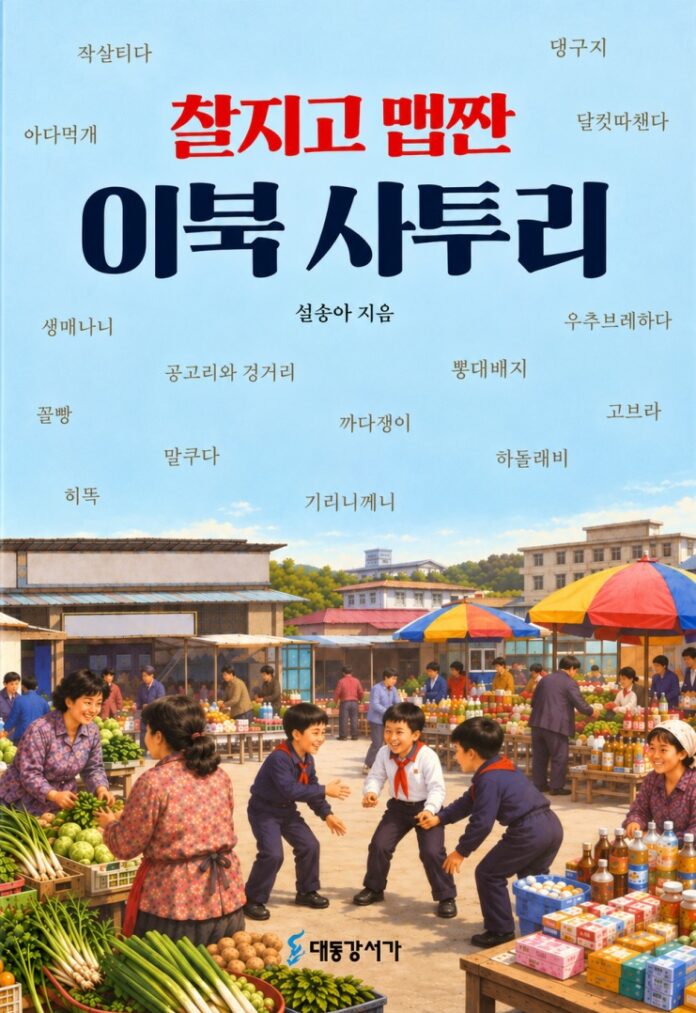
The cover of “Rich and Spicy Northern Dialects” by Seol Song Ah, a defector from South Pyongan province, published by Daedonggang Seoga. (Daedonggang Seoga)
A film I watched recently added Korean subtitles to a conversation between North Korean characters, as though they were speaking a foreign language. Eight decades after the peninsula was divided, that scene in 2026 showed how far North and South Korean dialects have drifted apart, and also raised harder question about how well South Koreans understand the people living in North Korea at all.
I have covered North Korea for 18 years, and working alongside journalists who defected from the North is part of my daily routine. As a South Korean, though, I often found those conversations a struggle even though we were speaking the same language. Unfamiliar words popped up constantly, and some expressions only made sense after I pieced together the context several times. Accents and phrasing also varied by region, reminding me again and again that division had split far more than territory.
That is why reading “Rich and Spicy Northern Dialects” (Daedonggang Seoga), by South Pyongan province native and defector Seol Song Ah, felt both strange and welcome. Expressions I once had to ask about over and over reappeared throughout its pages. They were difficult at times, yet they stirred up old memories in an unexpected way. I even recalled my early days on the North Korea beat, when I would bicker with defector colleagues over the meaning of a single word.
This is not a dictionary of dialects but something closer to a social history told through everyday speech. Following the dialects of the Hamgyong, Pyongan and Hwanghae regions, it moves from school days to romance, family life and the workplace. It ends in the jangmadang, the private markets that have kept many North Korean households afloat since the famine of the 1990s.
That structure makes the book entertaining one moment and quietly bitter the next. Behind the earthy banter, other sides of North Korean society keep surfacing, from patriarchal family culture to the exhaustion of surviving economic collapse. Scenes from workplaces and party organizations reveal a system built on loyalty to the regime and mutual surveillance. The market chapters show the remarkable grit of people who used every means available just to put food on the table. The book never lectures readers about North Korean society, yet its structure comes into view naturally as you follow people’s words and stories.
There is warmth here as well, especially in Japanese loanwords like bento (lunch box) and kuruma (cart) that I often heard growing up in the South Korean countryside. Their usage and staying power surely differed between the two Koreas, but my generation in the South heard similar words from our elders. A single fading word can hold one person’s childhood memories and, on a larger scale, the social history of an entire era.
Children’s games tell a similar story, since the chants used to pick teams differed from region to region. Reading that passage, I thought of a recent South Korean variety show that compared team-picking chants from across the country. The words differ between Pyongan and Hamgyong, Seoul and Gyeongsang, or Jeolla and Chungcheong, but children everywhere simply want to split up and play. Division may have changed the language, but I doubt it can ever fully separate the joys and sorrows of the people who speak it.
After many years of reporting on North Korea, I have noticed that North Koreans are remarkably skilled at verbal sparring. You see it when market vendors clash with enforcement officers and when sellers and customers haggle over every last won. People trade words to dodge crackdowns, protect their goods and claim their share of the profit. Brilliant metaphors and wordplay sometimes spill out along the way. Their sexual jokes can also be so bold that South Korean listeners struggle to keep up.
I do not think this simply means North Koreans speak roughly by nature. Instead, I see it as a survival skill learned by people living under heavy political and social control. Where openly criticizing those in power is nearly impossible, satire, jokes, curses and slang can become indirect outlets for discontent. Dialect, in that sense, is far more than old-fashioned speech. It records how ordinary North Koreans got by in their dealings with the state, party organizations, family and the market.
North Korean authorities have long insisted that language carries ideology and culture. The Pyongyang Cultural Language Protection Act, adopted in January 2023, ties the Pyongyang standard to a socialist way of speaking. It names the elimination of so-called puppet language, the regime’s derogatory term for South Korean speech, as one of its main goals. The law prescribes penalties as harsh as execution for spreading it, and enforcement has even targeted the local dialect in Kaesong.
After reading Seol’s book, though, I found myself wanting to turn that logic on its head. If language carries ideology, then the way ordinary North Koreans speak must carry their thinking as well. Tracking changes in their speech could reveal how their consciousness is shifting.
The language of the jangmadang offers the clearest example of this shift in North Korean society. As marketization has spread, the way people address one another, the expressions they use in trade and their attitudes toward money have all changed. The language law even bans oppa, a word for older brother that South Korean women also use for boyfriends, along with the honorific nim attached to job titles. Ironically, those bans reveal how deeply smuggled K-dramas and market relationships have seeped into everyday speech.
Despite the crackdowns, young North Koreans keep using South Korean expressions among friends. In Sinuiju, universities have even formed enforcement teams to police students’ speech and clothing. Changes in speech, then, may well amount to a running record of social change.
That trend also gives me some cause for concern about the future of the Korean language. If heavy-handed controls like the language law continue while chances for North and South Koreans to meet keep shrinking, the gap between them is likely to widen. Kim Jong Un’s declaration in late 2023 that the two Koreas are hostile states has made such encounters rarer still. The problem goes well beyond the two sides using different words for the same things. If the same expression comes to stir different emotions on each side, the cost of understanding one another will rise sharply.
This is where I think Seol’s book poses another challenge to readers on both sides of the border. Following the author as she traces the roots of everyday idioms, including one meaning roughly “no arguing,” raises new questions. Did the words we think of as North Korean really emerge in the North after 1945? Or are they old Hamgyong and Pyongan dialects that simply became North Korean speech after division? And what common roots might still link regional dialects in South Korea with those of the North today?
It may be time to move beyond simply comparing the differences between North and South Korean speech. We could instead treat the dialects of the entire peninsula as one vast history of everyday language and trace its evolution.
I am reminded of Malmoi, the dictionary project launched by the Korean Language Society during Japanese colonial rule. At a time when Koreans feared their language might disappear, society members gathered words from every corner of the country. Japanese colonial authorities later arrested and jailed many of its members in 1942. Gathering words was never just about recording vocabulary, since it meant preserving the memories, history and culture of the people who used them.
After 80 years of division, we may need a new kind of Malmoi of our own. That would mean recording the words people have actually used, and still use, in Pyongyang and Sinuiju, Hamhung and Chongjin. Those words could then be linked to the dialects spoken across South Korea’s regions.
As I closed Seol’s book, I kept returning to a single thought about how outsiders should listen to North Korea. To understand the country, we cannot listen only to its authorities, because what ordinary North Koreans say matters just as much. Their real lives, which rarely appear in official documents, survive in the most ordinary kinds of talk. That includes market haggling, children’s chants, young couples’ confessions of love and jokes traded among coworkers enduring grueling labor.
Dialect preserves the memory of people’s lives in exactly that way, long after official records fall silent. Finding and recording those words, and trying to understand one another, may be where we start closing the distance that 80 years of division has opened.
Read in Korean