Expert says appearance of vessel near Chongjin’s steel mill suggests it was intentionally beached to be dismantled
A cargo vessel appeared to become stranded off North Korea’s eastern coast last month, satellite imagery shows, in what one expert described as a possible operation to scrap the boat for parts.
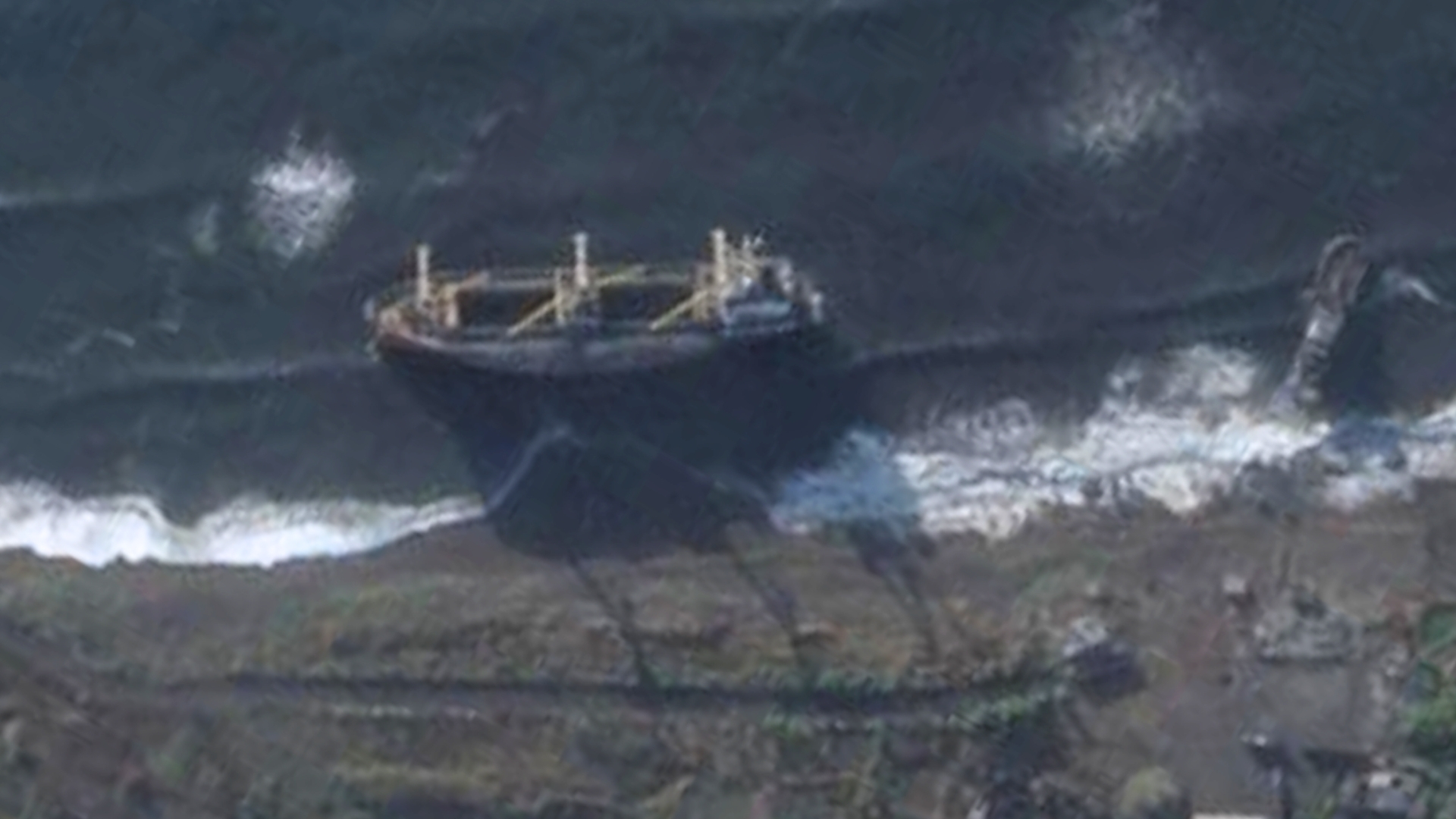
The ship measuring roughly 100 meters in length appeared outside the Chongjin port between Oct. 16 and 19, Planet Labs satellite imagery shows, with the vessel remaining grounded by the shore as of Tuesday.
The Seoul-based SI-Analytics firm was first to report on the ship’s appearance by Chongjin’s old steel mill, suggesting that several smaller boats carried out an unsuccessful salvage operation after the ship became stuck.
At least three smaller boats were visible near the vessel on Oct. 19, Planet Labs satellite imagery shows. A larger ship 120 meters in length approached the site the next day, likely one of the cargo carriers that were seen in the harbor earlier.
The stranded 100m vessel at Chongjin near the city’s old steel mill with three smaller boats in its vicinity on Oct. 19, 2026 | Image: Planet Labs, edited by NK Pro
The same grounded boat with a larger freighter and smaller boat nearby in Chongjin on Oct. 20, 2026 | Image: Planet Labs, edited by NK Pro
The grounded vessel and a smaller auxiliary boat in Chongjin on Oct. 21, 2026 | Image: Planet Labs, edited by NK Pro
The grounded vessel in Chongjin on Oct. 27, 2026 | Image: Planet Labs, edited by NK Pro
The grounded vessel in Chongjin on Oct. 28, 2026 | Image: Planet Labs, edited by NK Pro
The grounded vessel and several boats nearby in Chongjin on Oct. 31, 2026 | Image: Planet Labs, edited by NK Pro
The same vessel still stranded by Chongjin’s shore as of Nov. 3, 2026 | Image: Planet Labs, edited by NK Pro
On Oct. 28, an approximately 70-meter-long auxiliary vessel approached the stranded ship. Three days later, several smaller boats and the roughly 120-meter-long boat were also visible nearby.
The location of the incident is outside the Chongjin harbor, where a DPRK warship capsized during a launching ceremony last year, and next to a public beach.
Neil Watts, a former South African naval officer who formerly worked with the U.N. to track illicit DPRK maritime activity, suggested North Korea intentionally beached the ship to dismantle it for parts, as opposed attempting to salvage it after it unintentionally ran aground.
“The close proximity to the steel mill and apparent absence of adverse weather conditions, combined with a lack of serious attempts to salvage the vessel does suggest that the intention is to scrap the vessel,” the expert told NK News.
Dismantling ships — a practice known as ship breaking — isn’t very common in North Korea, and the DPRK vessels have often been scrapped overseas, like at the infamous Chittagong scrapyard in Bangladesh, China and other countries.
But Watts emphasized that the DPRK frequently operates vessels beyond their expected lifespan and thus may have decided to scrap the ship off Chongjin.
If North Korea intentionally ran the ship aground, it would be in line with the practice of beaching seen in Bangladesh, India and Pakistan, where vessels are rammed onto beaches before workers take them apart.
While details on the ship off Chongjin’s coast are unclear, Watts suggested its presence could be a “pointer to possible replacement by another illegally acquired vessel.”
North Korea is prohibited from purchasing foreign vessels under U.N. Security Council Resolution 2397. However, the country has been known to circumvent the restrictions and add new vessels to its fleet.
Watts noted that multiple “derelict vessels” have made their final stop on North Korea’s shore, but the Chongjin case “may be the first intended for scrapping.”
North Korea is also known for acquiring old foreign vessels that appear scrapped on paper and then putting them to use as so-called ghost ships, which are difficult to monitor due to their obfuscated identities.
Edited by David Choi