The Nigerian government has announced a new national strategy to prevent noma, a rapidly progressing and often fatal infection that continues to affect children in underserved communities.
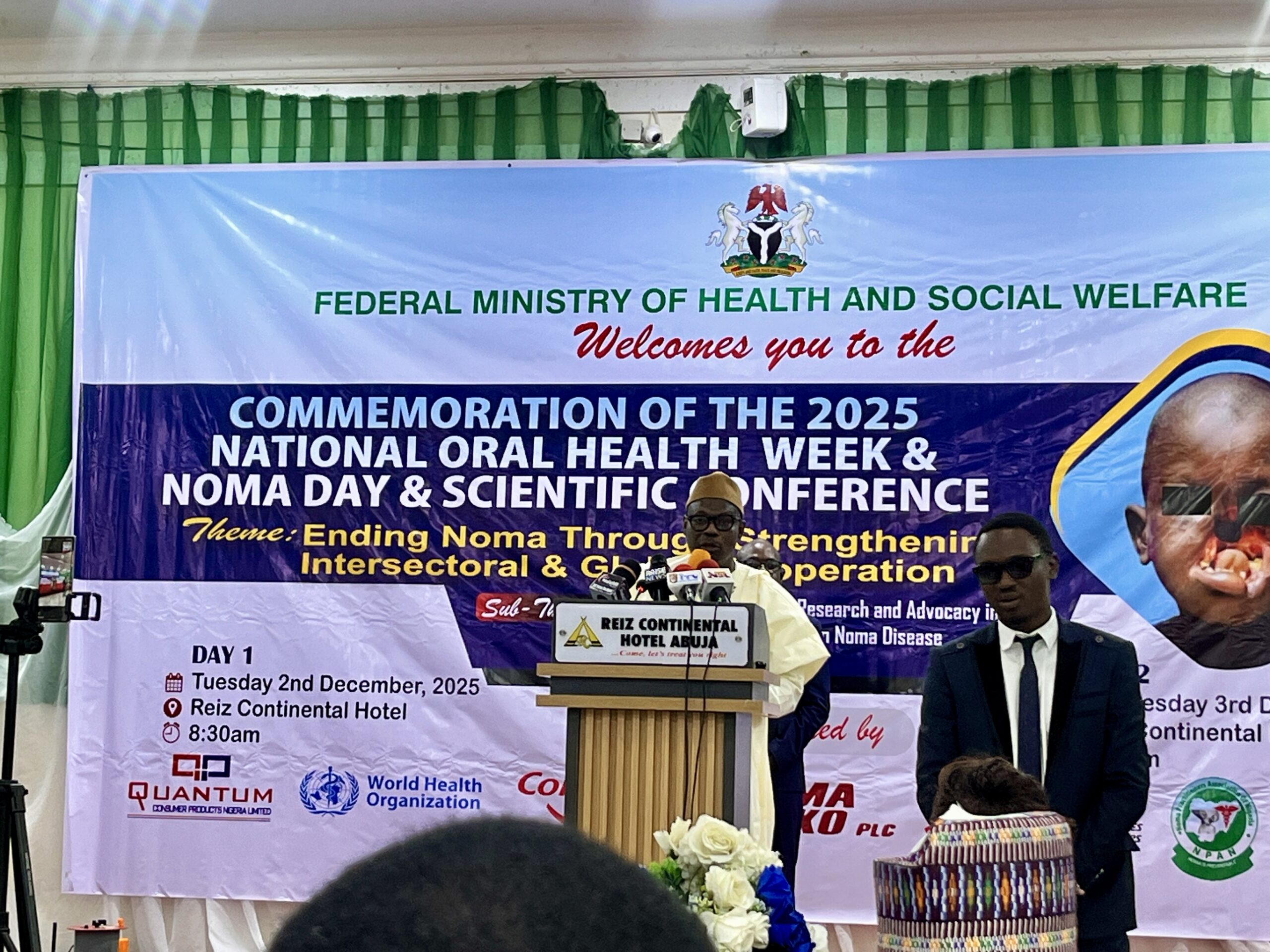
Speaking on Tuesday at the 2025 National Oral Health and Noma Day and Diagnostic Scientific Conference, the Minister of State for Health and Social Welfare, Iziaq Salako, said the new strategy aims to scale up surveillance, early diagnosis and community-level interventions to curb noma.
Mr Salako said noma remains a societal failure driven by poverty, malnutrition and weak health systems.
He said noma, classified by the World Health Organisation (WHO) as a neglected tropical disease, is entirely preventable, yet continues to claim lives due to late detection, inadequate surveillance, and limited access to timely care, resulting in avoidable deaths.
Government outlines expanded response
Mr Salako said the government is expanding efforts to ensure that noma is detected early at the primary healthcare level.
As part of this, he said the Ministry of Health and Social Welfare has begun training primary healthcare workers, community health workers and traditional birth attendants to identify, manage and refer to early cases of oral diseases, including noma.
He noted that treatment of noma at designated centres, including surgery, rehabilitation and psychosocial support, is offered free of charge.
He also said the reorganisation of the Basic Health Care Provision Fund (BHCPF) will enable more funding for oral health and noma-related services, especially in vulnerable communities.
Mr Salako noted ongoing work at the Noma Children’s Hospital in Sokoto, which provides comprehensive treatment and rehabilitation for survivors.
He added that households in communities where noma has been reported should be automatically listed in the national social register as beneficiaries of government social protection programmes.
The health ministry, he said, is ready to support efforts to link affected families to social assistance.
High burden and late detection
According to Mr Salako, Nigeria lies within the “noma belt” in sub-Saharan Africa and has some of the highest reported cases, especially in the north-west.
He noted that the disease often begins as a simple gum infection but can become life-threatening within days if untreated.
He said poor oral hygiene, malnutrition and extreme poverty remain the major drivers of the infection, while fragile surveillance systems mean many cases are neither detected nor treated early
Call for multi-sector collaboration
Mr Salako stressed that tackling noma requires an all-of-society approach, with investment in nutrition, water and sanitation, housing, immunisation, maternal and child health, and community awareness.
He called on state governments, civil society, academia, development partners and the private sector to support the federal government’s efforts to strengthen oral health and eliminate noma.
He said the commemoration should serve as a catalyst for stronger policy action, research and community mobilisation, ensuring “no Nigerian child is lost to a preventable disease”.
Stronger collaboration
In her remark, the Permanent Secretary of the Ministry of Health, Daju Kachollom, said noma is not just a medical problem but a “stark indicator” of poverty, malnutrition and inadequate sanitation.
Ms Kachollom said tackling the disease will require coordinated action across sectors such as nutrition, WASH, education and community protection.
Highlighting Nigeria’s role in getting noma recognised as a neglected tropical disease, she said the country has attracted global attention and resources.
Reflecting on her own experience, she revealed that she only became aware of the severity of noma cases when she assumed office in 2023, particularly those coming from Sokoto.
She urged stakeholders to strengthen collaboration, share innovations, and sustain evidence-based, community-driven interventions that align with national oral health policy and universal health coverage goals.
Sustained financing
Speaking at the event, Ahmed Aldikhari, country representative of Médecins Sans Frontières (MSF), said the partnership between MSF, the federal government, and Sokoto State has made significant progress, especially through the Noma Children’s Hospital.
Since 2014, Mr Aldikhari said more than 1,600 reconstructive surgeries have been performed for 1,074 patients, including 99 surgeries for 89 patients in 2025 alone.
He said MSF has also trained 28 Nigerian surgeons and 14 anaesthetists, strengthening local medical capacity.
Mr Aldikhari emphasised the importance of early detection, noting that MSF outreach teams screened and referred 666 early-stage noma patients, showing how awareness and quick referral can prevent severe disability.
He added that Nigeria’s achievement in getting noma listed as a neglected tropical disease must be matched by increased investment in surveillance, prevention, and treatment.
He called on government agencies, donors, and partners to prioritise long-term funding and planning for oral health and noma elimination.