Guest contributor
Khin Ohmar
We are in the midst of a revolution that is powerful, inspiring, and, at times, may feel painfully slow. Since the Spring Revolution began after the military coup on February 1, 2021, many expected a faster path to victory.
But as we now approach the junta’s sham elections planned to begin on December 28 and continue into January 2026, it’s clearer than ever: real transformation takes perseverance, clarity, and the courage to adapt to change as needed within the revolution.
The promise and challenge of collective leadership
In the early months of the revolution, the National Unity Consultative Council (NUCC) emerged as the most inclusive platform for leadership, bringing together elected representatives, ethnic resistance groups, members of the Civil Disobedience Movement (CDM), youth and women’s organizations, LGBTIQA+ activists, and civil society leaders.
The vision was bold: collective leadership shaping the future of a federal democratic Myanmar.
The ideal of collective leadership is powerful to transform power relations and promote genuine representation. To put collective leadership into practice is complex, sometimes even chaotic.
It requires commitment and clarity on all sides, as well as structures and mechanisms in place for the leadership to effectively lead and function, mitigate power imbalances, and ensure accountability and transparency.
We should think through and reflect carefully on complex issues such as: Can a senior commander of an ethnic resistance organization and a grassroots Civil Society Organization (CSO) coordinator truly share power on equal footing in a coalition that pledges collective leadership?
Can women’s groups effectively advocate for justice in cases of conflict-related sexual violence in coalition bodies in which armed actors or political parties are involved, when they’re also involved in writing the very policy frameworks they’re expected to monitor and implement?
Can organizations with vastly different structures and mandates hold each other accountable within the same coalition?
Arguably the answer to each of those questions is no, but that doesn’t preclude the vision of collective leadership. Each of the stakeholders in the revolution has very important and yet very different roles. Each is essential. Yet when roles are confused, they can easily undermine one another.
Political parties and ethnic resistance organizations are membership-based and elect representatives. They enter coalitions with a formal mandate from their constituencies, which gives them power and accountability to their communities’ interests.
CSOs, on the other hand, maintain their power through their independence—of thought, action, and decision. Their role is in large part to keep power holders accountable to the ideals of the larger movement goals, and they provide the checks and balances needed for transparency and widespread inclusive representation.
In coalitions, these differences create power imbalances and blur the lines of decision-making and policymaking. CSOs cannot maintain their impartial watchdog roles in coalitions in which they are embedded in the leadership and politics of those bodies. The structure threatens to silence their voices and rights and undermine their interests.
The stakes are higher than ever
The junta’s aggressive push for a farce of an election makes effective collaboration and coordination among revolutionary actors more urgent than ever. If the revolution shows unity or united leadership, the world will see through this sham vote. But if coordination falters, people may interpret the confusion as defeat, and that is when despair creeps in.
We must act now to clarify the roles, responsibilities, and boundaries of the various actors in this revolution. For example, the NUCC was created in urgency as needed by the revolution, but four years later, it should be able to solidify many shortfalls of its internal foundations: clear procedures for decision-making processes, oversight or review mechanisms, governance or facilitation structures, and a system of checks and balances.
When those limitations or flaws go unaddressed, even well-intentioned actors can fall into patterns of blame, defensiveness, and disengagement or domination. The promise of collective leadership risks being reduced to rhetoric.
Despite our aspirations, the revolution has not erased power imbalances based on gender identity, class, ethnicity, religion, and geography. Policies for inclusion, gender equality, protection of minorities, transitional justice, and accountability have been written, but they have not been done in consultation with CSOs nor were they disclosed for public opinion.
These policies concern people, and thus public opinion matters greatly. But the reality is that unless we implement these policies in practice when and where needed during the revolution, nothing truly changes.
What must change now
Taking the same example of the NUCC: this most inclusive body can become highly effective in practice, as it still holds immense potential as the revolution’s policy directive body. Its power lies not in command, but in articulation and inclusion of various stakeholders: giving shape, direction, and coherence to the revolution’s political vision.
But for that to happen, transparency and accountability to the public must become a collective discipline. That means: Structured reviews of performance and mandate; clarity of roles and responsibilities, mutual accountability agreements, a facilitation or governance mechanism, and the political courage to practice meaningful participation of all involved in equal terms and with transparency. Only through these practices can the collective leadership be realized as it claims to champion.
Ultimately, CSOd will be most strategically effective when they operate outside the NUCC or other political coalitions. This distance helps preserve the independence needed to provide checks and balances; monitor political processes for transparency and accountability; and document violations, advocate for victims’ access to justice, and support remedies.
Some roles require distance, while others call for deep engagement while maintaining clear boundaries. CSOs across sectors should initiate debate and mobilize public opinion to inform policy development without becoming enmeshed in the politics of policymaking itself.
In this way, their expertise can shape effective policy while preserving the independence required to later monitor its implementation—all are essential and necessary contributions to strengthen the revolution.
We need to normalize these distinctions to ensure the revolution moves forward with progress and advances toward achieving our collective vision to establish federal democracy.
We must not lose sight of the values that brought us here
This revolution is larger than any platform, alliance, or leader in modern Burma/Myanmar history. Its success will depend on whether its forces can lead together with clarity, humility, and shared responsibility.
Let us not lose sight of the values that brought us here. Let us ask hard questions, create space for honest conversations, and practice the political culture we hope to inherit.
As I’ve written before, chaos can feel threatening, but it also creates opportunities for communication, for solidarity, and for long-term transformation.
Let’s take the current chaos of the sham elections and their fallout to build our collective strength and mitigate the threats of division. If we do this, the revolution will surely win, and we will dismantle tyranny.
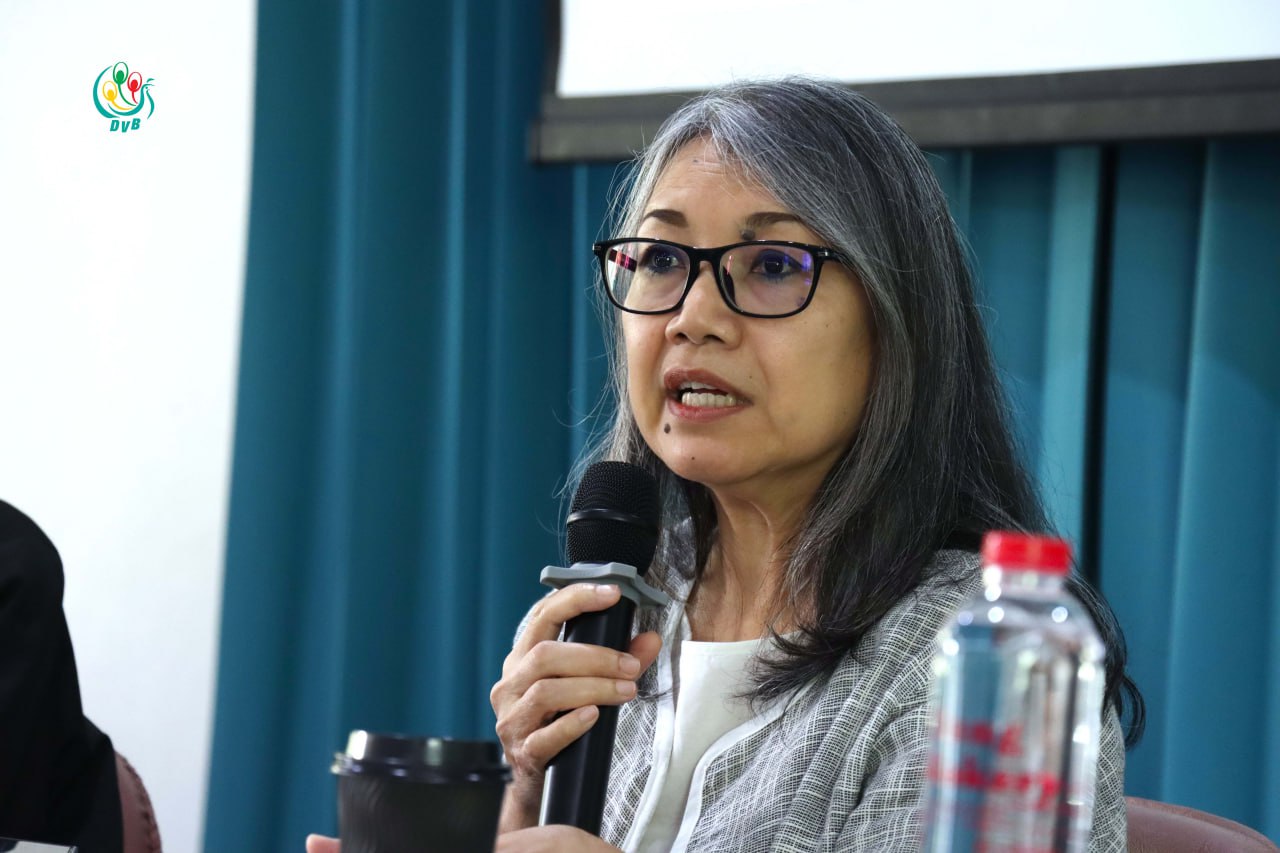
Khin Ohmar is a Myanmar human rights activist who was involved in organizing the ‘8888’ nationwide pro-democracy uprising. She is also the founder and chairperson of Progressive Voice, a Myanmar human rights organization. She developed the Women Peacebuilding Program for Women’s League of Burma and served as program coordinator from 2000 to 2006.
DVB publishes a diversity of opinions that does not reflect DVB editorial policy. We’d like to hear what you think about this or any of our stories: [email protected]