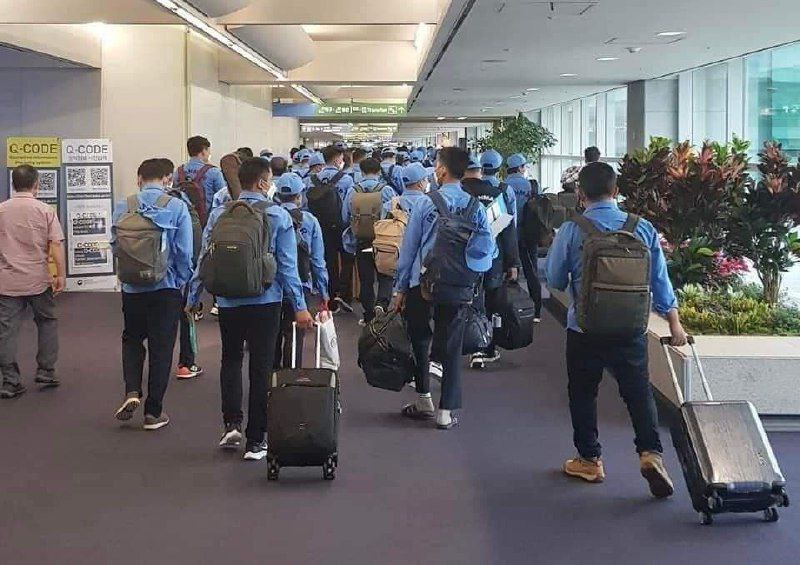
The regime in Naypyidaw has introduced strict new measures targeting returning overseas migrant workers, requiring those who re-enter the country on leave or short family visits to sign a formal pledge agreeing to submit to mandatory military service if summoned by authorities.
Labor rights advocacy networks and migrant support organizations warn that this requirement leaves returning workers facing high risks of being trapped inside Myanmar or subjected to immediate conscription.
Moe Gyo, chairperson of the Joint Action Committee for Burmese Affairs (JACBA), highlighted that both male and female returning workers face severe risks of forced military recruitment upon crossing back over the border.
Under the regime’s enforced “People’s Military Service Law,” military service is mandatory for men aged 18–35 and women aged 18–27 for up to two years, while specialists such as medical doctors aged up to 45 face terms of up to three years.
The National Unity Government (NUG) reports that approximately 135,080 men have been conscripted across 27 training intakes as the regime attempts to offset heavy battlefield attrition.
NUG documents over 135,000 conscripts drafted into Myanmar military due to high attrition
Regime spokesperson Khaing Khaing Soe publicly rejected a recent report from the Myanmar Defence and Security Institute (MDSI)—a research network of former military personnel—stating that a second intake of female conscripts began training at a facility in Yangon Region’s Hmawbi Township in August.
The conscription pledges follow a series of restrictive regulatory directives issued by the regime’s Ministry of Labour aimed at controlling overseas labor channels and extracting foreign currency.
On Sept. 20, the regime issued a directive requiring overseas workers visiting Myanmar to present proof of paying a two per cent income tax and remitting 25 per cent of their earnings through regime-controlled official banking channels before being allowed to depart the country.
First introduced in September 2023, the remittance mandate is now tightly coupled with border departure audits to ensure compliance.
The International Organization for Migration (IOM) and the World Bank report that the 2021 military coup, severe economic contraction, and the enforcement of mandatory conscription have triggered an unprecedented migration wave out of Myanmar.
Thousands of young people continue to seek escape routes—primarily to Thailand and Malaysia, followed by China, Singapore, Japan, and South Korea—to avoid forced enlistment.
Labor rights groups highlight that because a significant portion of this movement relies on irregular, unmonitored border channels, verifying exact cross-border migration statistics remains extremely difficult.