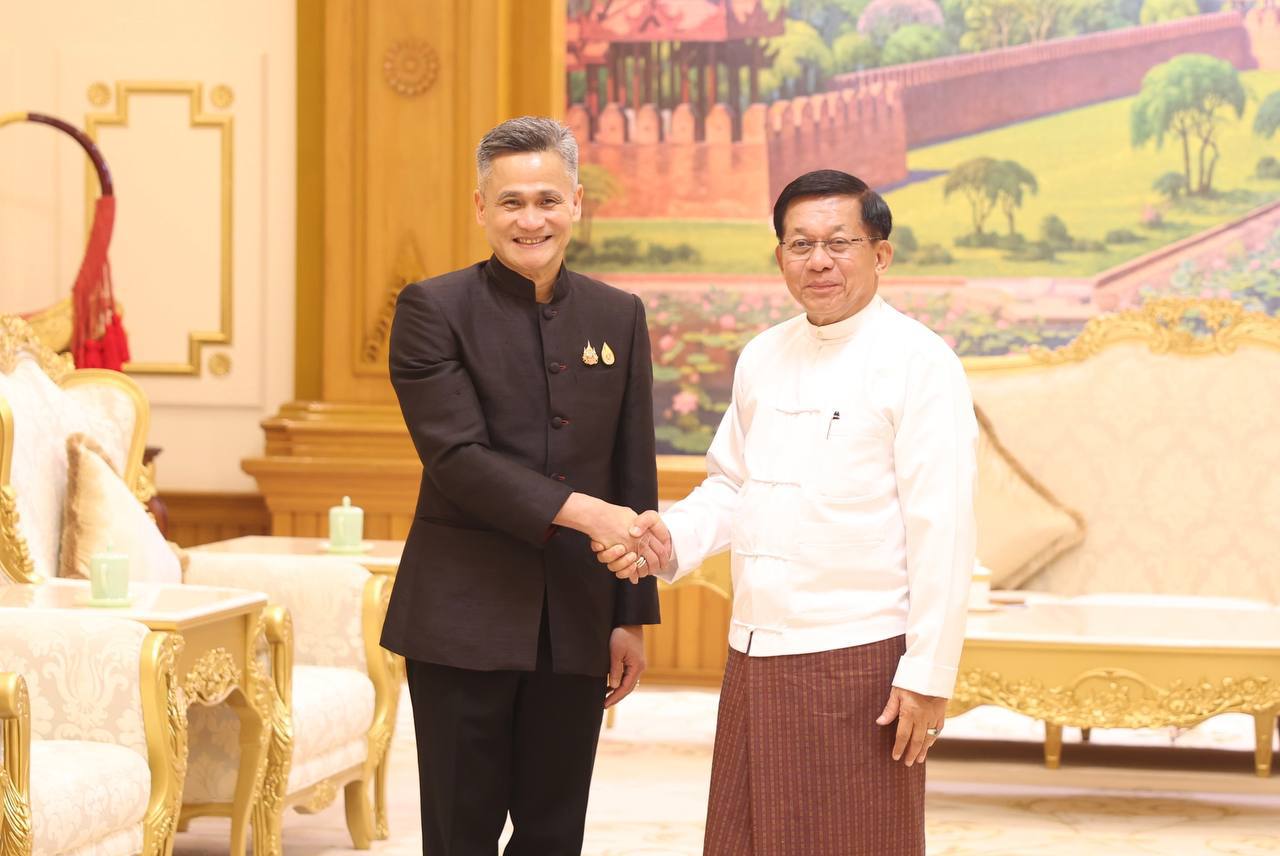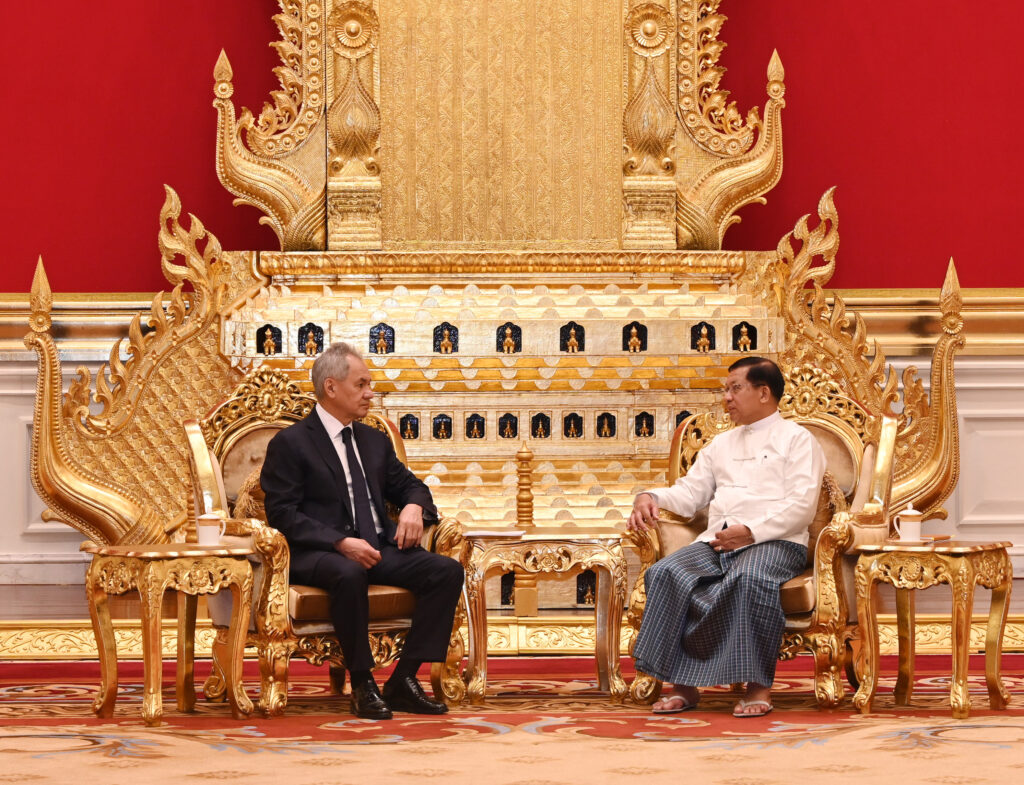
Regime leader Senior General Min Aung Hlaing met with a Russian delegation led by the Secretary of the Security Council of the Russian Federation, Sergei Shoigu, in Naypyidaw on Tuesday — ending speculation over his week-long absence from events in the capital, including the National Defence and Security Council (NDSC) bi-annual meeting on Jan. 29.
Regime media reported that Min Aung Hlaing told Shoigu that Myanmar’s Pyidaungsu Hluttaw, or bicameral legislature, will convene during the third week of March following the end of the military’s 2025-26 elections — held in 263 of Myanmar’s 330 townships — on Jan. 25.
The Union Election Commission (UEC) stated on Feb. 3 that the military-proxy Union Solidarity and Development Party (USDP) won 231 seats in the Pyithu Hluttaw, or lower house of parliament, and 108 seats in the Amyotha Hluttaw, or upper house, as well as 379 seats in state and regional parliaments across the country.
Under the 2008 Constitution, if a party wins 294 of 586 seats from 263 townships in the Pyidaungsu Hluttaw it can appoint the president. The military is allotted 25 per cent of all seats, or 166, in parliament. This means the combined total of USDP and appointed military lawmakers will be 505 – far surpassing the 294 seats required to pick the president.
Htin Kyaw Aye, an independent Myanmar election analyst, told DVB that a USDP victory was predetermined by Min Aung Hlaing, who seized power from Aung San Suu Kyi’s National League for Democracy (NLD) party in the 2021 coup, and wants to be Myanmar’s next president.
The USDP is followed by the pro-regime National Unity Party (NUP), which won a total of 68 seats, and the Shan and Nationalities Democratic Party (SNDP), which won a total of 39 seats across all three levels of parliament.
The regime’s NDSC introduced a new “Union Counselling Council” law on Tuesday, allowing the next president to form and appoint a council of at least five members, including a chairperson and a secretary.
It added that the council shall serve as an advisory body on security, peace, lawmaking, and international relations to the executive branch, without overriding the powers of the executive and judicial branches.
The NDSC amended Section 5(b) of the Protection of Personal Privacy and Personal Security of Citizens Law, which now states that the authorities shall not enter into a person’s residence without being accompanied by at least two witnesses who should comprise ward or village administrators, “unless it is absolutely necessary for national defence, security, and public peace,” on Feb 3.
It also added a clause “except for those who have duties and authority to act in accordance with the law for the purposes of national defence, security, and public peace” to Section 8 which stipulates that no one shall enter a premise or spy on a person without a permit, authorization, or warrant of any kind without the approval of the president or the government.
Min Aung Hlaing suspended Sections 5, 7, and 8 of the privacy protection law on Aug. 1. This allowed regime authorities to search a citizen’s premises without a witness, conduct surveillance or tracking, or detain individuals for over 24 hours without a warrant from a court.
High Court lawyer Kyi Myint told DVB that the regime will lift the suspension only when the parliament reconvenes.
The NLD government enacted the privacy protection law in 2017. It was suspended during the state of emergency enacted during the coup on Feb. 1, 2021. It ended on July 31, 2025, which allowed Min Aung Hlaing to call fresh elections.
NLD leaders State Counsellor Aung San Suu Kyi and President Win Myint have been held in detention since Feb. 1, 2021. Both are serving lengthy prison sentences handed down by regime courts.