Guest contributors
Napas Thein and Maung Lwan-wai
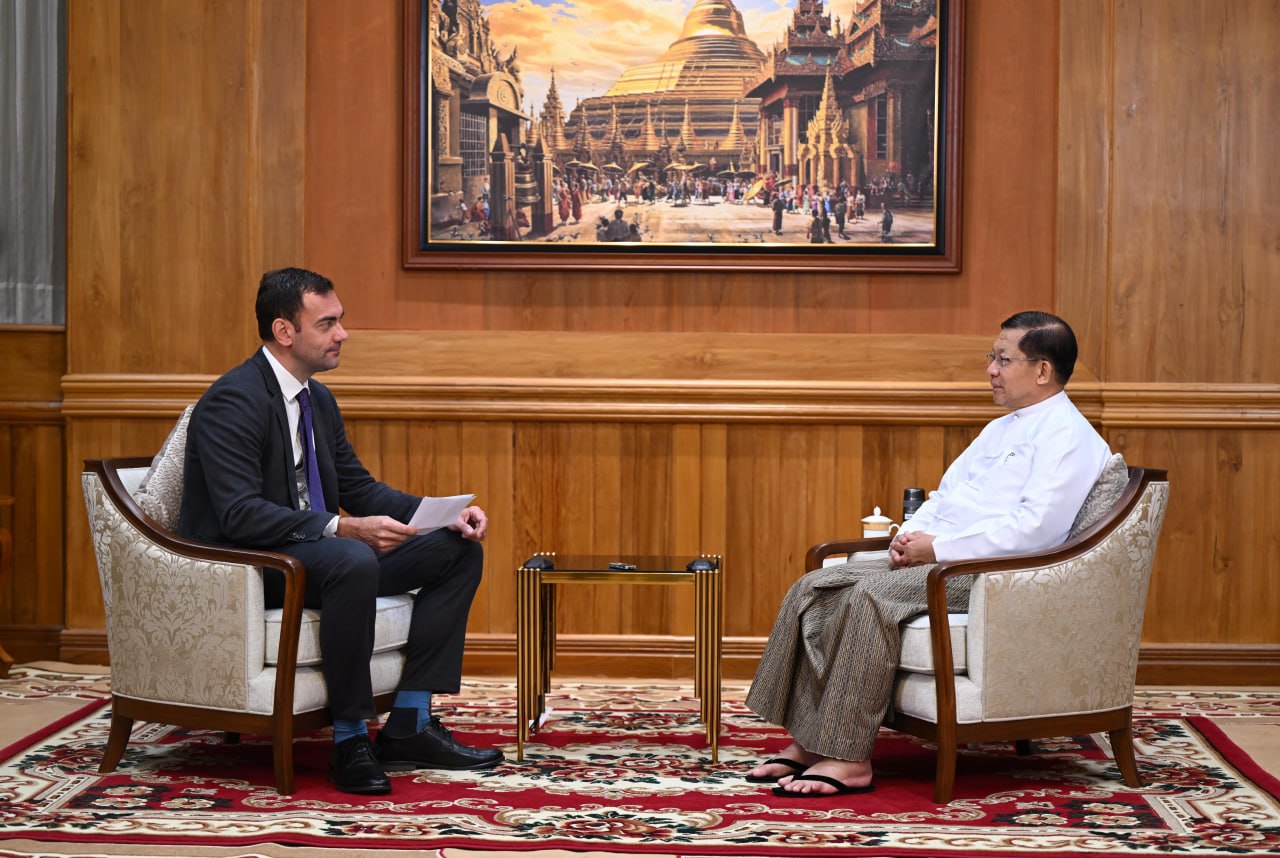
The TIME Magazine interview with Min Aung Hlaing was the junta’s latest attempt at presenting an image of international normalcy in Myanmar to the regime which itself ousted the elected government during the military coup in 2021.
While this bid for normalcy failed dramatically, it represents a small part of the junta’s foreign policy push since 2022 to quietly convince the international community to engage diplomatically with Min Aung Hlaing’s post-sham election government.
Min Aung Hlaing has had some successful visits to regional counterpart countries, including ASEAN member states Vietnam, Thailand, Cambodia, and Laos.
A potential (and very criticized) meeting with Malaysian Prime Minister Anwar Ibrahim is in the works. This is on top of other engagements with bigger powers – namely India, China, and Russia.
But this push has been happening at a different level altogether over the past few years through various Embassy and Consulate Missions around the world.
An analysis of over 2,500 posts by Myanmar’s diplomatic missions on the junta’s own Ministry of Foreign Affairs website shows a sharp increase in reported international interactions beginning in 2024 and accelerating through 2025 and 2026.
Much of this engagement remains concentrated in Asia, but it has increasingly extended into Europe, the Middle East, Africa and elsewhere in the past year alone.
None of these diplomatic engagements alone can change the ground situation in Myanmar. But they do present a risk for democratic actors: that the junta regime is gradually working on presenting themselves as the legitimate actor, and only normal channel, for engagement within Myanmar.
Source: Authors’ analysis of publicly reported embassy and consular activities from the junta’s Ministry of Foreign Affairs.
The junta first started ramping up its diplomatic engagements through its embassies and consulates in mid 2022.
Another push begins early 2024, coinciding with the January 11, 2024 ceasefire that paused the initial phase of Operation 1027.
Notably, most of these engagements took place in China, particularly through their missions in Chongqing, Nanning, Kunming, and Beijing.
The most recent push began after the ending of the junta-held sham elections in January.
Following that was a stark shift in diplomatic strategy abroad: a decline in engagements in the Asia-Pacific and a rise in engagements in the Americas, Middle East and North Africa, and Europe.
The countries within these non-Asia Pacific regions that get the most activity through their missions are the United States, Kuwait, Canada, Saudi Arabia, the United Kingdom, Egypt, Serbia, Nicaragua, Belarus, and the Permanent Mission to the U.N. in Austria.
Source: Authors’ analysis of publicly reported embassy and consular activities from the junta’s Ministry of Foreign Affairs.
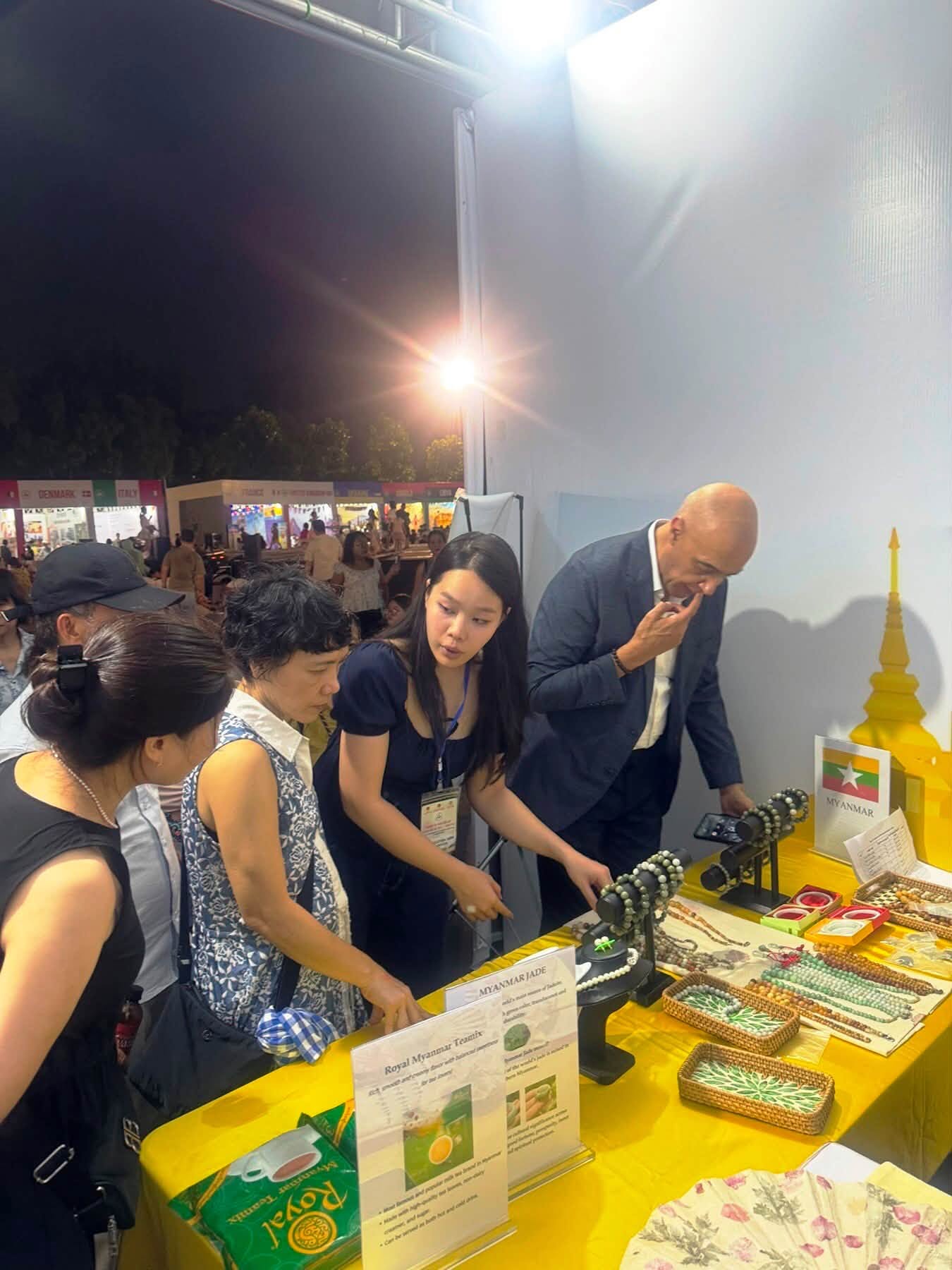
At face value, most of these engagements look relatively benign, consisting of the Charge d’Affairs or Ambassador attending business expos, hitching on tours organized by other states, attending traditional food and cultural events, and joining ASEAN-branded events on a variety of topics.
Others are proxies for indirectly deepening relations with states like Russia and Iran on foreign soil.
Some, however, do present more concern. Despite official state policies in some of these countries condemning the junta, Myanmar junta officials have scored appearances with some big whigs.
The junta ambassador in Washington D.C. attended events with the U.S. Under Secretary of War, Assistant Secretary of State for East Asian and Pacific Affairs Michael G. DeSombre and Chair of the Senate Foreign Relations Subcommittee on East Asia Republican Senator Pete Ricketts.
The junta ambassador to Kuwait presented credentials to Amir Sheikh Meshal Al-Ahman Al-Jaber Al Sabah himself.
In Canada, the junta’s ambassador to Ottawa Zaw Tun Oo shared a photo of a group ASEAN handshake with the Minister of Foreign Affairs Anita Anand and took a portrait with the Province of Alberta’s own leader Premier Danielle Smith.
The junta does not need international actors and ASEAN governments to believe that it has restored control over Myanmar. All it needs is a conclusion that the conflict has reached an enduring stalemate and that the military authorities therefore remain an unavoidable interlocutor for engagement.
Diplomacy does not guarantee success
The junta may look like it is making progress on the international stage, with gradual gains in the ASEAN region. But this is perhaps more a miscalculation among international actors than it is a measure of the junta’s success in Myanmar.
Let’s take a look at Syria. By 2023, governments across the Middle East had increasingly concluded that Bashar al-Assad had survived Syria’s civil war.
Syria was readmitted to the Arab League and regional governments restored relations with Damascus, with Assad once again appearing alongside other Arab leaders.
By December 2024, the United States and UAE discussed potentially lifting sanctions on Bashar al-Assad if he distanced Syria from Iran and cut weapons routes to Hezbollah.
Less than a week later, the Assad regime quickly fell in a successful offensive that even the rebels were surprised about.
The lesson is that international normalization should not be mistaken for evidence of domestic consolidation.
Foreign governments may begin accommodating a regime because they believe it will endure, and be profoundly wrong about the on-the-ground reality.
The junta’s diplomatic progress is still in the early stages
The junta’s diplomatic gains have not yet translated into the forms of international reintegration that would most significantly strengthen its position: expanded economic access, investment, assistance, military cooperation, diplomatic protection and wider political recognition.
For example, the junta still is restricted from accessing political representation from ASEAN’s highest-level meetings, something Singapore seems willing to affirm preceding its Chairmanship.
Additionally, the upcoming judgment in the genocide case at the International Court of Justice presents the potential for even more diplomatic risks for potential partners looking at pursuing normalization.
The junta is likely going to try to tackle this setback. Over the next few months, it is likely that it will be pursuing aggressive attempts at normalization both with ASEAN and the rest of the international community, using the 2025-26 sham elections as the justification.
International actors may argue that engagement with the junta could extract concessions on political rights, human rights and the treatment of minorities, pointing to Myanmar’s post-2011 opening as precedent.
But today’s circumstances are fundamentally different: the military returned to direct rule by overthrowing that political system in 2021.
Engagement should therefore be judged by concrete concessions and not assumptions that normalization will produce another gradual transition, especially with a personalist regime like that of Min Aung Hlaing’s.
Recognition is not the only prize
For years, much of the international struggle surrounding Myanmar has revolved around legitimacy. While it remains important, this strategy has obscured a more immediately achievable objective.
Myanmar’s resistance does not need every Association of Southeast Asian Nations (ASEAN) member state to recognize an alternative government before those governments can engage with alternative Myanmar institutions.
Instead, the more pragmatic objective is guaranteeing parallel engagement.
Where ethnic and resistance authorities exercise meaningful territorial or administrative control, international actors should have mechanisms for dealing with them.
That could include humanitarian coordination, border management, health, education, disaster response, transnational crime and political consultation.
On top of that, where Min Aung Hlaing’s regime may seek concessions in the form of economic assets, military resources, or political recognition, democratic actors should be readily available to provide the counter argument.
We may not be able to persuade the international community, and in particular ASEAN, to choose one side of Myanmar’s war.
But international engagement should still reflect Myanmar’s fragmented distribution of political and territorial authority rather than assuming that Naypyidaw remains the country’s only meaningful political interlocutor.
Use ASEAN’s Five-Point Consensus
The Five-Point Consensus (5PC) already provides political space for this kind of parallel engagement. Established in 2021, the 5PC is the bloc’s framework for addressing the Myanmar crisis, calling for the cessation of violence, constructive dialogue, mediation by an ASEAN Special Envoy, humanitarian assistance, and access to Myanmar for an ASEAN Special Envoy to meet with all parties.
On that last point, the Special Envoy has been used to engage various parties in this conflict, while ASEAN currently maintains restrictions on Myanmar’s political representation at ASEAN’s highest-level meetings.
Democratic actors should use that opening to push for regular and institutionalized engagement with the Steering Council for the Emergence of a Federal Democratic Union (SCEF), ethnic revolutionary organizations and other political stakeholders, rather than allowing renewed engagement with Naypyidaw to become ASEAN’s default approach.
Expand Cross-Border Humanitarian Assistance
Humanitarian assistance provides an immediate area where parallel engagement can become practical. ASEAN leaders have already agreed that assistance should reach internally displaced people without discrimination, including through cross-border efforts where necessary.
Democratic actors should push ASEAN to put that commitment into practice at a greater scale. ASEAN members and international partners should expand financing for credible local humanitarian organizations and existing cross-border networks capable of reaching populations outside junta-controlled areas.
Doing so would operationalize a policy ASEAN has already endorsed: humanitarian assistance should reach people based on need rather than political allegiance.
The junta’s attempt to turn its continued survival into international normality should not be ignored. And expecting the international community to make the moral decision automatically would also be unrealistic.
Instead, democratic actors should push their international diplomacy efforts towards reflecting Myanmar’s actual distribution of political authority through parallel engagement.
Failing to do so may inadvertently help the military achieve politically what it has been unable to secure on the battlefield.
Note on Data and Methodology
More than 2,500 post-coup posts from the Myanmar junta’s Ministry of Foreign Affairs website were scraped in both Burmese and English, with language-specific postings recorded separately and each post coded by location, country, region, diplomatic mission and purpose; pre-coup posts were not available on the website. Each data point points to a specific Embassy, Consulate, or Permanent Mission and the country(ies)/organization it exists in. It does not include unpublished engagements, or engagements beyond the mission level.
Notably, engagements through the junta mission in Russia are surprisingly low in 2026. However, the junta published various engagements with Russian representatives through other missions, including Kuwait, ASEAN, Norway, the U.S., India, and Korea.
Napas Thein is a research fellow with the Myanmar and Policy Community Knowledge Hub, based at the University of Toronto.
Maung Lwan-wai is a Myanmar public policy researcher and PhD Candidate at Chiang Mai University.
DVB publishes a diversity of opinions that does not reflect DVB editorial policy. We’d like to hear what you think about this or any of our stories: [email protected]