The 5th International Conference on Burma Studies (ICBMS5) officially opened on Friday at Chiang Mai University (CMU) under the theme “Between Crisis & Possibility.”
The three-day international gathering brings together scholars, activists, researchers, and civil society practitioners to address Myanmar’s post-2021 coup trajectory through high-level policy panels, academic discussions, film screenings, and documentary art installations.
Visualizing Resilience: The ‘Fragments of Myanmar’ exhibition
Among the prominent features at the CMU UNISERV venue is “Fragments of Myanmar,” an exhibition curated by the Bangkok-based regional cultural center SEA Junction.
The mini-exhibition offers a seven-year visual retrospective of photojournalism documenting key historical moments—including the Rohingya exodus, the post-2021 Spring Revolution, natural disasters such as the 2025 earthquake and annual flooding, as well as the daily lives of Myanmar migrant workers in Thailand.
“I think the message we want to send is not only of suffering, but also a message of courage, a message of hope… Their view of the conflict is much more powerful than 100 academic papers or presentations because they show the face of the people; they show the suffering as well as the endurance of these people,” Rosalia Sciortino, the Director of SEA Junction, told DVB.
Sciortino highlighted the immense risks borne by local photojournalists and visual media workers in Myanmar, who continue to document human rights violations while facing constant threats of arrest, imprisonment, and military violence.
Plenary Panel: Addressing the Border ‘Poly-Crisis’
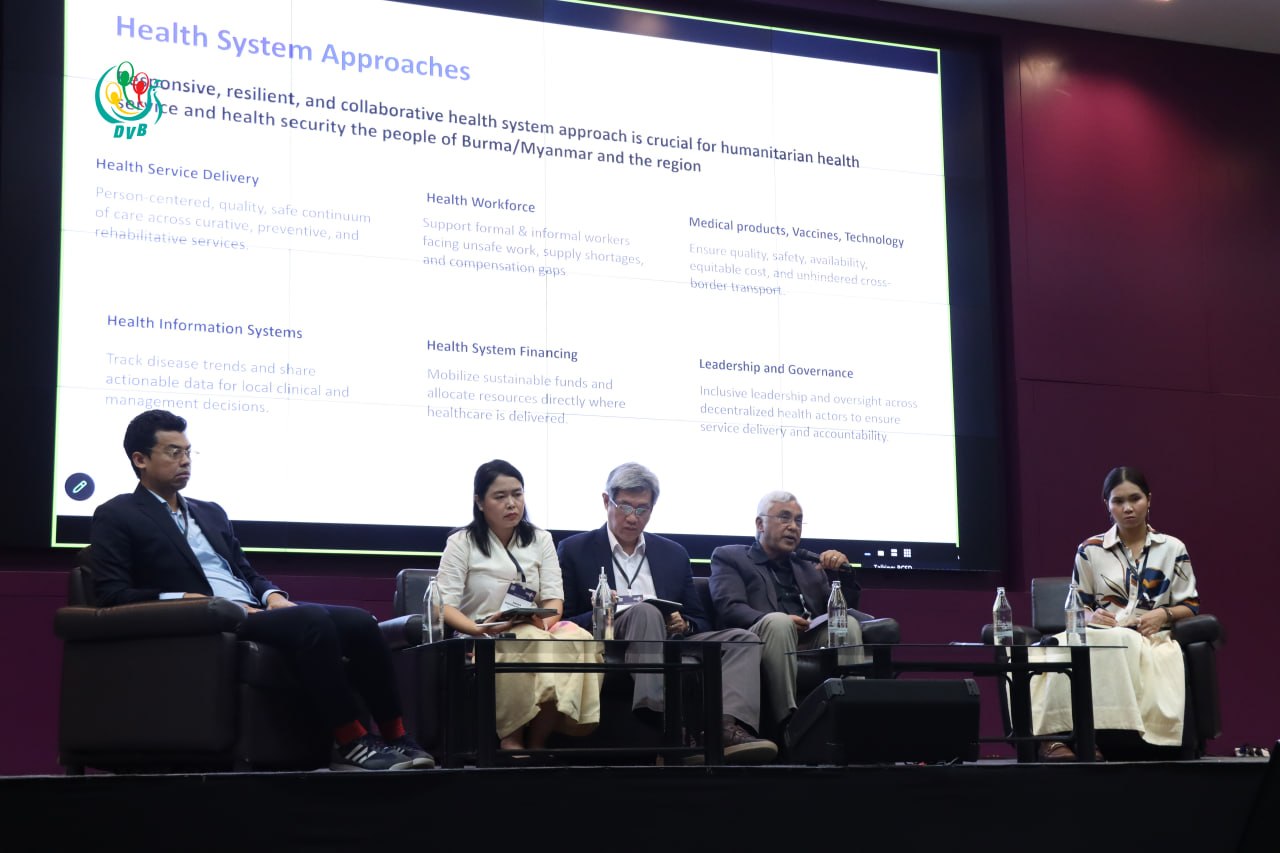
During the conference’s opening plenary session, titled “The Way Forward for the Thai-Myanmar Border,” panelists examined the multifaceted challenges resulting from Myanmar’s ongoing conflict—termed a “poly-crisis”—characterized by mass displacement, enforced military conscription, economic instability, and acute human security threats.
ICBMS5 Key Focus Areas & Border Dynamics
├── Key Themes: Geopolitics, Forced Displacement, Human Security, & Resistance Governance
├── Root Cause of Displacement: Military Regime Aggression in Naypyidaw
├── Border Challenges: Conscription Evacuation, Labor Migration, & Humanitarian Access
└── Conference Output: 3 Main Academic Panels, 6 Film Screenings, & Interactive Workshops
Panelists included Sirada Khemanitthathai, a lecturer at Chiang Mai University; Piya Hanvoravongchai, an associate professor at the National University of Singapore; and Myat Htoo Razak, a professor and co-director at Chulalongkorn University. The session was moderated by Khathaleeya Liandee of Chulalongkorn University.
“Forced displacement from Myanmar to Thailand still continues. The Naypyidaw regime is the main problem of forced displacement,” Sirada Khemanitthathai told DVB.
Three-day agenda
Running from August 14-16, ICBMS5 features three core academic panels, six documentary film screenings, and specialized workshops designed to foster regional policy dialogue and solidarity networks across ethnic, social, and academic lines.